
Document scrutiny is the review of submitted documents for completeness, readability, consistency and suitability for a specific application. It can also include authenticity checks against an issuing authority or another trusted source, where those checks are available and authorized. Passing scrutiny means meeting the checks used by that reviewing organization; it does not automatically establish every fact in a document.
Use this guide to understand the checks, prepare a document set and design a review workflow. The exact documents, accepted formats and deadlines depend on the organization receiving the application.
How do scrutiny, verification and validation differ?
These terms overlap, and organizations may use them differently. In a practical review workflow, validation checks whether submitted information meets a rule, verification checks a claim against evidence, and scrutiny brings those checks together to reach a documented decision.
| Check | Question it answers | Example | What it does not establish |
|---|---|---|---|
| Validation | Is the file or field acceptable under the rule? | Required pages are present; date field can be read. | That the document is genuine. |
| Verification | Does this claim match a trusted source? | A qualification matches a record supplied by its issuer. | That every other claim in the application is correct. |
| Scrutiny | Does the complete submission satisfy the review requirements? | Reviewer checks documents, discrepancies and supporting evidence before recording an outcome. | Approval for every later stage of an application. |
What should a document scrutiny checklist include?
A useful checklist covers the required documents, the checks for each document and the action to take when evidence is missing. Start with the receiving organization’s published requirements; the checklist below is a general working template, not a universal document list.
| Check | Applicant preparation | Reviewer action |
|---|---|---|
| Required documents | Match the submission to the official checklist. | Record each required item as present, missing or not applicable. |
| Complete and readable files | Include all required pages without cropping important details. | Request a clearer or complete copy when evidence cannot be read. |
| Consistent identity details | Check names and dates across the application and supporting documents. | Identify the exact mismatch and request acceptable supporting evidence. |
| Relevant dates | Check issue, expiry and qualifying dates where applicable. | Apply the relevant validity period or eligibility cut-off. |
| Issuer and source evidence | Supply the document type and issuer information requested. | Use authorized issuer checks where available; record unavailable checks. |
| Required format | Follow the portal’s file type, size and signing instructions. | Distinguish a format problem from a substantive discrepancy. |
| Decision record | Retain the submission acknowledgement. | Record findings, unresolved items, reviewer and decision date. |
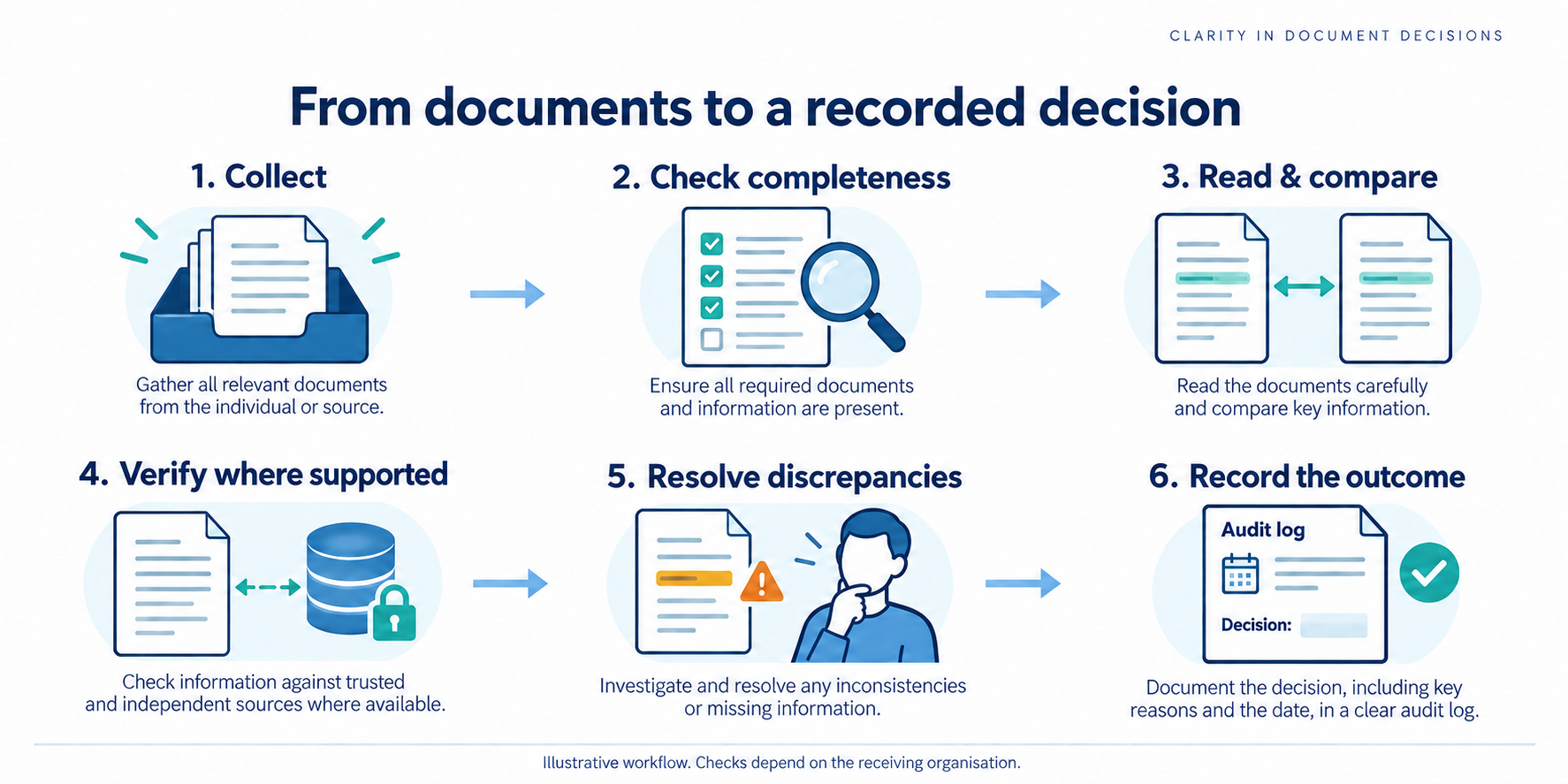
How does the document scrutiny process work?
A scrutiny workflow collects the required documents, checks them against defined rules, resolves exceptions and records the result. The following eight stages are a proposed operating model; an individual portal may combine stages or use different names.
- Define requirements. List document types, accepted formats, relevant dates and the checks needed for the application. Assign an owner for unclear cases.
- Collect the submission. Associate documents with the correct application and retain a submission reference. Separate required items from optional supporting evidence.
- Check completeness and readability. Identify missing pages, unsupported files and unreadable scans before relying on extracted information.
- Read the relevant fields. Capture only the information needed for the defined review. Compare extracted values with the original when uncertain.
- Validate and verify. Check consistency and applicable rules. Where supported and authorized, compare relevant claims with issuer records or other trusted evidence.
- Resolve discrepancies. State precisely which item needs attention and which correction or evidence is acceptable. Distinguish missing evidence from confirmed contradictory evidence.
- Record the outcome. Use defined outcomes such as complete, correction requested or further review required. A source being unavailable should remain distinguishable from a confirmed mismatch.
- Retain the review record. Record the checks performed, evidence consulted, unresolved issues and decision rationale under the organization’s access and retention rules.
Illustrative admissions example: an uploaded marksheet is readable, but the name differs from the application. The reviewer records the mismatch and requests the supporting evidence allowed by the institution. The mismatch is a review item, not by itself proof of fraud.
What happens when a document needs correction?
The reviewing organization may request a replacement file, supporting evidence or a corrected application. Read the specific notice before taking action, because correction steps and deadlines vary by portal and application cycle.
For example, Maharashtra State CET Cell’s 2026–27 postgraduate engineering admissions instructions describe returning an application with errors through the candidate login so the candidate can correct and resubmit it. That is a named workflow example, not a rule for every admission, recruitment or licensing portal. Official CET Cell instructions
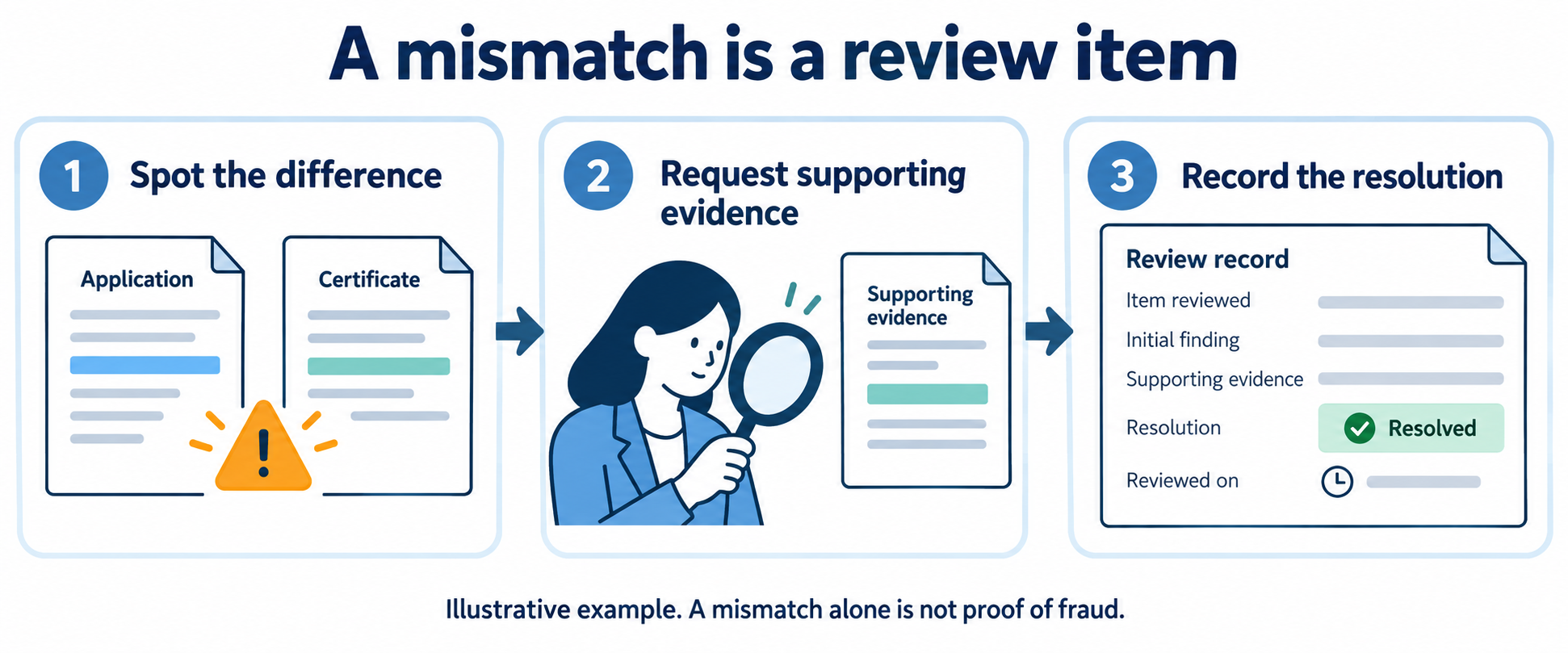
- Spot the difference. Identify which field differs between the application and its supporting document.
- Request supporting evidence. Explain what the applicant should provide under the receiving organisation’s rules.
- Record the resolution. Keep the initial finding, evidence received, outcome and review date together.
Which parts of scrutiny can AI assist with?
AI can assist with reading document fields, organizing submissions and flagging items for review. A workflow may combine those functions with rule checks and supported source verification; extracting text from a document is not the same as proving its authenticity.
Evaluate automation against your actual document types and review rules. Use representative, appropriately protected samples, including unclear scans, missing pages, conflicting values and unavailable source checks. Agree which outcomes can proceed automatically and which require an authorized reviewer.
Measure field-level extraction errors, incorrect acceptances, unnecessary referrals, correction requests and end-to-end turnaround time. Report sample size and conditions beside performance figures. Software processing time and the time until an applicant receives a decision are different measures.
For academic workflows, see document scrutiny in education. For broader procurement questions, use the document verification software guide.
Where is document scrutiny used?
Admissions, recruitment and vendor onboarding are examples of workflows that review supporting documents. Each organisation defines its own required evidence and decision rules.
- Admissions: review academic records and evidence supporting eligibility claims. See education document scrutiny.
- Recruitment: compare submitted qualifications and employment details with supported evidence. See employment verification APIs.
- Vendor onboarding: check submitted business records against the procurement requirements. See the software buyer’s guide.
Which proof documents should you prepare?
Use the receiving organisation’s checklist to select the required documents. Academic records, identity documents, employment records and business registrations support different claims; a single generic list cannot determine what your application needs.
For each requested document, record the claim it supports, the acceptable issuer or format, relevant validity dates and the required verification method. Mark unavailable checks explicitly instead of treating them as passed.
What to remember
- Start with the receiving organisation’s requirements.
- Reading a field does not prove that it is authentic.
- Keep missing evidence separate from a confirmed mismatch.
- Record the checks performed and the reason for the outcome.
Questions about document scrutiny
Does document scrutiny mean my application is approved?
Not necessarily. A completed document check may be one stage of a larger application process. Check the portal’s outcome, remaining steps and official instructions before treating it as final approval.
How long does document scrutiny take?
There is no single turnaround time. It depends on the organization, workload, document quality, required checks and whether corrections are needed. Use the receiving organization’s published timeline or helpdesk for application-specific information.
Is OCR enough to verify a document?
No. OCR reads text from a document. Verification requires appropriate evidence or checks beyond extracting the text; the required checks depend on the claim being verified.
What if two documents show different details?
Read the discrepancy notice and provide the correction or supporting evidence permitted by the reviewing organization. A mismatch needs investigation and is not automatically proof that either document is fraudulent.
Can DocuExprt update my government application status?
DocuExprt’s commercial document workflows are separate from an authority’s applicant helpdesk. Use the official portal or reviewing authority to ask about a personal application status.
Discuss your document scrutiny workflow
Tell the team about the documents you handle and the review process you want to improve.
Open the enquiry page if the form does not load.