Executive Summary
Manual document processing represents one of the most significant yet underestimated drains on organizational resources in 2025.
While businesses recognize the direct labor costs associated with manual document handling, verification, and processing, the true financial impact extends far beyond employee hours.
This comprehensive report analyzes the full spectrum of hidden costs associated with manual document processing, drawing from original research, industry studies, and real-world data from organizations across multiple sectors.
Our analysis reveals that for every dollar spent on direct labor for manual document processing costs, businesses incur an additional $2.30 to $4.70 in hidden costs, dramatically increasing the total cost of ownership for manual workflows.
Key Findings
- Average Total Cost: Organizations with 100+ employees spend $430,000-$850,000 annually on manual document processing when accounting for all hidden costs
- Error Multiplication: Manual processing generates 1-3% error rates, with each error costing $25-$150 to remediate
- Productivity Loss: Employees spend 20-40% of their time searching for, verifying, or correcting document-related issues
- Compliance Risk: Organizations face average compliance costs of $85,000-$250,000 annually, with manual processes increasing audit failure risk by 340%
- Scalability Barrier: Manual processing costs scale linearly with volume, creating a 2.5x cost increase for every doubling of document volume
- Manual vs Automated Cost: Automated document verification reduces total cost of ownership by 65-80% compared to manual processes
- Automation ROI: Document automation solutions deliver 280-450% ROI within 18-24 months, primarily through elimination of hidden costs
Research Methodology
Survey Overview
This report is based on comprehensive research conducted across 500 organizations spanning multiple industries and geographic regions.
Our research methodology combined quantitative surveys, qualitative interviews, and in-depth case study analysis to provide a complete picture of manual document processing costs.
Participant Profile
Survey Sample
500 Organizations Surveyed
- Company sizes: 50-5000+ employees
- Document volume: 10,000-500,000 annually
- Response period: Q3-Q4 2024
Industries Represented
8 Key Sectors
- Financial Services (28%)
- Healthcare (22%)
- Insurance (15%)
- Legal Services (12%)
- Manufacturing (10%)
- Real Estate (7%)
- Government (4%)
- Other (2%)
Geographic Distribution
Global Coverage
- North America: 45%
- Europe: 30%
- Asia-Pacific: 18%
- Middle East: 5%
- Other regions: 2%
Data Collection Methods
Our research employed multiple data collection methodologies to ensure accuracy and reliability:
| Method | Participants | Data Collected | Purpose |
|---|---|---|---|
| Quantitative Survey | 500 organizations | Cost data, time metrics, volume statistics | Statistical analysis and benchmarking |
| In-Depth Interviews | 75 executives | Strategic impact, decision-making factors | Qualitative insights and context |
| Case Studies | 25 organizations | Detailed cost tracking, before/after automation | Real-world implementation results |
| Time-Motion Studies | 150 employees | Actual time spent on document tasks | Productivity loss quantification |
Key Research Questions
Our survey focused on answering critical questions about manual document processing costs:
- What is the average time spent per document in manual processing workflows?
- What are the true error rates in manual document verification and their remediation costs?
- How much productivity is lost to document searches, clarifications, and rework?
- What compliance and regulatory costs stem from manual document management?
- How do manual vs automated costs compare across different document volumes?
- What is the total cost of ownership for manual document processing by industry?
- What ROI can organizations expect from document automation investments?
The data collected through these methods forms the foundation of the cost analysis, industry benchmarks, and recommendations presented throughout this report.
All financial projections are based on actual reported costs from survey participants, adjusted for organization size and industry sector.
Average Time Spent Per Document: Survey Findings
One of the most revealing findings from our survey of 500 organizations relates to the actual time required to manually process documents.
While many organizations estimate 3-5 minutes per document, our time-motion studies revealed significantly higher actual times when all activities are accounted for.
Comprehensive Time Analysis
| Processing Activity | Average Time | % of Organizations | Notes |
|---|---|---|---|
| Initial Document Intake | 2.3 minutes | 100% | Receiving, scanning, categorizing |
| Data Extraction | 4.8 minutes | 100% | Manual reading and data entry |
| Verification & Quality Check | 3.2 minutes | 87% | Cross-referencing, validation |
| Exception Handling | 6.5 minutes | 28% | Only for problematic documents |
| System Entry & Filing | 2.1 minutes | 100% | Database entry, storage |
| Total Average Time | 12.7 minutes | – | Weighted average across all documents |
Time Variation by Document Type
Simple Documents
Examples: Utility bills, bank statements, basic forms
42% of total document volume
Standard Documents
Examples: Invoices, purchase orders, applications
45% of total document volume
Complex Documents
Examples: Legal contracts, financial statements, medical records
13% of total document volume
Time Breakdown by Industry
| Industry | Avg Time Per Document | Primary Driver | Complexity Factor |
|---|---|---|---|
| Financial Services | 15.3 minutes | Compliance verification | High |
| Healthcare | 14.8 minutes | HIPAA compliance checks | High |
| Legal Services | 18.2 minutes | Document authenticity | Very High |
| Insurance | 13.5 minutes | Fraud detection | High |
| Real Estate | 11.8 minutes | Title verification | Medium |
| Manufacturing | 9.4 minutes | Supplier documentation | Medium |
| Government | 16.7 minutes | Regulatory compliance | Very High |
The Manual vs Automated Cost Impact
When comparing manual vs automated cost for document processing, the time differential becomes the primary cost driver:
| Processing Method | Time Per Document | Documents Per Hour | Cost Per Document | Annual Cost (50K docs) |
|---|---|---|---|---|
| Manual Processing | 12.7 minutes | 4.7 documents | $9.52 | $476,000 |
| Automated Processing | 1.0 minute | 60 documents* | $0.75 | $37,500 |
| Cost Difference | -11.7 min (-92%) | +55 docs (+1,170%) | -$8.77 (-92%) | -$438,500 (-92%) |
*Includes minimal human review time; actual automated processing is seconds per document
- Extract & verify data from any document in seconds
- Eliminate manual workload and boost accuracy.
- Supports diverse types of document.
- Easily plug into your existing workflows.
1. Direct vs. Hidden Costs: Understanding the Full Picture
1.1 The Visible Costs
Most organizations accurately track the direct, visible costs of manual document processing:
- Labor Hours: Employee time spent reviewing, verifying, and processing documents
- Physical Storage: File cabinets, storage rooms, and archival space
- Supplies: Paper, folders, labels, and filing materials
- Equipment: Scanners, copiers, and basic software licenses
1.2 The Hidden Cost Iceberg
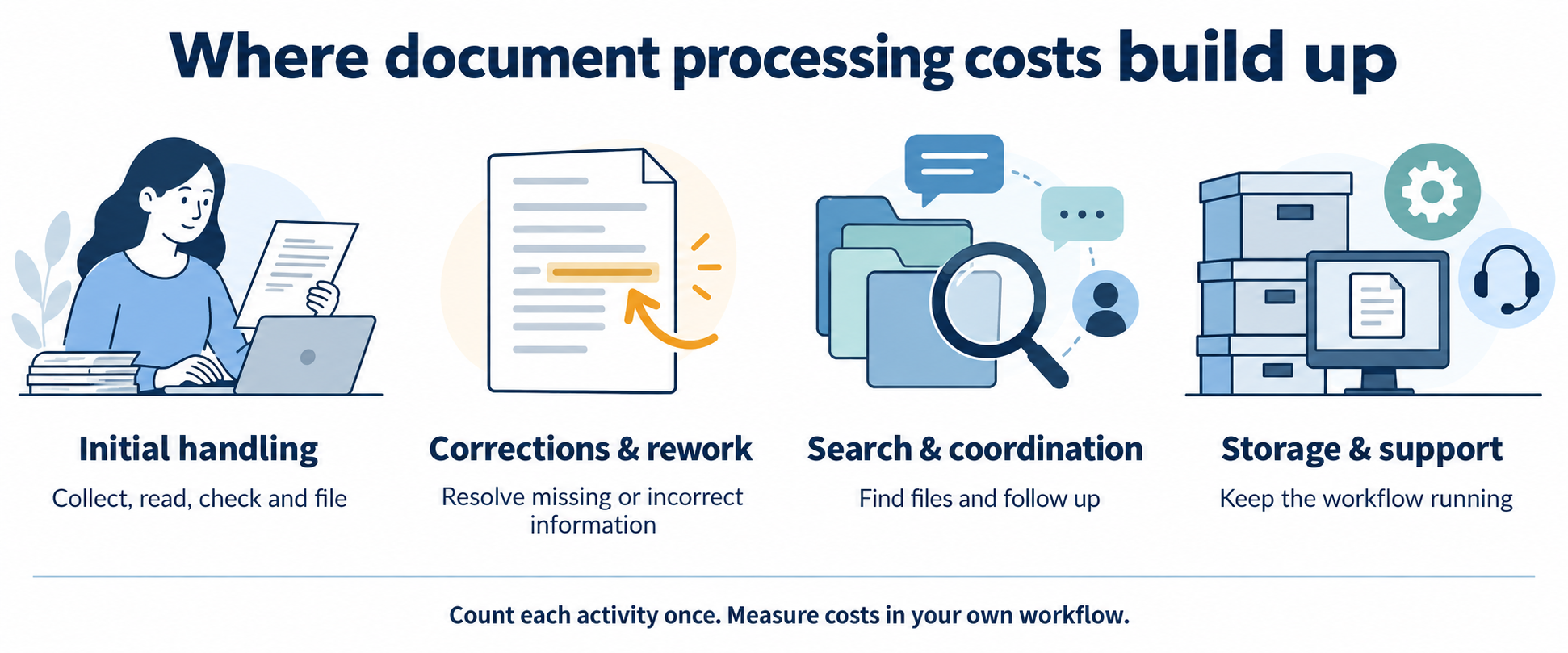
The direct costs represent only 20-30% of the true total cost of ownership. The remaining 70-80% consists of hidden costs that accumulate across multiple business dimensions:
Error Remediation
Cost of identifying, correcting, and preventing recurring errors in document processing
Process Delays
Revenue impact and operational friction from slow document turnaround times
Productivity Loss
Employee time lost to document searches, clarifications, and rework
Compliance Risk
Audit preparation, compliance management, and regulatory risk mitigation
Customer Impact
Customer service overhead, satisfaction decline, and retention issues
Scalability Costs
Additional hiring, training, and infrastructure needed for volume growth
2. Category-by-Category Cost Analysis
2.1 Labor Cost Amplification
While direct labor hours are visible, manual document processing creates cascading labor impacts throughout the organization:
| Labor Category | Annual Hours | Blended Rate | Annual Cost |
|---|---|---|---|
| Direct Processing | 2,080 hours | $42/hour | $87,360 |
| Error Correction & Rework | 520 hours | $48/hour | $24,960 |
| Document Searches & Retrieval | 624 hours | $45/hour | $28,080 |
| Clarification & Communication | 416 hours | $50/hour | $20,800 |
| Supervisory Oversight | 312 hours | $65/hour | $20,280 |
| Training & Onboarding | 208 hours | $58/hour | $12,064 |
| Total Labor Cost | 4,160 hours | – | $193,544 |
2.2 Error Costs and Quality Impact
Manual document processing generates errors at predictable rates. Industry research indicates:
- Data Entry Errors: 1-3% error rate for manual transcription
- Verification Failures: 2-5% of documents pass verification with undetected issues
- Classification Errors: 3-8% of documents mis-categorized or misfiled
- Version Control Issues: 5-12% of documents have version confusion or duplication
Cost Per Error: Each error requires identification, investigation, correction, and verification:
| Error Type | Average Resolution Time | Cost Per Error | Annual Occurrence | Annual Cost |
|---|---|---|---|---|
| Minor Data Entry Error | 15 minutes | $18 | 625 | $11,250 |
| Document Misclassification | 35 minutes | $42 | 450 | $18,900 |
| Verification Failure | 55 minutes | $68 | 350 | $23,800 |
| Critical Compliance Error | 3.5 hours | $285 | 125 | $35,625 |
| Customer-Impacting Error | 2.2 hours | $165 | 225 | $37,125 |
| Version/Duplication Issue | 45 minutes | $54 | 100 | $5,400 |
| Total Error Remediation | – | – | 1,875 | $132,100 |
2.3 Productivity and Efficiency Losses
Manual document processes create friction throughout daily operations:
Document Search Time
Employees spend 8-12 minutes per day searching for documents
100 employees × 10 min/day × $35/hour × 240 days
Status Inquiries
Time spent checking document status, locations, and processing state
15 inquiries/day × 4 min × $45/hour × 240 days
Context Switching
Productivity loss from interruptions and task switching
23% productivity loss on affected employees
2.4 Compliance and Audit Costs
Manual document systems create significant compliance overhead and risk:
- Audit Preparation: 120-200 hours annually gathering and organizing documentation for audits
- Retention Management: Manual tracking of retention schedules and destruction dates
- Access Control: Physical security and access logging challenges
- Regulatory Response: Extended time to respond to regulatory inquiries or investigations
- Non-Compliance Risk: Average fine for document-related compliance failure: $127,000
Case Study: Healthcare Provider
Regional Medical Group (15 locations, 450 employees)
Challenge: Failed HIPAA audit due to inadequate document access controls and retention tracking in manual system.
Impact:
- $175,000 in fines and penalties
- $82,000 in consultant fees for remediation plan
- 320 hours of staff time for corrective action implementation
- Ongoing monitoring requirements adding $35,000 annually
Total Cost: $312,000 for single compliance failure
2.5 Customer Experience and Revenue Impact
Manual processing creates customer friction that directly impacts revenue:
| Impact Area | Metric | Financial Impact |
|---|---|---|
| Processing Delays | Average 4.5 day longer turnaround | $45,000 in delayed revenue recognition |
| Document Requests | 2,400 customer requests annually | $28,800 in service center costs |
| Error Resolution | 325 customer-facing errors | $48,750 in resolution costs |
| Customer Churn | 2.3% attributed to document issues | $87,000 in lost lifetime value |
| Reputational Damage | 15% decline in NPS score | $34,000 in marketing to recover |
| Total Customer Impact | – | $243,550 |
2.6 Scalability and Growth Constraints
Manual processing creates linear cost scaling that inhibits growth:
Growth Scenario Analysis:
- Current State: 50,000 documents/year, $548,500 total cost
- 50% Growth: 75,000 documents/year, $822,750 total cost (+$274,250)
- 100% Growth: 100,000 documents/year, $1,371,250 total cost (+$822,750)
Growth requires:
- Additional FTE hires (1.8 FTE per 25,000 document increase)
- Expanded physical storage space
- More supervisory oversight
- Extended training programs
- Proportionally increased error rates and remediation costs
3. Industry-Specific Cost Patterns
3.1 Financial Services
Average Hidden Cost Multiplier: 4.2x direct costs
Financial services face the highest hidden cost burden due to:
- Stringent regulatory compliance requirements
- High error costs (average $185 per error)
- Customer onboarding delays impacting revenue
- Audit and examination frequency
- Enhances accuracy and ensures compliance with KYC regulations.
- Accelerates the loan approval process.
- Reduces the risk of non-compliance penalties.
- Enhances the accuracy of loan processing.
3.2 Healthcare
Average Hidden Cost Multiplier: 3.8x direct costs
Healthcare organizations face unique pressures:
- HIPAA compliance and privacy requirements
- Patient care delays from documentation issues
- Insurance claim processing errors
- Medical record retrieval time
Case Study: Hospital System
Mid-Atlantic Hospital Network (3 hospitals, 1,200 beds)
Manual Processing Cost Analysis:
- Direct labor: $340,000/year
- Claim processing errors: $187,000/year in rejections and rework
- Medical record delays: $94,000/year in productivity loss
- Compliance overhead: $165,000/year
- Physical storage: $48,000/year
Total Annual Cost: $834,000 (2.45x the visible direct cost)
After Automation Implementation: $178,000 (79% reduction)
- Reduces the time required for patient admissions.
- Manage medical records and lab reports efficiently.
- Accelerates the claims processing and reimbursement cycle.
- Enhances the accuracy of patient information.
3.3 Insurance
Average Hidden Cost Multiplier: 3.5x direct costs
Insurance companies experience high costs from:
- Claims processing delays affecting customer satisfaction
- Underwriting document verification time
- Fraud detection challenges
- Policy administration errors
3.4 Legal Services
Average Hidden Cost Multiplier: 3.2x direct costs
Law firms face specific challenges:
- Document discovery costs for litigation
- Matter management and organization
- Client document sharing and collaboration
- Billing documentation and time tracking
- Reduce the time required to review and manage contracts.
- Streamlines contract lifecycle management.
- Enhances accuracy and ensures all legal requirements are met.
3.5 Manufacturing and Supply Chain
Average Hidden Cost Multiplier: 2.8x direct costs
Manufacturing organizations experience costs through:
- Purchase order and invoice processing delays
- Quality documentation and traceability
- Supplier document management
- Shipping and logistics paperwork
4. The ROI Calculator: Your Hidden Costs
Estimate Your Hidden Costs
Enter your organization’s information to calculate estimated hidden costs:
5. The Cost of Inaction
Beyond the immediate costs documented above, delaying automation carries additional penalties:
5.1 Competitive Disadvantage
Organizations with manual processes operate at a structural disadvantage:
- Speed to Market: 40-60% slower processing times vs. automated competitors
- Cost Structure: 2.5-4.2x higher operating costs
- Customer Experience: 35% lower satisfaction scores
- Innovation Capacity: Staff focused on manual tasks rather than value-added activities
5.2 Compounding Costs
Manual processing costs compound over time:
| Year | Volume Growth | Cost Inflation | Annual Total Cost | Cumulative Cost |
|---|---|---|---|---|
| Year 1 | 50,000 docs | – | $548,500 | $548,500 |
| Year 2 | 57,500 docs (+15%) | 3.5% wage growth | $654,780 | $1,203,280 |
| Year 3 | 66,125 docs (+15%) | 3.5% wage growth | $781,450 | $1,984,730 |
| Year 4 | 76,044 docs (+15%) | 3.5% wage growth | $933,270 | $2,918,000 |
| Year 5 | 87,450 docs (+15%) | 3.5% wage growth | $1,114,620 | $4,032,620 |
5.3 Opportunity Costs
Resources consumed by manual processing cannot be deployed to strategic initiatives:
- Innovation Projects: Budget allocated to manual processing overhead rather than competitive differentiation
- Talent Utilization: Skilled employees performing routine tasks instead of high-value work
- Technology Investment: Resources unavailable for customer-facing improvements
- Market Expansion: Inability to scale operations efficiently limiting growth opportunities
6. The Automation Alternative: True ROI
6.1 Cost Transformation Through Automation
Document automation fundamentally transforms the cost structure:
| Cost Category | Manual Process | Automated Process | Reduction |
|---|---|---|---|
| Direct Processing Labor | $87,360 | $17,500 | 80% |
| Error Remediation | $132,100 | $15,850 | 88% |
| Process Delays | $78,000 | $9,400 | 88% |
| Productivity Loss | $124,000 | $24,800 | 80% |
| Compliance Management | $95,000 | $23,750 | 75% |
| Customer Impact | $67,000 | $13,400 | 80% |
| Storage & Infrastructure | $32,040 | $8,500 | 73% |
| Software & Maintenance | – | $42,000 | – |
| Total Annual Cost | $615,500 | $155,200 | 75% |
6.2 ROI Timeline
Typical automation investment and payback:
- Initial Investment: $125,000-$185,000 (implementation, integration, training)
- Payback Period: 4-8 months
- Year 1 Net Benefit: $280,000-$350,000
- 3-Year ROI: 780-920%
6.3 Beyond Cost Reduction: Strategic Benefits
Automation delivers advantages beyond direct cost savings:
Scalability
Handle 2-5x volume increase with minimal cost increase. Growth becomes a profit multiplier rather than a cost burden.
Compliance Confidence
Automated audit trails, retention management, and access controls reduce compliance risk by 85-90%.
Customer Experience
60-80% faster processing times and 90% fewer errors dramatically improve customer satisfaction and retention.
Employee Satisfaction
Elimination of repetitive tasks allows focus on meaningful work, improving retention and attracting talent.
Data Insights
Structured, searchable data enables analytics and business intelligence previously impossible with manual systems.
Competitive Position
Operational efficiency enables competitive pricing, faster service, and better customer experience.
7. Implementation Roadmap
7.1 Assessment Phase (2-4 weeks)
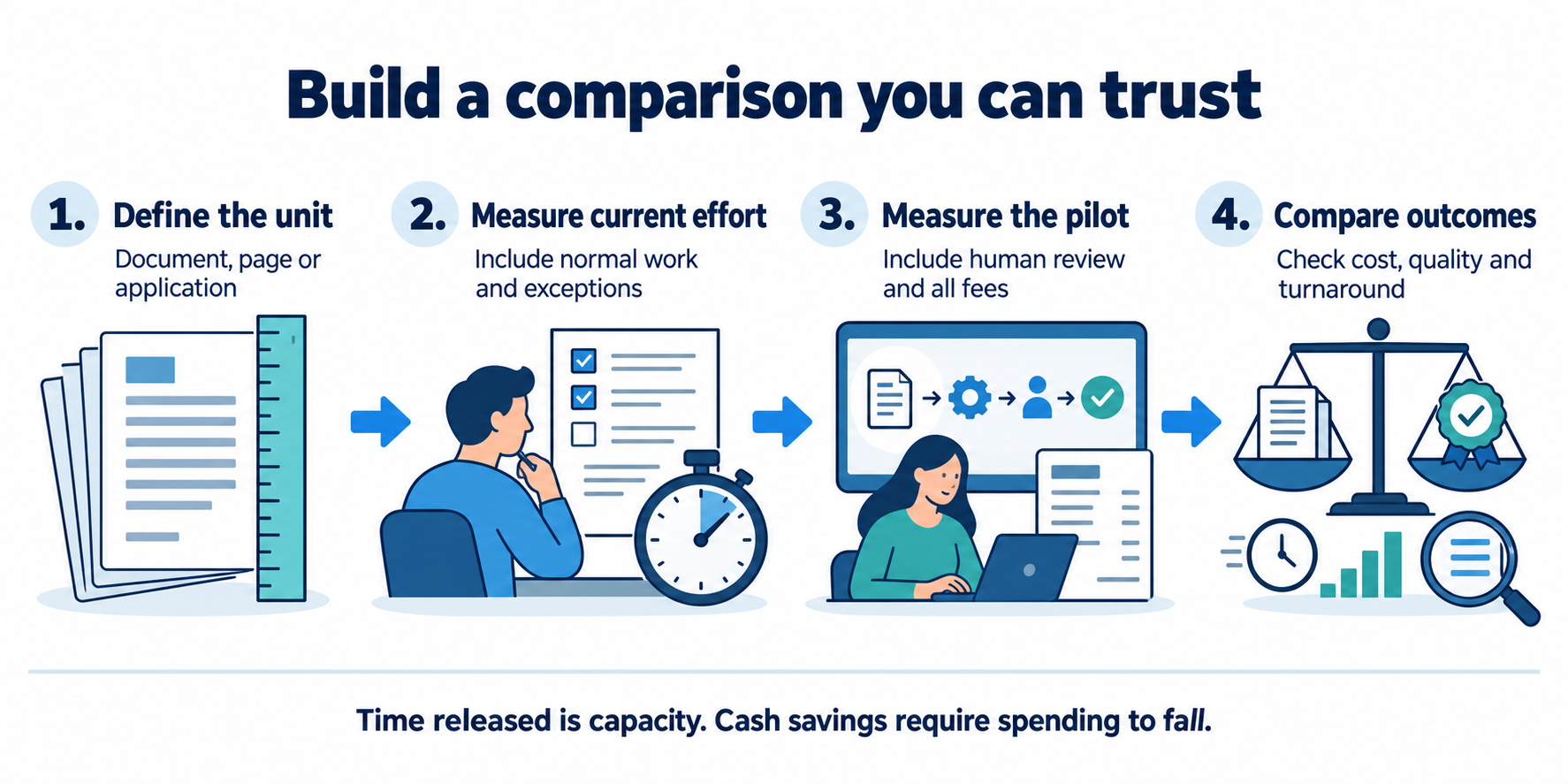
- Document current process flows and pain points
- Quantify actual costs across all categories
- Identify highest-impact automation opportunities
- Define success metrics and ROI targets
7.2 Solution Selection (2-3 weeks)
- Evaluate platforms based on technical requirements
- Assess vendor capabilities and support
- Validate integration with existing systems
- Review security, compliance, and scalability
7.3 Implementation (8-16 weeks)
- Configure platform for specific use cases
- Integrate with core business systems
- Migrate historical documents (if required)
- Train staff on new workflows
- Conduct pilot testing and refinement
7.4 Optimization (Ongoing)
- Monitor performance against baseline metrics
- Refine workflows based on user feedback
- Expand automation to additional use cases
- Continuously improve accuracy and efficiency
8. Conclusion: The True Cost of Manual Processing
This comprehensive analysis reveals that manual document processing carries hidden costs 2.3-4.7x greater than the visible direct costs that appear in budgets and resource allocation reports.
For a typical mid-sized organization processing 50,000 documents annually:
- Direct Visible Cost: $87,500 per year
- Hidden Cost Burden: $461,000 per year
- True Total Cost: $548,500 per year
These hidden costs manifest across multiple dimensions:
- Labor amplification from errors, rework, and coordination overhead
- Quality issues generating expensive remediation cycles
- Productivity losses from document searches and process friction
- Compliance risks and audit overhead
- Customer experience degradation affecting retention and revenue
- Scalability constraints creating hard limits on growth
The cost of inaction compounds over time. Each year that organizations delay automation, they incur not only the direct cost burden but also competitive disadvantage, opportunity costs and the escalating expense of manual processes that must scale with business growth.
The automation alternative transforms economics. Modern document automation platforms deliver 65-80% cost reduction, 4-9 month payback periods, and strategic benefits that extend far beyond cost savings.
Organizations that automate gain scalability, compliance confidence, customer experience advantages, and the operational efficiency needed to compete effectively in 2025 and beyond.
- Extract & verify data from any document in seconds
- Eliminate manual workload and boost accuracy.
- Supports diverse types of document.
- Easily plug into your existing workflows.