
Document Fraud Detection: How AI Image Forensics Catches Tampered Documents
Global fraud losses reached $442 billion in 2024. In identity verification alone, machine vision technologies caught $3 billion worth of forged documents - and that's only what was detected. By early 2025, deepfakes accounted for 40% of all biometric fraud instances.
The problem is accelerating. After analyzing tens of millions of documents, fraud detection platforms have found that up to 17% of digital bank statements used for loan applications have been tampered with, and 15% of company registration certificates submitted during vendor onboarding are fake.
AI-generated documents - fake PAN cards, fabricated salary slips, synthetic academic certificates - are now sophisticated enough to pass visual inspection by trained professionals.
Traditional document verification - human reviewers looking at documents for "obvious" signs of tampering - fails against this reality. You cannot visually detect pixel-level digital manipulation, AI-generated text patterns, or metadata inconsistencies. And you certainly cannot verify at the speed and scale that modern enterprises require.
This guide covers how AI-powered document fraud detection works from image forensics and metadata analysis to the ultimate defense: government database cross-verification that catches what even the best AI-generated forgeries cannot fake.
Table of Contents
- The Growing Threat of Document Fraud
- How AI Image Forensics Detects Document Tampering
- Government Database Cross-Verification - The Second Layer
- Detecting AI-Generated Documents - The 2026 Threat
- Industry-Specific Fraud Detection Workflows
- Building a Fraud Detection Workflow in DocuExprt
- Key Takeaways
- FAQ
The Growing Threat of Document Fraud
Document fraud is not a new problem - but the tools available to fraudsters in 2026 have fundamentally changed the threat landscape. What once required physical counterfeiting skills now requires only a laptop, AI tools, and a PDF editor.
Document Fraud by the Numbers
| Fraud Metric | Scale |
|---|---|
| Global fraud losses (2024) | $442 billion |
| Consumer-reported fraud losses in US (2024) | $12.5 billion (25% YoY increase) |
| Forged documents caught by machine vision | $3 billion worth in identity verification |
| Synthetic identity document fraud growth (North America) | 311% increase |
| Deepfakes as percentage of biometric fraud (2025) | 40% |
| Tampered bank statements in loan applications | Up to 17% |
| Fake company registration certificates | 15% of submissions |
| AI fraud detection prevention value (2025) | $25.5 billion in prevented losses |
| Organizations victimized by payments fraud (2024) | 79% |
Four types of document fraud arranged by sophistication: physical tampering, digital manipulation, complete fabrication, and AI-generated documents.
Types of Document Fraud
Sophistication and detection difficulty rise with each tier.
Physical tampering
Altering dates, amounts, or names on real documents — erasing, rewriting, swapping pages, or modifying stamps and seals.
Digital manipulation
Photoshop and PDF editors used to alter salary slips, bank statements, and certificates — often pixel-perfect to human reviewers.
Complete fabrication
Entirely fake documents built from scratch — government IDs, registration certificates, and academic degrees with realistic logos and seals.
AI-generated documents
Generative AI builds realistic PAN cards, salary slips, bank statements, and IDs with consistent fonts, formatting, and plausible data.
1. Physical Tampering:
Altering dates, amounts, names, or other details on genuine documents. This includes erasing and rewriting information, replacing pages in multi-page documents, and altering stamps or seals.
Physical tampering leaves traces - inconsistent ink, paper texture variations, alignment issues - that trained eyes can sometimes catch, but at scale this approach fails.
2. Digital Manipulation:
Using Photoshop, PDF editors, and other tools to modify digital documents. This is far more common than physical tampering and significantly harder to detect visually.
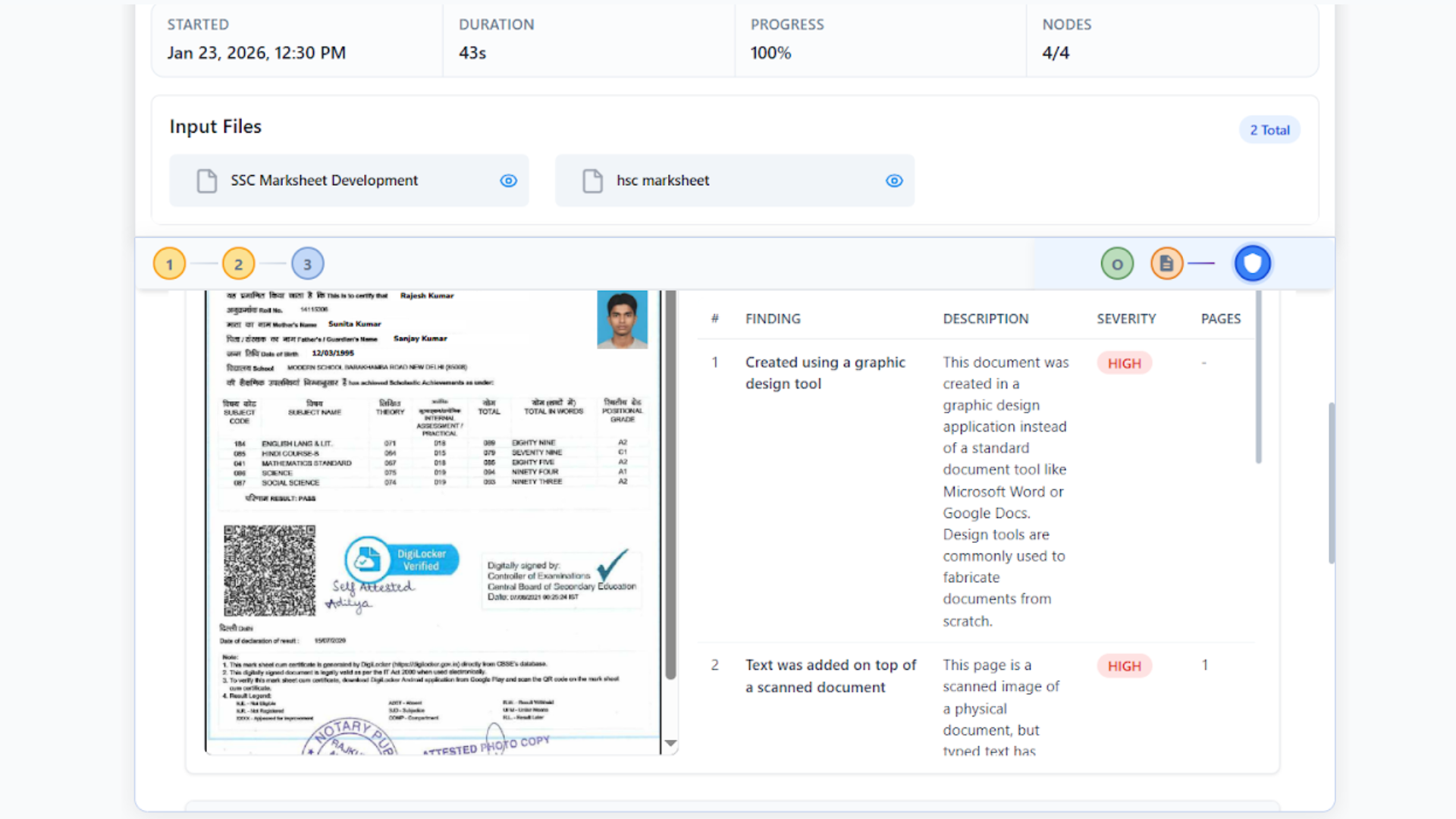
Altered salary slips, modified bank statements, and edited certificates can appear pixel-perfect to human reviewers. AI forensics can detect compression artifacts, font inconsistencies, and metadata anomalies that digital manipulation leaves behind.
3. Complete Fabrication:
Creating entirely fake documents from scratch - fake government IDs, fabricated company registration certificates, forged academic degrees with realistic logos, seals, and formatting.
The December 2025 operation in India uncovered over 1 million fake academic certificates that were virtually indistinguishable from legitimate documents.
4. AI-Generated Documents:
The newest and most dangerous category. Generative AI tools can now create realistic-looking PAN cards, salary slips, bank statements, and even identity documents with consistent formatting, appropriate fonts, and plausible data.
AI-generated documents don't have the telltale signs of traditional forgery - they are created clean, without the artifacts of cutting, pasting, or editing.
Industries Most Affected
| Industry | Fraud Type | Financial Impact |
|---|---|---|
| BFSI | Fake KYC documents, forged income proofs, manipulated bank statements | ₹36,014 crore in banking fraud (FY 2024-25) |
| Insurance | Altered medical bills, fake FIRs, inflated repair estimates | 5-10% of all claims are fraudulent |
| HR/Recruitment | Fake certificates, forged experience letters, inflated resumes | ₹8-12 lakhs per bad hire |
| Real Estate | Altered property documents, fake ownership certificates, forged NOCs | Lakhs to crores per fraudulent transaction |
| Education | Fake academic certificates, manipulated marksheets | 10-13% of BGV checks reveal discrepancies |
| Government | Fake identity documents for benefits, forged eligibility certificates | Billions in welfare scheme leakage |
- Extract & verify data from any document in seconds
- Eliminate manual workload and boost accuracy.
- Supports diverse types of documents.
- Easily plug into your existing workflows.
How AI Image Forensics Detects Document Tampering
Five forensic techniques work together at the pixel level to catch manipulation invisible to the human eye.
Enterprise-grade forensic AI models analyze documents at the pixel level, surfacing artifacts that no human reviewer can see.
The Five Techniques
Pixel-level compression analysis
Every save and re-save introduces compression artifacts. Modified regions carry a different signature than the rest of the document.
- Re-saved areas with double compression artifacts
- Sections with mismatched compression levels
- Inconsistent JPEG quantization tables
On a PAN card upload, if the name field shows a different compression pattern than the rest of the card, that section was modified after the original was created.
Font and typography analysis
Even when the same font is reused, replacement text leaves subtle differences in kerning, baseline, and letter spacing.
- Font mismatches between original and edited text
- Inconsistent kerning or letter spacing
- Overlay artifacts where new text covers old
- Baseline alignment shifts on modified lines
On academic certificates, the AI flags when a grade has been changed from "Second Class" to "First Class" by character swap — typography never matches perfectly.
Metadata analysis
Every digital file carries creation date, edit history, and software fingerprints. Tampered files leak through these breadcrumbs.
- Government docs "created" with consumer PDF editors
- Creation dates that don't match the claimed date
- Edit history past the alleged issue date
- Fingerprints from AI generation tools
A salary slip dated January 2026 shouldn't carry metadata showing it was created in March 2026 using Adobe Photoshop. The AI flags it instantly.
Edge detection and copy-move analysis
When sections are copied, pasted, or spliced, the boundaries leave detectable seams — even when the underlying content looks clean.
- Copy-move within or across documents
- Splicing where multiple sources are combined
- Inpainting traces where content was removed
- Cloned regions with identical noise patterns
On insurance claims with medical bills, the AI catches duplicated line items used to inflate amounts — identical pixel patterns can't appear naturally.
Template pattern recognition
Models trained on millions of genuine documents learn the exact layout, fonts, and design rules of every issuing authority.
- Documents that don't match the genuine template
- Wrong logos, colours, or field positions
- Missing watermarks, microprint, or holograms
- Layout deviations from authentic origin
Submitted PAN cards are compared against the authentic NSDL template — logo placement, font specifications, and field alignment all checked for deviation.

Government Database Cross-Verification - The Second Layer
AI image forensics is powerful but it has a fundamental limitation. As AI generation technology improves, forensic detection becomes an arms race. A sufficiently advanced AI-generated document may eventually produce clean forensics.
This is where government database cross-verification becomes the definitive defense layer. AI can generate a perfect-looking PAN card - but it cannot create a valid PAN entry in the NSDL database.
Why Image Forensics Alone Is Not Enough
| Scenario | Image Forensics Result | Government API Result | True Status |
|---|---|---|---|
| Genuine document | Pass | Pass (data matches) | Legitimate |
| Crude forgery | Fail (artifacts detected) | Fail (number doesn't exist) | Fraudulent |
| Expert digital manipulation | May pass | Fail (data mismatch) | Fraudulent - caught by API |
| AI-generated document | May pass (no editing artifacts) | Fail (number doesn't exist in database) | Fraudulent - caught by API |
The critical row is the last one. An AI-generated PAN card has no editing artifacts because it was created from scratch - no original document was modified. Image forensics may not flag it.
But when the extracted PAN number is checked against the NSDL database, it either exists with matching details, or it doesn't. This binary verification is immune to AI document generation.
DocuExprt's 30+ Government API Cross-Verification
| Document Type | Government API | Verification Logic |
|---|---|---|
| PAN Card | PAN Verification (NSDL) | Does this PAN exist? Does the name/DOB match the submitted document? |
| Aadhaar Card | Aadhaar eKYC (UIDAI) | Is this Aadhaar valid? Does demographic data match? |
| GSTIN Certificate | GSTIN Verification | Is this GSTIN active? Does the business name match? |
| Driving License | DL-Advanced (RTO) | Is this DL valid? Does it belong to the named person? |
| Passport | Passport Verification | Is this passport number valid? Name and DOB match? |
| Voter ID | Voter ID Verification | Is this EPIC number valid? |
| Bank Statement | Bank Account Verification | Does this account exist? Is the account holder name correct? |
| Employment Letter | UAN-to-Employment-History | Does EPFO have records matching this claimed employment? |
| MSME Certificate | Udyam Registration Status | Is this Udyam registration valid and active? |
| FSSAI License | FSSAI License Verification | Is this food license valid for the claimed category? |
| Company Registration | CIN-to-PAN, Director Lookup | Is this company registered with MCA? Are directors valid? |
Real-World Fraud Caught by Cross-Verification
Three cases where image forensics passed cleanly but API cross-checks against authoritative sources surfaced the truth.
Sophisticated PAN card forgery
A loan applicant submits a PAN card that passes every image forensics check — proper NSDL template, correct fonts, clean metadata. The document looks genuine because, in a sense, parts of it are.
- NSDL template matches authentic layout
- Fonts and kerning consistent throughout
- Metadata clean, no editor fingerprints
- PAN number is real and active
- Belongs to a different person entirely
- Identity stolen from a prior data breach
Fabricated employment history
An HR candidate submits experience letters from three companies showing 8 years of progressive growth — proper letterheads, signatures, and company stamps. Authoritative-looking on every visual axis.
- Three companies, 8 years of experience
- Proper letterheads and signatures
- Company stamps present and aligned
- Actual EPFO record: only 3 years
- Two of three employers never existed in record
- Five years of experience entirely fabricated
Manipulated insurance claim
A claimant submits medical bills totalling ₹8 lakhs from a hospital that genuinely exists. Image forensics flags subtle compression artifacts in the amount fields — and cross-verification reveals the rest.
- GSTIN exists and is active
- Hospital legitimacy confirmed
- Claim amount: ₹8 lakhs submitted
- Compression artifacts in amount fields
- Original bills totalled only ₹2.5 lakhs
- ₹5.5 lakhs of digital inflation
Detecting AI-Generated Documents - The 2026 Threat
AI-generated document fraud represents the most rapidly growing threat to document verification systems. Generative AI can now produce realistic fake documents - identity cards, financial statements, academic certificates, and official correspondence - that lack the traditional artifacts of manual forgery.
Why AI-Generated Documents Are Different
Traditional forgery modifies an existing document. This modification process leaves traces - compression artifacts, metadata changes, font inconsistencies.
AI-generated documents are created from scratch. There is no "original" that was modified, so traditional forensic techniques designed to detect editing may not flag them.
How AI-Generated Documents Differ from Genuine Ones
Despite their sophistication, AI-generated documents have distinguishing characteristics:
| Detection Vector | What AI Gets Wrong |
|---|---|
| Statistical text patterns | AI-generated text has uniform sentence structure, consistent complexity, and lacks the natural variation of human writing |
| Image generation artifacts | Subtle patterns in AI-generated images - slightly too-perfect symmetry, unusual noise distributions, generation model fingerprints |
| Content specificity | AI-generated recommendation letters and experience certificates tend to be generic, lacking specific project names, dated events, and verifiable details |
| Data validity | AI can generate a plausible-looking PAN number, but it cannot ensure that number is registered in NSDL's database |
DocuExprt's Three-Layer AI Document Detection
Layer 01
AI Forensic Analysis
Models trained to spot generation artifacts unique to AI-created documents — unusual pixel distributions, generation-model fingerprints, and statistical anomalies that separate AI output from camera-captured or scanned originals.
Pixel distribution
Model fingerprints
Statistical anomalies
Layer 02
Content Pattern Analysis
For text-heavy documents — recommendation letters, experience certificates, legal documents — DocuExprt reads text patterns for AI signatures: uniform complexity, generic phrasing, and the absence of specific verifiable details.
Uniform complexity
Generic language
Missing specifics
Layer 03
Government Database Verification The Ultimate Defense
The layer AI cannot defeat. AI can fabricate a perfect-looking document — but it cannot create a real entry inside a government system of record.
PAN
NSDL database
Aadhaar
UIDAI registry
GST
Returns portal
PF
EPFO records
MCA
Company registry
AI Forensic Analysis
Models trained to spot generation artifacts unique to AI-created documents — unusual pixel distributions, generation-model fingerprints, and statistical anomalies that separate AI output from camera-captured or scanned originals.
Content Pattern Analysis
For text-heavy documents — recommendation letters, experience certificates, legal documents — DocuExprt reads text patterns for AI signatures: uniform complexity, generic phrasing, and the absence of specific verifiable details.
Government Database Verification The Ultimate Defense
The layer AI cannot defeat. AI can fabricate a perfect-looking document — but it cannot create a real entry inside a government system of record.
Industry-Specific Fraud Detection Workflows
Insurance - Claims Fraud Detection
Insurance claims fraud costs the industry 5-10% of total claims payouts. Common document fraud in insurance includes altered medical bills, fake First Information Reports (FIRs), manipulated repair estimates, and fabricated receipts.
Documents uploaded
Claimant submits supporting documents through the claim portal. All intake formats are accepted.
AI image forensics
Pixel-level scan for tampering artifacts in the fields most often manipulated.
Data extraction
Structured fields pulled from each document for downstream verification and matching.
GSTIN verification
Confirm the hospital, garage, or service provider is a legitimate registered entity in active status.
Identity verification
PAN and Aadhaar checks confirm the claimant is who they say they are — and that the names match the documents submitted.
Cross-document analysis
Claimed amounts, dates, and entities are reconciled across every document submitted in this claim — and against historical claims by the same party.
Anomaly scoring
Every signal from the previous six steps feeds a probabilistic score. Claims above the fraud threshold are routed to investigators; clean claims continue to settlement.
BFSI - KYC Fraud Prevention
Banks process millions of identity documents for customer onboarding. Document fraud in banking directly enables financial crime - money laundering, identity theft, and unauthorized account access.
Identity documents uploaded
Customer submits identity and address documents through the onboarding flow. All standard formats are accepted.
AI forensics
Pixel-level scan of every identity document for tampering — altered names, modified photos, edited dates of birth, or swapped signatures.
PAN verification
The PAN number is confirmed against the NSDL database — checking that it exists, is active, and matches the holder name on the submitted card.
Aadhaar eKYC
UIDAI-backed verification with live face match — confirming the person on the call is the same person on the Aadhaar record.
Bank account verification
Confirms the customer actually owns the bank account being linked — ownership is established directly with the bank, not just inferred from the submitted documents.
Cross-verification
The same name and identity must reconcile across PAN, Aadhaar, and bank records. Mismatches — even small ones — are flagged as a fraud signal rather than a typo.
Risk scoring
Every signal from the previous six steps feeds a single risk score. The score routes the customer down the appropriate path — fast onboarding for low-risk profiles, deeper review for high-risk ones.
- Enhances accuracy and ensures compliance with KYC regulations.
- Accelerates the loan approval process.
- Reduces the risk of non-compliance penalties.
- Enhances the accuracy of loan processing.
HR - Resume and Certificate Fraud
With 56% of Indian hiring managers detecting at least one case of resume fraud in 2024, and over 1 million fake academic certificates uncovered in December 2025, HR document fraud is a growing enterprise risk.
Candidate documents uploaded
Candidate submits all supporting hiring documents through the recruitment portal. Every standard format is accepted.
AI forensics
Pixel-level scan of certificates and experience letters — checking for tampered grades, modified dates, and the authenticity of seals and holograms.
AI extraction
Structured fields are pulled from every document — names, dates, employers, qualifications — so resume claims can be matched against original sources downstream.
UAN employment history
Actual employment is verified against EPFO records — every employer, every tenure, every gap. The candidate's claimed history must match the government record.
PAN verification
The candidate's PAN is confirmed against the NSDL database — establishing identity and ensuring the holder name matches the documents and the EPFO record.
Cross-document analysis
Resume claims are systematically compared against government records — employer overlap, date alignment, role progression — surfacing anything the candidate could not back up with an authoritative source.
Discrepancy reporting
A detailed mismatch report is delivered to the hiring manager — every claim labelled verified, partial, or contradicted — so hiring decisions rest on evidence, not assumption.
Real Estate - Property Document Fraud
Forged property documents, fake ownership certificates, and altered sale deeds can lead to losses running into crores. Real estate document fraud is particularly dangerous because it often involves high-value transactions.
Property documents uploaded
The buyer or legal team submits all property documents through the verification portal. Every standard format is accepted.
AI forensics
Pixel-level scan across every property document — checking for tampered names, modified survey numbers, altered dates, and forged stamp paper or registration seals.
Seller identity verification
The seller's identity is confirmed against the NSDL and UIDAI databases — establishing that the person selling the property is genuinely who the documents claim them to be.
GSTIN verification
When the seller is a company, LLP, or other business entity, the GSTIN is verified to confirm the entity exists, is active, and is authorised to transact in real estate.
Director lookup
For corporate sellers, the company's ownership structure is verified — current directors, signing authorities, and any recent changes that might affect the validity of the transaction.
Multi-language extraction
Property documents in regional languages are processed with language-aware extraction — so registration details and title chains in any state's official language are read accurately into the report.
Cross-verification report
All findings — forensics, identity, entity, ownership, and extracted document data — are consolidated into a single legal-review report, with every claim labelled verified, partial, or flagged.
Building a Fraud Detection Workflow in DocuExprt
DocuExprt's visual no-code workflow builder enables enterprises to create multi-step fraud detection pipelines using 5 node types: Input, Processing, Conditional, Output, and Evaluation.
How Each Step Works
Step 1: Document Upload
The input node accepts documents in any format - PDF, scanned image, photograph, multi-page documents. Email triggers can automatically process documents received via designated fraud review inboxes.
Step 2: AI Image Forensics
The processing node runs forensic analysis across five dimensions: compression analysis, font/typography check, metadata examination, edge detection, and template matching. Each dimension produces a confidence score.
Step 3: AI Data Extraction
Simultaneously, the extraction engine pulls structured data from the document - names, numbers, dates, amounts, registration numbers. This data feeds the verification step.
Step 4: Government API Verification
Each extracted data point is verified against the relevant government database. API calls run in parallel for speed. Results are returned as match/mismatch/not-found with specific field-level details.
Step 5: Anomaly Scoring
The evaluation node combines all signals:
- Image forensics score (0-100)
- Government API match rate (percentage of fields verified)
- Cross-document consistency (data consistency across multiple submitted documents)
- Historical patterns (comparison against known fraud patterns)
Step 6: Conditional Decision
Based on the combined score, documents are automatically routed to approval, investigation, or rejection. Every decision includes a detailed report with specific findings for audit purposes.
Trigger System for Ongoing Monitoring
Fraud detection doesn't end at initial verification. DocuExprt's trigger system enables:
- Re-verification schedules: Automatically re-verify vendor and partner documents periodically
- Expiry monitoring: Alert when verified documents (licenses, certifications) approach expiry
- Pattern alerts: Notify when submission patterns match known fraud indicators
- Batch screening: Periodic re-screening of historical document archives against updated fraud models
- Extract & verify data from any document in seconds
- Eliminate manual workload and boost accuracy.
- Supports diverse types of documents.
- Easily plug into your existing workflows.
Key Takeaways
- Global fraud losses reached $442 billion in 2024 - with machine vision catching $3 billion in forged identity documents and synthetic identity fraud growing 311% in North America.
- Up to 17% of digital bank statements in loan applications are tampered with, and 15% of company registration certificates are fake - manual visual inspection cannot detect sophisticated digital manipulation at this scale.
- AI image forensics achieves 95%+ accuracy by analyzing pixel compression, font consistency, metadata, edge detection, and template matching - detecting manipulation invisible to human reviewers.
- Government database cross-verification is the definitive fraud defense - AI can generate a perfect-looking PAN card, but it cannot create a valid PAN entry in the NSDL database. DocuExprt's 30+ government APIs provide this verification layer.
- AI-generated document fraud is the fastest-growing threat in 2026 - deepfakes account for 40% of biometric fraud, and generative AI creates documents without the traditional artifacts of manual forgery.
- DocuExprt's three-layer detection combines AI forensics, content pattern analysis, and government database verification - each layer catches fraud that the others might miss, providing defence in depth.
- Industry-specific fraud workflows automate detection for BFSI, insurance, HR, and real estate - from insurance claims with inflated bills to KYC fraud with forged identity documents.
- The no-code workflow builder creates complete fraud detection pipelines - from document upload through forensic analysis, government API verification, anomaly scoring, and conditional routing, with full audit trails.
Frequently Asked Questions
How does AI detect document tampering?
AI detects document tampering through five forensic techniques. Pixel-level compression analysis identifies areas where a document has been edited and re-saved, creating double compression artifacts. Font and typography analysis detects font mismatches, kerning inconsistencies, and text overlay artifacts where new text replaces original content.
Metadata analysis examines creation dates, software fingerprints, and edit history for anomalies. Edge detection identifies copy-move manipulation where elements are duplicated or spliced between documents. Template pattern recognition compares submitted documents against known genuine templates, detecting layout deviations, incorrect logo placement, or missing security features.
DocuExprt combines all five techniques into a single forensic analysis that runs in seconds, producing a tampering confidence score for each submitted document.
Can AI detect fake PDF documents?
Yes. AI-powered systems detect fake PDF documents through multiple layers of analysis. At the image level, forensic AI identifies compression artifacts, font inconsistencies, and pixel-level manipulation traces.
At the metadata level, it examines the PDF's creation and modification history - a document claiming to be from a government agency but created in a consumer PDF editor is immediately suspicious. At the content level, AI analyzes extracted data for plausibility and consistency.
Most importantly, DocuExprt cross-verifies extracted data (PAN numbers, GSTIN, Aadhaar numbers) against government databases - providing definitive verification that no amount of PDF manipulation can defeat. Enterprise-grade systems achieve over 95% accuracy in detecting forged PDFs including bank statements, salary slips, and registration certificates.
How do you verify if a document is AI-generated?
Verifying AI-generated documents requires techniques beyond traditional forgery detection, because AI-generated documents are created from scratch without the editing artifacts of manipulated documents. DocuExprt uses three approaches:
First, AI forensic models trained to detect generation artifacts - unusual pixel distributions, model fingerprints, and statistical anomalies specific to AI-generated images.
Second, content pattern analysis that identifies AI writing signatures in text-heavy documents - uniform sentence structure, generic language, and lack of specific verifiable details.
Third and most critically, government database cross-verification. AI can generate a document that looks perfect, but it cannot create corresponding records in government databases. When the extracted data is checked against NSDL (PAN), UIDAI (Aadhaar), GST portal (GSTIN), or EPFO (employment), fabricated data fails verification immediately.
What is the accuracy of AI-based document fraud detection?
Enterprise-grade AI document fraud detection systems achieve over 95% accuracy in detecting forged documents across categories including bank statements, identity cards, certificates, and registration documents. However, accuracy varies by fraud type: traditional digital manipulation (Photoshop edits, PDF modifications) is detected with 95-98% accuracy due to clear forensic artifacts.
AI-generated documents present a greater challenge for forensic analysis alone, which is why DocuExprt combines AI forensics with government database cross-verification. The cross-verification layer provides near-100% accuracy for documents with verifiable data points (PAN, Aadhaar, GSTIN, UAN) - because the government database is the authoritative source regardless of how convincing the document appears visually.
How does government database cross-verification improve fraud detection?
Government database cross-verification transforms fraud detection from subjective visual assessment to objective data verification. When a document is submitted, DocuExprt extracts key data points (PAN number, Aadhaar number, GSTIN, bank account details) and verifies each against the issuing government database.
This approach catches fraud that image forensics cannot: perfectly forged documents with fake registration numbers (the number doesn't exist in the database), AI-generated documents with plausible but fabricated data, and identity theft cases where real registration numbers are used with the wrong person's details.
DocuExprt integrates 30+ government APIs covering identity (PAN, Aadhaar, passport, DL, Voter ID), business (GSTIN, CIN, Director Lookup, FSSAI, Udyam), banking (bank account, IFSC, UPI), and employment (UAN, EPFO records) - enabling comprehensive cross-verification across all major document types.