Document Fraud Detection: How AI Image Forensics Catches Tampered Documents

Document Fraud Detection: How AI Image Forensics Catches Tampered Documents

Global fraud losses reached $442 billion in 2024. In identity verification alone, machine vision technologies caught $3 billion worth of forged documents - and that's only what was detected. By early 2025, deepfakes accounted for 40% of all biometric fraud instances.

The problem is accelerating. After analyzing tens of millions of documents, fraud detection platforms have found that up to 17% of digital bank statements used for loan applications have been tampered with, and 15% of company registration certificates submitted during vendor onboarding are fake.

AI-generated documents - fake PAN cards, fabricated salary slips, synthetic academic certificates - are now sophisticated enough to pass visual inspection by trained professionals.

Traditional document verification - human reviewers looking at documents for "obvious" signs of tampering - fails against this reality. You cannot visually detect pixel-level digital manipulation, AI-generated text patterns, or metadata inconsistencies. And you certainly cannot verify at the speed and scale that modern enterprises require.

This guide covers how AI-powered document fraud detection works from image forensics and metadata analysis to the ultimate defense: government database cross-verification that catches what even the best AI-generated forgeries cannot fake.

The Growing Threat of Document Fraud

Document fraud is not a new problem - but the tools available to fraudsters in 2026 have fundamentally changed the threat landscape. What once required physical counterfeiting skills now requires only a laptop, AI tools, and a PDF editor.

Document Fraud by the Numbers

Fraud Metric Scale
Global fraud losses (2024) $442 billion
Consumer-reported fraud losses in US (2024) $12.5 billion (25% YoY increase)
Forged documents caught by machine vision $3 billion worth in identity verification
Synthetic identity document fraud growth (North America) 311% increase
Deepfakes as percentage of biometric fraud (2025) 40%
Tampered bank statements in loan applications Up to 17%
Fake company registration certificates 15% of submissions
AI fraud detection prevention value (2025) $25.5 billion in prevented losses
Organizations victimized by payments fraud (2024) 79%

Four types of document fraud arranged by sophistication: physical tampering, digital manipulation, complete fabrication, and AI-generated documents.

Types of Document Fraud

Sophistication and detection difficulty rise with each tier.

01 · TIER 1
Detectable

Physical tampering

Altering dates, amounts, or names on real documents — erasing, rewriting, swapping pages, or modifying stamps and seals.

Tells: ink shifts, paper texture, alignment
02 · TIER 2
Hard to detect

Digital manipulation

Photoshop and PDF editors used to alter salary slips, bank statements, and certificates — often pixel-perfect to human reviewers.

Tells: compression, font, and metadata anomalies
03 · TIER 3
Very hard

Complete fabrication

Entirely fake documents built from scratch — government IDs, registration certificates, and academic degrees with realistic logos and seals.

Scale: 1M+ fake certificates uncovered, India 2025
Newest threat
04 · TIER 4

AI-generated documents

Generative AI builds realistic PAN cards, salary slips, bank statements, and IDs with consistent fonts, formatting, and plausible data.

Threat: no editing artifacts — created clean

1. Physical Tampering:
Altering dates, amounts, names, or other details on genuine documents. This includes erasing and rewriting information, replacing pages in multi-page documents, and altering stamps or seals.

Physical tampering leaves traces - inconsistent ink, paper texture variations, alignment issues - that trained eyes can sometimes catch, but at scale this approach fails.

2. Digital Manipulation:
Using Photoshop, PDF editors, and other tools to modify digital documents. This is far more common than physical tampering and significantly harder to detect visually.

Altered salary slips, modified bank statements, and edited certificates can appear pixel-perfect to human reviewers. AI forensics can detect compression artifacts, font inconsistencies, and metadata anomalies that digital manipulation leaves behind.

3. Complete Fabrication:
Creating entirely fake documents from scratch - fake government IDs, fabricated company registration certificates, forged academic degrees with realistic logos, seals, and formatting.

The December 2025 operation in India uncovered over 1 million fake academic certificates that were virtually indistinguishable from legitimate documents.

4. AI-Generated Documents:
The newest and most dangerous category. Generative AI tools can now create realistic-looking PAN cards, salary slips, bank statements, and even identity documents with consistent formatting, appropriate fonts, and plausible data.

AI-generated documents don't have the telltale signs of traditional forgery - they are created clean, without the artifacts of cutting, pasting, or editing.

Industries Most Affected

Industry Fraud Type Financial Impact
BFSI Fake KYC documents, forged income proofs, manipulated bank statements ₹36,014 crore in banking fraud (FY 2024-25)
Insurance Altered medical bills, fake FIRs, inflated repair estimates 5-10% of all claims are fraudulent
HR/Recruitment Fake certificates, forged experience letters, inflated resumes ₹8-12 lakhs per bad hire
Real Estate Altered property documents, fake ownership certificates, forged NOCs Lakhs to crores per fraudulent transaction
Education Fake academic certificates, manipulated marksheets 10-13% of BGV checks reveal discrepancies
Government Fake identity documents for benefits, forged eligibility certificates Billions in welfare scheme leakage
Automate Document Verification with AI
  • Extract & verify data from any document in seconds
  • Eliminate manual workload and boost accuracy.
  • Supports diverse types of documents.
  • Easily plug into your existing workflows.
Book A Free Demo

How AI Image Forensics Detects Document Tampering

Five forensic techniques work together at the pixel level to catch manipulation invisible to the human eye.

95%+
Detection accuracy

Enterprise-grade forensic AI models analyze documents at the pixel level, surfacing artifacts that no human reviewer can see.

The Five Techniques

01

Pixel-level compression analysis

Every save and re-save introduces compression artifacts. Modified regions carry a different signature than the rest of the document.

What it detects
  1. Re-saved areas with double compression artifacts
  2. Sections with mismatched compression levels
  3. Inconsistent JPEG quantization tables
In practice

On a PAN card upload, if the name field shows a different compression pattern than the rest of the card, that section was modified after the original was created.

02

Font and typography analysis

Even when the same font is reused, replacement text leaves subtle differences in kerning, baseline, and letter spacing.

What it detects
  1. Font mismatches between original and edited text
  2. Inconsistent kerning or letter spacing
  3. Overlay artifacts where new text covers old
  4. Baseline alignment shifts on modified lines
In practice

On academic certificates, the AI flags when a grade has been changed from "Second Class" to "First Class" by character swap — typography never matches perfectly.

03

Metadata analysis

Every digital file carries creation date, edit history, and software fingerprints. Tampered files leak through these breadcrumbs.

What it detects
  1. Government docs "created" with consumer PDF editors
  2. Creation dates that don't match the claimed date
  3. Edit history past the alleged issue date
  4. Fingerprints from AI generation tools
In practice

A salary slip dated January 2026 shouldn't carry metadata showing it was created in March 2026 using Adobe Photoshop. The AI flags it instantly.

04

Edge detection and copy-move analysis

When sections are copied, pasted, or spliced, the boundaries leave detectable seams — even when the underlying content looks clean.

What it detects
  1. Copy-move within or across documents
  2. Splicing where multiple sources are combined
  3. Inpainting traces where content was removed
  4. Cloned regions with identical noise patterns
In practice

On insurance claims with medical bills, the AI catches duplicated line items used to inflate amounts — identical pixel patterns can't appear naturally.

05

Template pattern recognition

Models trained on millions of genuine documents learn the exact layout, fonts, and design rules of every issuing authority.

What it detects
  1. Documents that don't match the genuine template
  2. Wrong logos, colours, or field positions
  3. Missing watermarks, microprint, or holograms
  4. Layout deviations from authentic origin
In practice

Submitted PAN cards are compared against the authentic NSDL template — logo placement, font specifications, and field alignment all checked for deviation.

Document Tampering & Forensics

Government Database Cross-Verification - The Second Layer

AI image forensics is powerful but it has a fundamental limitation. As AI generation technology improves, forensic detection becomes an arms race. A sufficiently advanced AI-generated document may eventually produce clean forensics.

This is where government database cross-verification becomes the definitive defense layer. AI can generate a perfect-looking PAN card - but it cannot create a valid PAN entry in the NSDL database.

Why Image Forensics Alone Is Not Enough

Scenario Image Forensics Result Government API Result True Status
Genuine document Pass Pass (data matches) Legitimate
Crude forgery Fail (artifacts detected) Fail (number doesn't exist) Fraudulent
Expert digital manipulation May pass Fail (data mismatch) Fraudulent - caught by API
AI-generated document May pass (no editing artifacts) Fail (number doesn't exist in database) Fraudulent - caught by API

The critical row is the last one. An AI-generated PAN card has no editing artifacts because it was created from scratch - no original document was modified. Image forensics may not flag it.

But when the extracted PAN number is checked against the NSDL database, it either exists with matching details, or it doesn't. This binary verification is immune to AI document generation.

DocuExprt's 30+ Government API Cross-Verification

Document Type Government API Verification Logic
PAN Card PAN Verification (NSDL) Does this PAN exist? Does the name/DOB match the submitted document?
Aadhaar Card Aadhaar eKYC (UIDAI) Is this Aadhaar valid? Does demographic data match?
GSTIN Certificate GSTIN Verification Is this GSTIN active? Does the business name match?
Driving License DL-Advanced (RTO) Is this DL valid? Does it belong to the named person?
Passport Passport Verification Is this passport number valid? Name and DOB match?
Voter ID Voter ID Verification Is this EPIC number valid?
Bank Statement Bank Account Verification Does this account exist? Is the account holder name correct?
Employment Letter UAN-to-Employment-History Does EPFO have records matching this claimed employment?
MSME Certificate Udyam Registration Status Is this Udyam registration valid and active?
FSSAI License FSSAI License Verification Is this food license valid for the claimed category?
Company Registration CIN-to-PAN, Director Lookup Is this company registered with MCA? Are directors valid?

Real-World Fraud Caught by Cross-Verification

Three cases where image forensics passed cleanly but API cross-checks against authoritative sources surfaced the truth.

1stolen identity
Real PAN, fake holder — caught via NSDL
5years fabricated
8 claimed vs 3 actual EPFO years
₹5.5Linflated
₹8L claim on ₹2.5L of real bills
CASE 01 Loan fraud

Sophisticated PAN card forgery

A loan applicant submits a PAN card that passes every image forensics check — proper NSDL template, correct fonts, clean metadata. The document looks genuine because, in a sense, parts of it are.

Image forensics: passed
  • NSDL template matches authentic layout
  • Fonts and kerning consistent throughout
  • Metadata clean, no editor fingerprints
NSDL API: caught
  • PAN number is real and active
  • Belongs to a different person entirely
  • Identity stolen from a prior data breach
Verified against NSDL PAN API
CASE 02 HR fraud

Fabricated employment history

An HR candidate submits experience letters from three companies showing 8 years of progressive growth — proper letterheads, signatures, and company stamps. Authoritative-looking on every visual axis.

Letters: looked authentic
  • Three companies, 8 years of experience
  • Proper letterheads and signatures
  • Company stamps present and aligned
UAN/EPFO: caught
  • Actual EPFO record: only 3 years
  • Two of three employers never existed in record
  • Five years of experience entirely fabricated
Verified against UAN to Employment History API
CASE 03 Insurance fraud

Manipulated insurance claim

A claimant submits medical bills totalling ₹8 lakhs from a hospital that genuinely exists. Image forensics flags subtle compression artifacts in the amount fields — and cross-verification reveals the rest.

Hospital: verified real
  • GSTIN exists and is active
  • Hospital legitimacy confirmed
  • Claim amount: ₹8 lakhs submitted
Bills: amounts inflated
  • Compression artifacts in amount fields
  • Original bills totalled only ₹2.5 lakhs
  • ₹5.5 lakhs of digital inflation
Verified against GSTIN API Image forensics

Detecting AI-Generated Documents - The 2026 Threat

AI-generated document fraud represents the most rapidly growing threat to document verification systems. Generative AI can now produce realistic fake documents - identity cards, financial statements, academic certificates, and official correspondence - that lack the traditional artifacts of manual forgery.

Why AI-Generated Documents Are Different

Traditional forgery modifies an existing document. This modification process leaves traces - compression artifacts, metadata changes, font inconsistencies.

AI-generated documents are created from scratch. There is no "original" that was modified, so traditional forensic techniques designed to detect editing may not flag them.

How AI-Generated Documents Differ from Genuine Ones

Despite their sophistication, AI-generated documents have distinguishing characteristics:

Detection Vector What AI Gets Wrong
Statistical text patterns AI-generated text has uniform sentence structure, consistent complexity, and lacks the natural variation of human writing
Image generation artifacts Subtle patterns in AI-generated images - slightly too-perfect symmetry, unusual noise distributions, generation model fingerprints
Content specificity AI-generated recommendation letters and experience certificates tend to be generic, lacking specific project names, dated events, and verifiable details
Data validity AI can generate a plausible-looking PAN number, but it cannot ensure that number is registered in NSDL's database

DocuExprt's Three-Layer AI Document Detection

Layer 01

AI Forensic Analysis

Models trained to spot generation artifacts unique to AI-created documents — unusual pixel distributions, generation-model fingerprints, and statistical anomalies that separate AI output from camera-captured or scanned originals.

Pixel distribution Model fingerprints Statistical anomalies
Layer 02

Content Pattern Analysis

For text-heavy documents — recommendation letters, experience certificates, legal documents — DocuExprt reads text patterns for AI signatures: uniform complexity, generic phrasing, and the absence of specific verifiable details.

Uniform complexity Generic language Missing specifics
Layer 03

Government Database Verification The Ultimate Defense

The layer AI cannot defeat. AI can fabricate a perfect-looking document — but it cannot create a real entry inside a government system of record.

PAN
NSDL database
Aadhaar
UIDAI registry
GST
Returns portal
PF
EPFO records
MCA
Company registry

Industry-Specific Fraud Detection Workflows

Insurance - Claims Fraud Detection

Insurance claims fraud costs the industry 5-10% of total claims payouts. Common document fraud in insurance includes altered medical bills, fake First Information Reports (FIRs), manipulated repair estimates, and fabricated receipts.

1
Intake

Documents uploaded

Claimant submits supporting documents through the claim portal. All intake formats are accepted.

Medical bills FIR Repair estimates Identity proof
2
Analysis

AI image forensics

Pixel-level scan for tampering artifacts in the fields most often manipulated.

Amount fields Dates Patient details
3
Analysis

Data extraction

Structured fields pulled from each document for downstream verification and matching.

Hospital GSTIN Claimant identity Bill amounts
4
Verification

GSTIN verification

Confirm the hospital, garage, or service provider is a legitimate registered entity in active status.

GSTIN API Active registration
5
Verification

Identity verification

PAN and Aadhaar checks confirm the claimant is who they say they are — and that the names match the documents submitted.

PAN check Aadhaar check Name match
6
Decision

Cross-document analysis

Claimed amounts, dates, and entities are reconciled across every document submitted in this claim — and against historical claims by the same party.

Amount reconciliation Duplicate detection History match
7
Final · Output

Anomaly scoring

Every signal from the previous six steps feeds a probabilistic score. Claims above the fraud threshold are routed to investigators; clean claims continue to settlement.

Fraud probability Investigation queue Auto-clear path

BFSI - KYC Fraud Prevention

Banks process millions of identity documents for customer onboarding. Document fraud in banking directly enables financial crime - money laundering, identity theft, and unauthorized account access.

1
Intake

Identity documents uploaded

Customer submits identity and address documents through the onboarding flow. All standard formats are accepted.

PAN Aadhaar Address proof
2
Analysis

AI forensics

Pixel-level scan of every identity document for tampering — altered names, modified photos, edited dates of birth, or swapped signatures.

Tampering detection Photo integrity Field-level analysis
3
Verification

PAN verification

The PAN number is confirmed against the NSDL database — checking that it exists, is active, and matches the holder name on the submitted card.

NSDL API Active status Name match
4
Verification

Aadhaar eKYC

UIDAI-backed verification with live face match — confirming the person on the call is the same person on the Aadhaar record.

UIDAI API eKYC Face match Liveness check
5
Verification

Bank account verification

Confirms the customer actually owns the bank account being linked — ownership is established directly with the bank, not just inferred from the submitted documents.

Penny drop Account ownership IFSC validation
6
Decision

Cross-verification

The same name and identity must reconcile across PAN, Aadhaar, and bank records. Mismatches — even small ones — are flagged as a fraud signal rather than a typo.

Name consistency PAN ↔ Aadhaar Bank ↔ identity
7
Final · Output

Risk scoring

Every signal from the previous six steps feeds a single risk score. The score routes the customer down the appropriate path — fast onboarding for low-risk profiles, deeper review for high-risk ones.

Low risk
Auto-approve and onboard
High risk
Flag for Enhanced Due Diligence
AI Document Verification in Banking and Financial Services
  • Enhances accuracy and ensures compliance with KYC regulations.
  • Accelerates the loan approval process.
  • Reduces the risk of non-compliance penalties.
  • Enhances the accuracy of loan processing.
Book A Free Demo

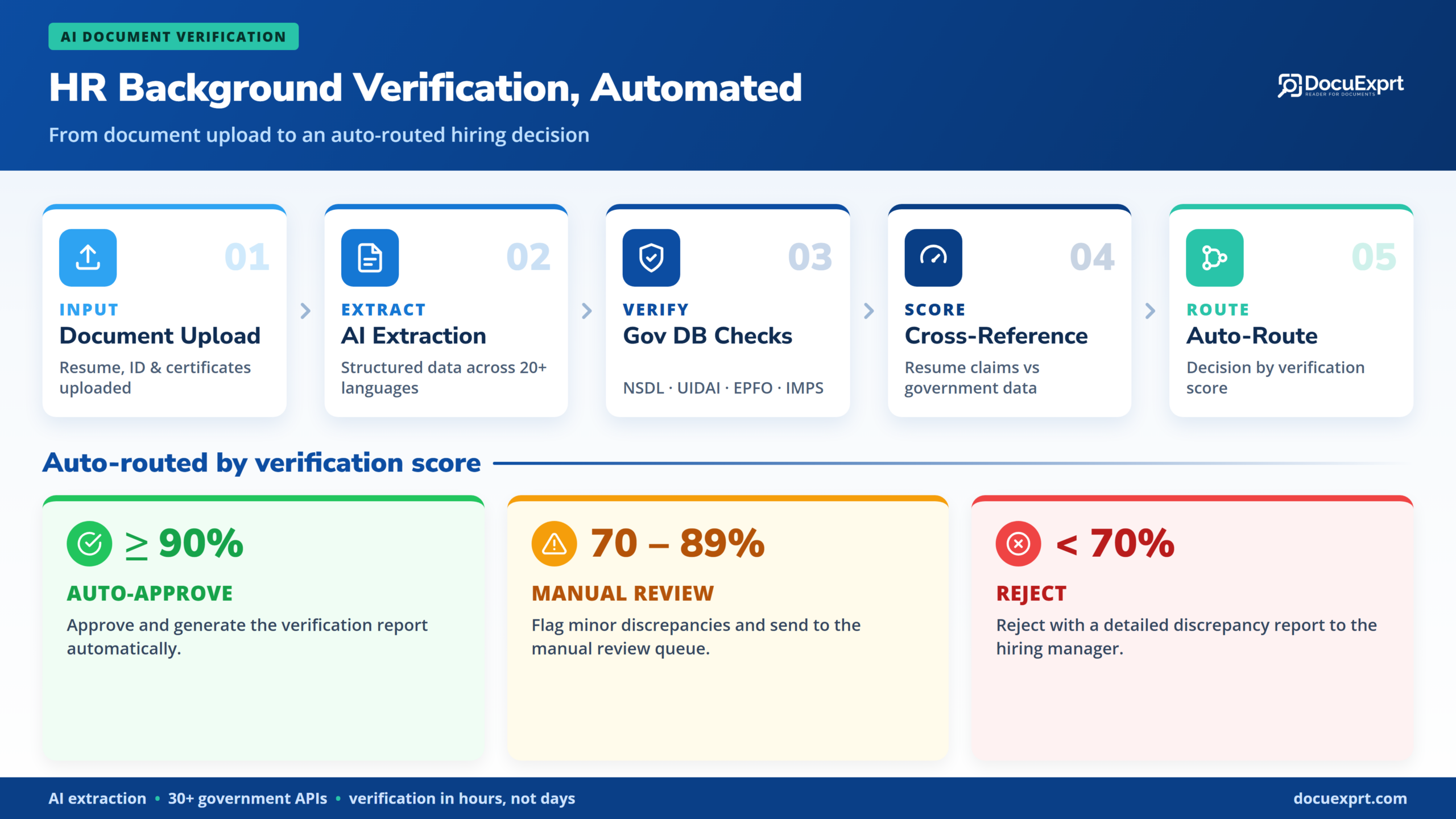
HR - Resume and Certificate Fraud

With 56% of Indian hiring managers detecting at least one case of resume fraud in 2024, and over 1 million fake academic certificates uncovered in December 2025, HR document fraud is a growing enterprise risk.

1
Intake

Candidate documents uploaded

Candidate submits all supporting hiring documents through the recruitment portal. Every standard format is accepted.

Resume Certificates Experience letters ID proof
2
Analysis

AI forensics

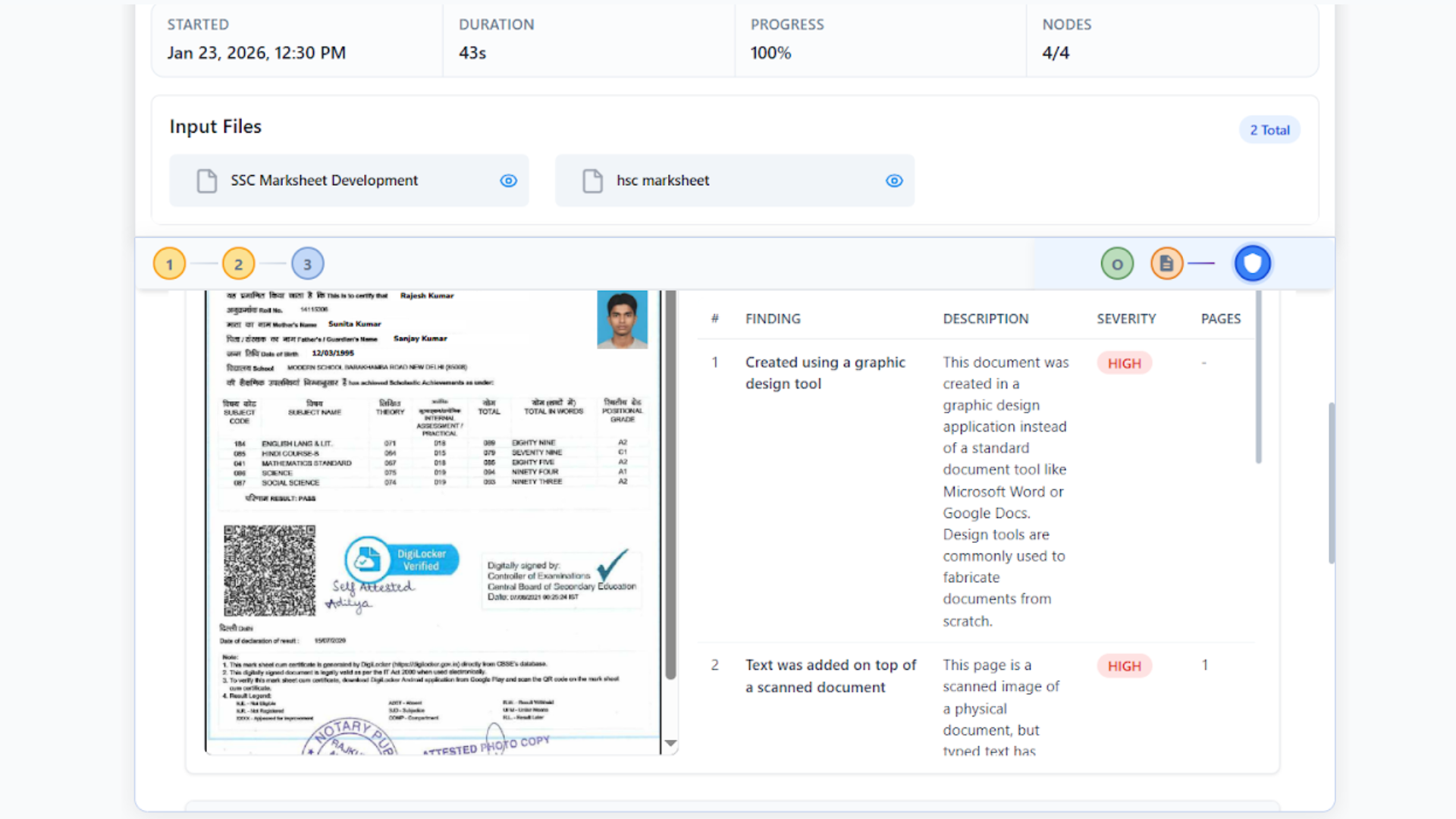
Pixel-level scan of certificates and experience letters — checking for tampered grades, modified dates, and the authenticity of seals and holograms.

Tampering scan Seal analysis Hologram check
3
Analysis

AI extraction

Structured fields are pulled from every document — names, dates, employers, qualifications — so resume claims can be matched against original sources downstream.

Education Employment dates Employer names Identity fields
4
Verification

UAN employment history

Actual employment is verified against EPFO records — every employer, every tenure, every gap. The candidate's claimed history must match the government record.

UAN API EPFO records Tenure match
5
Verification

PAN verification

The candidate's PAN is confirmed against the NSDL database — establishing identity and ensuring the holder name matches the documents and the EPFO record.

NSDL API Identity match Name reconciliation
6
Decision

Cross-document analysis

Resume claims are systematically compared against government records — employer overlap, date alignment, role progression — surfacing anything the candidate could not back up with an authoritative source.

Resume vs records Date overlaps Employer match
7
Final · Output

Discrepancy reporting

A detailed mismatch report is delivered to the hiring manager — every claim labelled verified, partial, or contradicted — so hiring decisions rest on evidence, not assumption.

Clean profile
All claims verified — proceed with hire
Discrepancies found
Mismatch report — manager review required

Real Estate - Property Document Fraud

Forged property documents, fake ownership certificates, and altered sale deeds can lead to losses running into crores. Real estate document fraud is particularly dangerous because it often involves high-value transactions.

1
Intake

Property documents uploaded

The buyer or legal team submits all property documents through the verification portal. Every standard format is accepted.

Sale deed Title documents Seller ID
2
Forensics

AI forensics

Pixel-level scan across every property document — checking for tampered names, modified survey numbers, altered dates, and forged stamp paper or registration seals.

Tampering scan Stamp authenticity Signature integrity
3
Verification

Seller identity verification

The seller's identity is confirmed against the NSDL and UIDAI databases — establishing that the person selling the property is genuinely who the documents claim them to be.

PAN check Aadhaar check Name match
4
Verification If business entity

GSTIN verification

When the seller is a company, LLP, or other business entity, the GSTIN is verified to confirm the entity exists, is active, and is authorised to transact in real estate.

GSTIN API Active registration Entity status
5
Verification

Director lookup

For corporate sellers, the company's ownership structure is verified — current directors, signing authorities, and any recent changes that might affect the validity of the transaction.

Company directors Signing authority Ownership history
6
Consolidation

Multi-language extraction

Property documents in regional languages are processed with language-aware extraction — so registration details and title chains in any state's official language are read accurately into the report.

हिन्दी मराठी தமிழ் తెలుగు ಕನ್ನಡ ગુજરાતી বাংলা + more
7
Final · Output

Cross-verification report

All findings — forensics, identity, entity, ownership, and extracted document data — are consolidated into a single legal-review report, with every claim labelled verified, partial, or flagged.

Clear title
All checks aligned — proceed with closing
Title issues
Anomalies flagged — legal team review

Building a Fraud Detection Workflow in DocuExprt

DocuExprt's visual no-code workflow builder enables enterprises to create multi-step fraud detection pipelines using 5 node types: Input, Processing, Conditional, Output, and Evaluation.

DocuExprt - Document Tampering & Forensics

How Each Step Works

Step 1: Document Upload
The input node accepts documents in any format - PDF, scanned image, photograph, multi-page documents. Email triggers can automatically process documents received via designated fraud review inboxes.

Step 2: AI Image Forensics
The processing node runs forensic analysis across five dimensions: compression analysis, font/typography check, metadata examination, edge detection, and template matching. Each dimension produces a confidence score.

Step 3: AI Data Extraction
Simultaneously, the extraction engine pulls structured data from the document - names, numbers, dates, amounts, registration numbers. This data feeds the verification step.

Step 4: Government API Verification
Each extracted data point is verified against the relevant government database. API calls run in parallel for speed. Results are returned as match/mismatch/not-found with specific field-level details.

Step 5: Anomaly Scoring
The evaluation node combines all signals:
- Image forensics score (0-100)
- Government API match rate (percentage of fields verified)
- Cross-document consistency (data consistency across multiple submitted documents)
- Historical patterns (comparison against known fraud patterns)

Step 6: Conditional Decision
Based on the combined score, documents are automatically routed to approval, investigation, or rejection. Every decision includes a detailed report with specific findings for audit purposes.

Trigger System for Ongoing Monitoring

Fraud detection doesn't end at initial verification. DocuExprt's trigger system enables:
- Re-verification schedules: Automatically re-verify vendor and partner documents periodically
- Expiry monitoring: Alert when verified documents (licenses, certifications) approach expiry
- Pattern alerts: Notify when submission patterns match known fraud indicators
- Batch screening: Periodic re-screening of historical document archives against updated fraud models

Automate Document Verification with AI
  • Extract & verify data from any document in seconds
  • Eliminate manual workload and boost accuracy.
  • Supports diverse types of documents.
  • Easily plug into your existing workflows.
Book A Free Demo

Key Takeaways

  1. Global fraud losses reached $442 billion in 2024 - with machine vision catching $3 billion in forged identity documents and synthetic identity fraud growing 311% in North America.
  2. Up to 17% of digital bank statements in loan applications are tampered with, and 15% of company registration certificates are fake - manual visual inspection cannot detect sophisticated digital manipulation at this scale.
  3. AI image forensics achieves 95%+ accuracy by analyzing pixel compression, font consistency, metadata, edge detection, and template matching - detecting manipulation invisible to human reviewers.
  4. Government database cross-verification is the definitive fraud defense - AI can generate a perfect-looking PAN card, but it cannot create a valid PAN entry in the NSDL database. DocuExprt's 30+ government APIs provide this verification layer.
  5. AI-generated document fraud is the fastest-growing threat in 2026 - deepfakes account for 40% of biometric fraud, and generative AI creates documents without the traditional artifacts of manual forgery.
  6. DocuExprt's three-layer detection combines AI forensics, content pattern analysis, and government database verification - each layer catches fraud that the others might miss, providing defence in depth.
  7. Industry-specific fraud workflows automate detection for BFSI, insurance, HR, and real estate - from insurance claims with inflated bills to KYC fraud with forged identity documents.
  8. The no-code workflow builder creates complete fraud detection pipelines - from document upload through forensic analysis, government API verification, anomaly scoring, and conditional routing, with full audit trails.

Frequently Asked Questions

How does AI detect document tampering?

AI detects document tampering through five forensic techniques. Pixel-level compression analysis identifies areas where a document has been edited and re-saved, creating double compression artifacts. Font and typography analysis detects font mismatches, kerning inconsistencies, and text overlay artifacts where new text replaces original content.

Metadata analysis examines creation dates, software fingerprints, and edit history for anomalies. Edge detection identifies copy-move manipulation where elements are duplicated or spliced between documents. Template pattern recognition compares submitted documents against known genuine templates, detecting layout deviations, incorrect logo placement, or missing security features.

DocuExprt combines all five techniques into a single forensic analysis that runs in seconds, producing a tampering confidence score for each submitted document.

Can AI detect fake PDF documents?

Yes. AI-powered systems detect fake PDF documents through multiple layers of analysis. At the image level, forensic AI identifies compression artifacts, font inconsistencies, and pixel-level manipulation traces.

At the metadata level, it examines the PDF's creation and modification history - a document claiming to be from a government agency but created in a consumer PDF editor is immediately suspicious. At the content level, AI analyzes extracted data for plausibility and consistency.

Most importantly, DocuExprt cross-verifies extracted data (PAN numbers, GSTIN, Aadhaar numbers) against government databases - providing definitive verification that no amount of PDF manipulation can defeat. Enterprise-grade systems achieve over 95% accuracy in detecting forged PDFs including bank statements, salary slips, and registration certificates.

How do you verify if a document is AI-generated?

Verifying AI-generated documents requires techniques beyond traditional forgery detection, because AI-generated documents are created from scratch without the editing artifacts of manipulated documents. DocuExprt uses three approaches:
First, AI forensic models trained to detect generation artifacts - unusual pixel distributions, model fingerprints, and statistical anomalies specific to AI-generated images.
Second, content pattern analysis that identifies AI writing signatures in text-heavy documents - uniform sentence structure, generic language, and lack of specific verifiable details.
Third and most critically, government database cross-verification. AI can generate a document that looks perfect, but it cannot create corresponding records in government databases. When the extracted data is checked against NSDL (PAN), UIDAI (Aadhaar), GST portal (GSTIN), or EPFO (employment), fabricated data fails verification immediately.

What is the accuracy of AI-based document fraud detection?

Enterprise-grade AI document fraud detection systems achieve over 95% accuracy in detecting forged documents across categories including bank statements, identity cards, certificates, and registration documents. However, accuracy varies by fraud type: traditional digital manipulation (Photoshop edits, PDF modifications) is detected with 95-98% accuracy due to clear forensic artifacts.

AI-generated documents present a greater challenge for forensic analysis alone, which is why DocuExprt combines AI forensics with government database cross-verification. The cross-verification layer provides near-100% accuracy for documents with verifiable data points (PAN, Aadhaar, GSTIN, UAN) - because the government database is the authoritative source regardless of how convincing the document appears visually.

How does government database cross-verification improve fraud detection?

Government database cross-verification transforms fraud detection from subjective visual assessment to objective data verification. When a document is submitted, DocuExprt extracts key data points (PAN number, Aadhaar number, GSTIN, bank account details) and verifies each against the issuing government database.

This approach catches fraud that image forensics cannot: perfectly forged documents with fake registration numbers (the number doesn't exist in the database), AI-generated documents with plausible but fabricated data, and identity theft cases where real registration numbers are used with the wrong person's details.

DocuExprt integrates 30+ government APIs covering identity (PAN, Aadhaar, passport, DL, Voter ID), business (GSTIN, CIN, Director Lookup, FSSAI, Udyam), banking (bank account, IFSC, UPI), and employment (UAN, EPFO records) - enabling comprehensive cross-verification across all major document types.

AI Document Verification for Government: Compliance & Citizen Services

AI Document Verification for Government: Compliance & Citizen Services


Introduction

India's Digital India programme has transformed the scale of government document processing. DigiLocker alone has crossed 57 crore registered users and issued over 990 crore documents digitally – serving as the backbone of paperless governance.

The UMANG platform offers 2,300 services across 23 languages with 626 crore transactions processed. Government e-Marketplace (GeM) recorded ₹4.09 lakh crore in procurement value in just 10 months of FY 2024-25 – a 50% year-over-year increase.

Yet behind this digital transformation lies a massive bottleneck: the document verification layer. Every welfare scheme application requires eligibility verification across multiple documents. Every government procurement requires vendor qualification checks.

Every citizen service from pension disbursement to property registration to license renewal depends on verifying identity documents, eligibility certificates, and compliance records against government databases.

For most government agencies, this verification still happens manually – clerks checking documents visually, making phone calls to other departments, and maintaining paper-based audit trails.

The result: long queues, processing delays measured in weeks, inconsistent verification quality, and vulnerability to document fraud that costs the exchequer billions through welfare scheme leakage.

India has already cancelled 5.87 crore ineligible ration cards and 4.23 crore duplicate LPG connections through digital verification – demonstrating both the scale of fraud and the power of automated document checks.

This guide covers how AI-powered document verification transforms government operations from citizen identity verification and welfare scheme eligibility to government procurement compliance and inter-department document processing.

The Digital Transformation Imperative for Government Document Processing

Government agencies at every level – central ministries, state departments, district administrations, PSUs, and municipal bodies – process enormous volumes of citizen documents daily. The sheer scale creates challenges that manual verification cannot solve.

The Scale of Government Document Processing

Government Document Processing Scale
DigiLocker registered users 57+ crore (as of August 2025)
DigiLocker documents issued digitally 990+ crore
UMANG platform services 2,300 across 23 languages
UMANG transactions processed 626+ crore
GeM procurement value (FY 2024-25, 10 months) ₹4.09 lakh crore
DBT transfers to date ₹44 lakh crore
Ineligible ration cards cancelled (fraud detection) 5.87 crore
Duplicate LPG connections removed 4.23 crore
Karmayogi platform officials onboarded 1.214 crore

Current Pain Points

For Citizens:
  • Long queues at government offices for document submission and verification
  • Multiple visits required when documents are incomplete or verification fails
  • Weeks-long processing times for services that should take hours
  • Inconsistent acceptance criteria across different offices and officers
For Government Agencies:
  • Manual verification is slow, error-prone, and not scalable during peak periods
  • No standardized process across departments – each verifier applies subjective judgment
  • Paper-based audit trails are incomplete, difficult to search, and vulnerable to manipulation
  • Cross-department verification requires physical document movement between offices
  • High administrative costs for low-value-add verification tasks
For the Exchequer:
  • Welfare scheme leakage through fake eligibility documents
  • Procurement fraud through unverified vendor credentials
  • Identity fraud enabling duplicate benefits collection
  • Billions lost annually to document-based fraud across government programmes

The Digital India Vision

The Government of India's Digital India programme envisions a paperless, transparent, accountable governance system. DigiLocker has already proven the model – 85% of users rate the platform "very good" and 78% report avoiding at least one physical visit per transaction. The next frontier is bringing this same digital efficiency to the verification layer – where AI can automate the checking, cross-referencing, and decision-making that currently depends on manual inspection.

AI-Powered Citizen Document Verification at Scale

Every government service delivery requires citizen identity verification. Whether a farmer applies for a subsidy, a student applies for a scholarship, or a pensioner requests disbursement – identity and eligibility must be confirmed against authoritative records.

Identity Verification for Government Services

Citizen Document Verification API Government Service Application
Aadhaar Aadhaar eKYC Universal identity verification for all citizen services
PAN Card PAN Verification Tax-related services, financial benefit schemes
Voter ID Voter ID Verification Electoral services, identity proof for local government services
Passport Passport Verification Immigration, consular services, international schemes
Driving License DL-Advanced Transport services, license renewals, vehicle registrations

DocuExprt's Aadhaar eKYC integration enables government agencies to verify citizen identity in real-time through UIDAI's authorized channels. OTP-based verification confirms identity without requiring physical document submission – a citizen can verify their identity from home, eliminating the need for office visits.

Face-Aadhaar matching via DigiLocker adds a biometric verification layer for high-security services – confirming that the person requesting the service is the legitimate Aadhaar holder. This prevents identity impersonation in benefit disbursement, property registration, and other high-value government transactions.

Welfare Scheme Eligibility Verification

Welfare scheme fraud costs the Indian exchequer billions annually. The cancellation of 5.87 crore ineligible ration cards demonstrates the scale of the problem. AI-powered document verification can automate eligibility checks across multiple criteria simultaneously.

Eligibility Document What to Verify Verification Method
Income Certificate Income within scheme threshold Cross-check against PAN/ITR records
Caste/Community Certificate Belongs to eligible category Document extraction + database verification
Domicile Certificate Resident of applicable state/district Aadhaar address verification
BPL Certificate Below Poverty Line status Cross-reference with BPL database
Age/Birth Certificate Meets age criteria Aadhaar demographic verification
Bank Account Details Valid account for DBT Bank Account Verification API

Automated eligibility workflow: A citizen applies for a welfare scheme online. DocuExprt's AI extracts data from all submitted documents – identity proofs, income certificates, category certificates.

Each data point is verified against the relevant government database. Eligibility criteria are checked automatically (income below threshold, correct age bracket, valid domicile, matching category). If all criteria pass, the application is auto-approved for benefit disbursement.

If any criterion fails, the system generates a specific rejection reason – not a vague "documents insufficient" but a precise "income exceeds scheme threshold based on PAN-linked ITR data."

This precision reduces citizen grievances (clear reasons for rejection), eliminates fraud (documents verified against databases, not visual inspection), and accelerates processing from weeks to minutes.

Business Compliance Verification for Government Departments

Government departments interact with businesses through licensing, procurement, taxation, and regulation. Each interaction requires business document verification.

Business Verification API Government Use Case
GSTIN Verification GSTIN API Tax compliance, procurement vendor checks, license applications
MSME/Udyam Verification Udyam API MSME procurement quotas, subsidy eligibility, PSL compliance
FSSAI Verification FSSAI API Food department licensing, restaurant permits, food safety inspections
CIN/Director Lookup Company Verification APIs Corporate tax assessments, regulatory compliance, tender qualification
TDS Compliance TDS Verification Tax deduction compliance for government contractors

Inter-Department Document Processing

One of the most persistent pain points in government operations is the movement of documents between departments for multi-stage approval processes.

The Current Reality

A typical government service requiring inter-department approval follows this pattern:

  1. Citizen submits documents at Department A
  2. Department A verifies and forwards physical file to Department B
  3. File sits in Department B's inbox for days/weeks
  4. Department B verifies its portion and forwards to Department C
  5. Process repeats across 3-5 departments
  6. Total processing time: 2-8 weeks for a process that could take hours

Each department re-verifies the same identity documents, creating redundant work. Physical file movement creates tracking problems. Lost files require re-submission. And there is no unified audit trail across departments.

DocuExprt's Centralized Document Verification Hub

DocuExprt transforms inter-department processing by creating a centralized digital verification layer:

Single verification, multiple consumers: When a citizen's identity documents are verified once through government APIs (Aadhaar, PAN, etc.), the verification result is available to all departments involved in the workflow. No redundant re-verification.

Digital routing: Instead of physical files moving between offices, verified document data flows through DocuExprt's workflow system. Each department receives the extracted, verified data relevant to their decision – not a physical file to manually review.

Parallel processing: Instead of sequential department-to-department routing, multiple departments can review their respective portions simultaneously. A building permission that requires checks from planning, fire safety, and environment departments can process all three in parallel.

Unified audit trail: Every verification action, routing decision, and departmental approval is logged with timestamps and user details. This creates a complete, searchable audit trail across all departments involved.

Processing time impact: Multi-department approvals that take 2-8 weeks with physical file routing can be completed in 1-3 days with digitized, parallel-processed verification workflows.

Automate Document Verification with AI
  • Extract & verify data from any document in seconds
  • Eliminate manual workload and boost accuracy.
  • Supports diverse types of documents.
  • Easily plug into your existing workflows.
Book A Free Demo

Government Procurement Compliance

Government procurement – valued at ₹4.09 lakh crore on GeM alone in FY 2024-25 – requires rigorous vendor document verification. Every supplier bidding on government contracts must prove business legitimacy, MSME status (for procurement quotas), tax compliance, and financial health.

Vendor Qualification for Government Procurement

Verification Step API Used Procurement Compliance Purpose
GSTIN Check GSTIN Verification (Detailed) Business legitimacy, active registration, filing compliance
MSME Status Udyam Registration Status 25% MSME procurement mandate compliance
Director Check Director Lookup (DIN) Disqualified directors, shell company detection
PAN Verification PAN Verification Tax identity of authorized signatories
Bank Account Bank Account Verification Valid account for payment processing
TDS Compliance TDS Verification Tax deduction and deposit compliance

MSME Procurement Mandate Compliance

The Indian government mandates that 25% of annual procurement by central ministries, departments, and PSUs must come from MSMEs, with 4% reserved for SC/ST enterprises and 3% for women-owned MSMEs. Verifying MSME classification is both a compliance requirement and a transparency measure.

DocuExprt's Udyam verification API confirms MSME registration in real-time – checking whether the enterprise is genuinely registered, correctly classified (Micro/Small/Medium), and within the applicable investment and turnover thresholds. This prevents false MSME claims that would distort procurement statistics and potentially trigger audit penalties.

GeM Marketplace Compliance

For procurement through the Government e-Marketplace, vendor qualification can be automated through DocuExprt's workflow builder:

  1. Vendor submits GeM registration documents
  2. AI extraction pulls GSTIN, PAN, Udyam number, bank details
  3. GSTIN verification confirms active business registration and filing compliance
  4. Udyam verification confirms valid MSME classification
  5. Director Lookup checks for disqualified directors or shell company indicators
  6. Bank account verification confirms payment details
  7. Compliance score generated – pass/fail/review
  8. Automated vendor qualification report for procurement committee

DigiLocker Integration and Paperless Workflows

DigiLocker is India's most successful digital document platform – 57 crore users, 990 crore documents issued, 2,131 issuers, 2,611 requesters. Integration with DigiLocker enables government agencies to access citizen documents directly from the digital vault, eliminating physical document submission entirely.

How DigiLocker Integration Works with DocuExprt

Citizen-Consented Document Access: Instead of asking citizens to photocopy, scan, and submit physical documents, government agencies can request documents directly from the citizen's DigiLocker wallet – with the citizen's explicit consent. This eliminates the single largest source of document fraud in government services: fake physical documents.

Eliminating Fake Document Submissions: When documents are pulled directly from DigiLocker (issued by authorized government issuers), they carry the issuer's digital signature. These cannot be tampered with – unlike photocopies or scanned images that citizens currently submit. Combined with DocuExprt's government API verification layer, this creates a two-tier authenticity guarantee.

Workflow Integration: DocuExprt's workflow builder can include DigiLocker as an input node – pulling specific document types (Aadhaar, PAN, driving license, academic certificates) from the citizen's digital vault as part of the verification pipeline. The pulled documents feed directly into AI extraction and government API verification, creating an end-to-end digital process from document retrieval to verified decision.

Impact on Citizen Experience

Metric Without DigiLocker Integration With DigiLocker Integration
Documents to carry Physical originals + photocopies None (digital access)
Physical visits required 2-4 per service 0-1
Document submission time 30-60 minutes per visit 2-5 minutes online
Fraud risk High (photocopies can be forged) Minimal (digitally signed documents)
Processing delay Days to weeks Minutes to hours
Re-submission for rejection Common (unclear requirements) Rare (specific rejection reasons)

Government-Specific Workflows in DocuExprt

DocuExprt's visual no-code workflow builder enables government agencies to create citizen service pipelines tailored to their specific requirements.

Workflow 1: Citizen Service Desk

DocuExprt · AI Verification

Automated AI-powered eligibility assessment & decision engine

Step 1
📋
Entry Point
Citizen Document Submission
Via Citizen Portal  ·  DigiLocker Integration
Step 2
🤖
AI Processing
AI Document Extraction
Identity documents  ·  Eligibility documents
Step 3a
🔐
KYC
Aadhaar eKYC Verification
UIDAI API
Step 3b
🪪
Tax ID (if applicable)
PAN Verification
Income Tax Dept. API
⚖️
Eligibility Criteria Check
Evaluation Node  ·  Rule Engine + AI Scoring
✔ If All Criteria Met
Outcome · Approved
Auto-Approve & Generate Service Certificate
Digitally signed certificate issued to citizen instantly
⚠ If Partial Match
📂
Outcome · Pending
Request Additional Documents
Citizen notified with a specific list of missing items
✕ If Criteria Not Met
🚫
Outcome · Rejected
Reject & Issue Detailed Reason Report
Transparent rejection report delivered to citizen via portal
Approved
Pending / Partial
Rejected

Use case: Welfare scheme applications, certificate issuance, license renewals
Processing time: Under 10 minutes per application (vs. days/weeks manual)

Workflow 2: Government Procurement Vendor Qualification

DocuExprt · Vendor Verification

AI-powered compliance scoring & procurement eligibility engine

Step 1
🏢
Entry Point
Vendor Document Submission
Via GeM Portal  ·  Procurement Portal Integration
Step 2
🤖
AI Processing
AI Document Extraction
Intelligent OCR & entity recognition across all submitted files
GSTIN PAN Udyam Reg. Bank Details
Step 3a
🧾
GST Authority
GSTIN Verification
Detailed filing status, active check & address match
Step 3b
🏭
MSME Ministry
Udyam / MSME Check
Classification, validity & category confirmation
Step 4a
👤
MCA / ROC
Director Lookup
DIN check, debarment & beneficial ownership
Step 4b
🏦
Payment Gateway
Bank Account Verification
Penny-drop validation & IFSC / account match
Step 5
📊
Compliance Engine
Vendor Compliance Scoring
Weighted rule engine + AI risk model across all verification signals
Threshold
0 – Disqualified Borderline Qualified →
⚖️
Score Threshold Evaluation
Routing based on compliance score vs. procurement threshold
✔ Score ≥ Threshold
Outcome · Qualified
Qualified & Added to Approved Vendor List
Vendor onboarded; compliance certificate issued & GeM profile updated
⚠ Borderline Score
🔍
Outcome · Manual Review
Escalated to Procurement Officer for Manual Review
Full AI-generated dossier provided to officer for human decision
✕ Score < Threshold
🚫
Outcome · Disqualified
Disqualified & Detailed Report Issued
Vendor notified with itemised score breakdown & remediation steps
Qualified
Manual Review
Disqualified

Use case: GeM vendor onboarding, tender pre-qualification, PSU vendor management
Processing time: 3-5 minutes per vendor (vs. 1-2 weeks manual)

Workflow 3: Pension Disbursement Verification

DocuExprt · Pension Verification

Automated life certificate validation & pension disbursement engine

Step 1
👴
Entry Point
Pensioner Identity Submission
Submitted via Pension Portal, Jeevan Pramaan App, or assisted kiosk
Aadhaar Bank Details
Step 2
🔐
UIDAI · eKYC
Aadhaar eKYC — Life Certificate Verification
Biometric / OTP-based liveness check confirming pensioner is alive & active
Step 3
🏦
Pension Account
Bank Account Verification
Penny-drop validation & active status check on pension disbursement account
Step 4
📋
EPFO · UAN (Recent Retirees)
Employment History Check
UAN-linked service record validation — confirms retirement date & pension eligibility period
Step 5
📑
Confirmation Engine
Pension Eligibility Confirmation
Cross-validation of all signals before disbursement decision
Aadhaar identity & liveness confirmed
Pension bank account active & matched
Employment / retirement record validated
No duplicate or fraudulent claim detected
⚖️
Verification Outcome Routing
All checks pass vs. any mismatch or anomaly detected
✔ If Verified
Outcome · Approved
Approve Disbursement & Update Pension Records
Pension released to verified account; Jeevan Pramaan record updated & pensioner notified via SMS
⚠ If Mismatch
🚨
Outcome · Flagged
Flag for Investigation & Notify Pension Office
Disbursement held; anomaly report raised with specific mismatch details for pension office review
Approved
Flagged / Held

Use case: Monthly/annual pension life certificate verification, pensioner identity confirmation
Processing time: Under 2 minutes per pensioner

Trigger System for Government Operations

DocuExprt's trigger system automates recurring government verification needs:

  • License/Certificate Expiry Monitoring: Alert departments when issued licenses (FSSAI, trade licenses, building permits) approach expiry for renewal processing
  • Periodic Re-Verification: Schedule annual eligibility re-checks for ongoing welfare beneficiaries
  • Document Submission Deadlines: Notify citizens when required document submissions are due
  • Compliance Calendar: Automated reminders for regulatory filing and reporting deadlines

On-Premise Deployment for Government Data Sovereignty

Government agencies operate under strict data sovereignty requirements. Aadhaar numbers, PAN details, voter records, property documents cannot be processed on external cloud infrastructure under the Digital Personal Data Protection (DPDP) Act 2023.

DocuExprt's on-premise deployment solves this by installing the complete AI verification platform on government-owned infrastructure:

What Gets Deployed On-Premise

ComponentCapability
AI Extraction EngineOCR, NLP, QR code decoding for 50+ document types in 20+ languages
Visual Workflow BuilderNo-code workflow creation with conditional logic, routing, and approval steps
Government API ConnectorsPAN, Aadhaar, GSTIN, DL, Passport, Voter ID — connected via govt network/VPN
Fraud Detection ModuleAI-powered anomaly detection, metadata analysis, QR cross-validation
Admin DashboardRole-based access, audit trails, analytics — all on local servers
Template SystemPre-built and custom templates for all government document types

Government-Specific Benefits

  • Air-gapped processing for defense, intelligence, and law enforcement documents
  • No data egress — all document processing happens within the government network
  • Compliance with GIGW (Guidelines for Indian Government Websites) standards
  • Integration with NIC infrastructure and government cloud (MeghRaj/GI Cloud)
  • Customer-managed encryption with government-approved cryptographic standards

Deployment Options for Government

OptionUse CaseTimeline
Dedicated Government Cloud (GI Cloud/MeghRaj)State and central government agencies1-2 weeks
On-Premise (Internet-Connected)PSUs, municipal corporations, district offices2-3 weeks
On-Premise (Air-Gapped)Defense, intelligence, law enforcement3-4 weeks

QR Code Verification for Citizen Documents

Government-issued documents increasingly embed QR codes for tamper-proof authentication. DocuExprt's QR extraction and validation works with:

  • Aadhaar e-KYC: UIDAI Secure QR for offline verification without API calls
  • PAN 2.0: Dynamic QR with real-time data from CBDT database
  • Academic Certificates: UGC-mandated QR for degree authenticity verification
  • FSSAI Licenses: QR-encoded license details for food safety compliance
  • DigiLocker Documents: QR codes on digitally issued government documents

When processing citizen applications at scale — welfare scheme enrollment, license renewals, permit applications — QR verification adds a fast, automated authenticity check that reduces manual scrutiny workload by 80%+.

Security and Compliance for Government Deployments

Government deployments have specific security, data sovereignty, and compliance requirements that exceed standard enterprise needs.

Data Sovereignty and Storage

  • Data residency: All citizen data processed and stored within India's borders
  • Cloud storage options: Compatible with government-approved cloud infrastructure (MeghRaj, NIC Cloud)
  • Encryption: AES-256 encryption for data at rest, TLS 1.3 for data in transit
  • Data retention policies: Configurable retention periods aligned with government records management rules

Role-Based Access Control (5 Levels)

DocuExprt's 5-level RBAC system maps directly to government administrative hierarchies:

Access Level Government Role Example Permissions
Level 1: Viewer Data Entry Operator View verification results only
Level 2: Operator Verification Clerk Run verifications, view results
Level 3: Supervisor Section Officer All above + approve/reject + manage queue
Level 4: Admin Department Head All above + create workflows + manage users
Level 5: Super Admin CIO/IT Director Full system access + audit logs + configuration

Audit Trail and Compliance Logging

Every action in DocuExprt is logged with:

  • User identity (who performed the action)
  • Timestamp (when)
  • Action type (what was done)
  • Input data and verification results
  • Decision taken and reason codes
This audit trail satisfies requirements for RTI (Right to Information) responses, CAG (Comptroller and Auditor General) audits, and departmental inquiries – providing instant, structured access to complete verification histories.

Enterprise Features for Government Scale

  • Workspace isolation: Multiple departments can operate on the same platform with complete data isolation
  • Bulk processing: Handle volume spikes during scheme enrollment drives, election periods, or fiscal year-end
  • API-first architecture: Integrate with existing e-governance platforms (NIC applications, state portals, GeM)
  • Multi-language support: Process documents in 20+ Indian languages – essential for state-level government operations
Automate Document Verification with AI
  • Extract & verify data from any document in seconds
  • Eliminate manual workload and boost accuracy.
  • Supports diverse types of documents.
  • Easily plug into your existing workflows.
Book A Free Demo

Key Takeaways

  1. DigiLocker has crossed 57 crore users and 990 crore documents issued – creating a massive digital document ecosystem, but the verification layer for government services still largely depends on manual processing.
  2. India cancelled 5.87 crore ineligible ration cards and 4.23 crore duplicate LPG connections through digital verification – demonstrating that automated document checks save billions in welfare scheme leakage.
  3. Government e-Marketplace processed ₹4.09 lakh crore in procurement in 10 months of FY 2024-25 – vendor qualification verification at this scale is impossible without automation.
  4. AI-powered citizen identity verification through Aadhaar eKYC and PAN APIs reduces service delivery from weeks to minutes – eliminating physical visits, long queues, and inconsistent verification quality.
  5. Inter-department document routing that takes 2-8 weeks with physical files can be completed in 1-3 days with centralized digital verification and parallel processing workflows.
  6. Welfare scheme eligibility verification can be fully automated – AI extraction of eligibility documents + government database cross-verification + conditional logic for auto-approval or specific rejection reasons.
  7. Government procurement vendor qualification integrates GSTIN, Udyam, Director Lookup, and bank verification – automating MSME mandate compliance and preventing procurement fraud through shell companies.
  8. DocuExprt's 5-level RBAC, workspace isolation, audit trails, and data sovereignty features are specifically designed for government deployment requirements including CAG audits and RTI compliance.

Frequently Asked Questions

How can AI help government agencies process citizen documents faster?

AI accelerates government document processing through three mechanisms. First, intelligent extraction – AI reads and extracts structured data from citizen documents (identity proofs, income certificates, eligibility documents) in seconds, regardless of format or language, replacing manual data entry. Second, real-time government database verification – instead of manual cross-checking, DocuExprt verifies identity data against Aadhaar (UIDAI), PAN (NSDL), and other government databases via APIs, confirming authenticity in seconds rather than days. Third, automated decision-making – workflow conditional logic checks eligibility criteria automatically (income thresholds, age brackets, domicile requirements) and routes applications to approval, rejection, or review with specific reasons. The combined effect transforms service delivery from weeks of manual processing to minutes of automated verification.

Is DocuExprt suitable for on-premise government deployments?

DocuExprt is designed for enterprise-grade deployments including government environments with strict data sovereignty requirements. The platform supports data residency within India, compatibility with government-approved cloud infrastructure (MeghRaj, NIC Cloud), AES-256 encryption for data at rest and TLS 1.3 for data in transit, and configurable data retention policies aligned with government records management rules. The API-first architecture enables integration with existing e-governance platforms, NIC applications, and state government portals. For agencies requiring complete control over their infrastructure, DocuExprt's architecture supports deployment configurations that keep all citizen data within government-controlled environments.

How does AI document verification improve government transparency?

AI document verification improves transparency in three measurable ways. First, every verification action generates a timestamped, immutable audit trail – who submitted what document, when it was verified, what the result was, and who made the decision. This audit trail satisfies RTI, CAG audit, and departmental inquiry requirements. Second, automated verification removes subjective human judgment from the process – the same eligibility criteria are applied consistently to every application, eliminating discretionary approvals or rejections. Third, specific rejection reasons (e.g., "income exceeds threshold based on PAN-linked ITR data") replace vague "documents insufficient" responses, reducing citizen grievances and corruption opportunities.

Can the platform integrate with existing e-governance systems?

Yes. DocuExprt's API-first architecture is designed for integration with existing government IT infrastructure. The platform provides REST APIs for connecting with NIC-developed applications, state government portals, UMANG, and GeM. Cloud storage integrations support Amazon S3, Azure Blob, GCP, and other storage systems used by government agencies. Data export capabilities (MS SQL Server, Excel) enable feeding verified data into existing government databases and MIS systems. Webhook notifications can trigger actions in external systems when verifications complete. The platform also supports DigiLocker integration for citizen-consented document retrieval, enabling seamless connection with India's digital document ecosystem.

What security standards does DocuExprt meet for government use?

DocuExprt meets enterprise security standards required for government deployments: AES-256 encryption for all data at rest, TLS 1.3 for all data in transit, 5-level role-based access control (RBAC) mapping to government administrative hierarchies, complete audit trails with user identity, timestamps, and action logs for every operation, workspace isolation ensuring data separation between departments, configurable data retention and deletion policies, and API authentication with token-based security. The platform's architecture supports deployment within government-approved cloud environments, maintaining data sovereignty within India's borders. All government API integrations (Aadhaar, PAN, GSTIN, etc.) are conducted through authorized, secured channels.

Can DocuExprt be deployed in an air-gapped government environment?

Yes. DocuExprt's on-premise deployment supports full air-gapped operation where the platform runs on government-owned servers with no internet connectivity. The AI extraction engine, workflow builder, fraud detection, and QR code validation all function offline. Government API connectors (PAN, Aadhaar, GSTIN) can be configured via government intranet, VPN, or NIC-provided dedicated links.

AI Document Verification for Insurance: Claims Processing, KYC & Fraud Detection

AI Document Verification for Insurance: Claims Processing, KYC & Fraud Detection

Automate Insurance Document Verification – Extract, Verify, and Detect Fraud in Seconds

Start Free Trial

Introduction

India's insurance industry settled a record 32.6 million health claims in FY 2024-25, while the motor insurance market races toward Rs 1.83 lakh crore by 2030.

Behind every claim lies a stack of documents – policy forms, medical bills, FIRs, identity proofs, bank details – each requiring verification before a single rupee is disbursed.

Here's the problem: 10-20% of insurance claims contain fraudulent elements, costing global insurers $308 billion annually.

In India alone, fraudulent health insurance claims drain an estimated Rs 600-800 crore from insurers every year. And with deepfake-enabled document fraud surging 3,000% since 2023, manual verification isn't just slow – it's dangerously inadequate.

IRDAI's new Insurance Fraud Monitoring Framework 2025 (effective April 2026) mandates that every insurer establish fraud monitoring committees, implement Red Flag Indicators, and move from reactive detection to proactive prevention. The message is clear: automate or face regulatory action.

This guide shows how AI-powered document verification transforms insurance operations – from claims processing and policyholder KYC to real-time fraud detection – while ensuring full IRDAI compliance.

32.6M

Health Claims Settled
FY 2024-25

$308B

Global Insurance Fraud
Cost Per Year

3,000%

Deepfake Document
Fraud Surge Since 2023

92-98%

AI Fraud Detection
Accuracy

63-90%

Faster Claims
Processing with AI

The Document Verification Challenge in Insurance

Insurance operations generate one of the highest document volumes of any industry. A single motor claim can involve 8-12 documents; a health insurance claim, 15-20. Multiply this across millions of annual claims, and the scale becomes staggering.

The Numbers That Define the Problem

Challenge Impact
Health claims volume 32.6 million claims settled in FY 2024-25
Fraud rate 10-20% of claims contain fraudulent elements
India fraud losses Rs 600-800 crore annually in health insurance alone
Global fraud cost $308.6 billion per year (Coalition Against Insurance Fraud)
Manual processing time 10+ days average per claim
Deepfake document surge 3,000% increase in AI-generated fraud since 2023
Digital document forgery 244% increase from 2023, 1,600% since 2021

Document Types Across Insurance Lines

Motor Insurance

Driving License (DL), Vehicle RC, FIR/police report, repair/damage estimates, bank account details, policy document

Health Insurance

Hospital bills, discharge summaries, diagnostic reports, prescriptions, PAN card (TDS), Aadhaar, bank details, pre-authorization forms

Life Insurance

Identity proof (PAN, Aadhaar, Passport), age proof, income documentation, medical exam reports, nominee details, death certificate (for claims)

Each document needs extraction, validation, and cross-verification – processes that manual teams handle at enormous cost with unacceptable error rates.

The Human Verification Bottleneck

Claims adjusters processing documents manually face three compounding problems:

Manual Verification

  • Speed: Average claims processing takes 10+ days
  • Accuracy: Human reviewers identify deepfakes correctly only 24.5% of the time
  • Scale: Cannot keep up with 90%+ digitally issued policies
  • Cost: Rs 800-1,200 per claim processing
  • Fraud Detection: Catches only 15-20% of actual fraud
  • KYC Time: 3-5 days for new policy issuance
  • Error Rate: 5-8% document error rate
  • Languages: Limited by team language skills

VS

AI-Powered Verification

  • Speed: Claims processed in 36 hours (63-90% faster)
  • Accuracy: AI achieves 92-98% fraud detection accuracy
  • Scale: Processes millions of documents without bottlenecks
  • Cost: Rs 150-300 per claim (60-80% reduction)
  • Fraud Detection: Catches 70-85% of actual fraud (3-5x better)
  • KYC Time: 4 hours (90% faster)
  • Error Rate: Less than 0.5% (10-15x improvement)
  • Languages: 20+ languages including regional Indian

How AI Transforms Insurance Document Verification

QR Code Verification for Insurance KYC Documents

Insurance KYC relies heavily on PAN cards, Aadhaar, and driving licenses — all of which now embed QR codes containing verified data from issuing authorities. DocuExprt adds a critical verification layer by automatically extracting and validating these QR codes:

  • PAN 2.0 Cards: Decode dynamic QR to verify cardholder name, PAN number, and DOB against OCR-extracted fields — catching altered PAN cards used for fraudulent policy applications
  • e-Aadhaar: Validate UIDAI Secure QR for offline identity verification during field agent-assisted policy issuance
  • Medical Certificates: Verify QR codes on digitally issued medical certificates and hospital discharge summaries used in health claim processing

This dual-layer approach (OCR + QR) is particularly effective against the 3,000% surge in deepfake-enabled document fraud since 2023 — where visual elements are sophisticated enough to fool human reviewers, but QR data cryptographically proves the document's origin.

See Claims QR Verification in Action

Start Free Demo

Claims Document Automation

AI-powered document extraction fundamentally changes claims processing economics. Instead of a claims adjuster manually reading each medical bill, repair invoice, or hospital discharge summary, AI extracts structured data from unstructured documents in seconds.

What AI extraction handles:

  • Medical bills: Line-item extraction of procedures, costs, hospital details, dates
  • Repair invoices: Part descriptions, labor charges, garage details, damage assessment
  • FIRs and police reports: Incident details, dates, locations, involved parties
  • Bank statements: Transaction verification for income/expense claims

DocuExprt's AI extraction engine processes documents in 20+ languages – critical for India's multilingual insurance market where claims originate in Hindi, Tamil, Telugu, Gujarati, Marathi, and more. The platform extracts structured data from PDFs, scanned images, and even photographed documents with AI-powered accuracy.

Policyholder KYC with Government APIs

IRDAI mandates KYC for every new insurance relationship – no exceptions since January 2023. The accepted methods include Aadhaar-based eKYC, Digital KYC, CKYC, and Video KYC. DocuExprt integrates with 30+ government databases to automate the entire KYC lifecycle:

Government API Coverage Table

Verification Type Government Database Insurance Use Case
PAN Verification NSDL/Income Tax Identity check, TDS compliance on large claims
Aadhaar eKYC UIDAI Biometric identity verification for new policies
Bank Account IMPS/NEFT Beneficiary verification for claim payouts
DL Verification SARATHI/RTO Motor insurance underwriting and claims
RC Verification VAHAN/RTO Vehicle ownership confirmation for motor policies
Passport MEA High-value policy verification, NRI customers
GSTIN GSTN Corporate/group insurance policyholder KYB

Multi-factor verification workflow: Instead of verifying each document in isolation, DocuExprt's agentic workflow builder chains verifications together. Submit a motor claim, extract claimant identity, verify PAN, check DL validity, confirm RC ownership, validate bank account, fraud scan, then approve or flag.


Automate Insurance Document Verification with AI

  • Extract & verify data from any document in seconds
  • Eliminate manual workload and boost accuracy.
  • Supports diverse types of document.
  • Easily plug into your existing workflows.

Book A Free Demo


Fraud Detection Using AI Document Forensics

Insurance fraud is evolving faster than traditional investigation teams can adapt. AI-generated medical records, digitally altered repair invoices, and deepfake identity documents are now cheap to produce and increasingly difficult to detect visually.

DocuExprt's AI Fraud Detection Capabilities

Document Tampering Detection

Pixel-level analysis for altered dates, amounts, and details. Font consistency checks across sections. Metadata forensics and digital signature verification.

Duplicate & Pattern Detection

Cross-reference claims across submissions. Pattern matching to identify organized fraud rings. Anomaly scoring based on claim amount, frequency, and document characteristics.

Government DB Cross-Verification

Real-time PAN via NSDL, Aadhaar via UIDAI, DL via SARATHI, RC via VAHAN, Bank Account via IMPS. Verify every document against the source of truth.

AI-Generated Document Detection

Deepfake document identification using AI image forensics. Statistical analysis of pixel patterns for machine-generated content. 92-98% accuracy vs. 24.5% for humans.

Insurance-Specific Workflows in DocuExprt

DocuExprt's visual no-code workflow builder uses 5 node types (Input, Processing, Conditional, Output, Evaluation) to create insurance-specific automation pipelines. Here are the three most impactful workflows:

Workflow 1: New Policy KYC Automation

Input

Document Upload

Processing

AI Extraction

Verification

PAN Verification API

Verification

Aadhaar eKYC API

Verification

Bank Account Check

Conditional

KYC Score Check

Output

Auto-Approve or Manual Review

Impact: Reduces policy issuance time from 3-5 days to under 4 hours. Eliminates 80% of manual KYC processing while catching invalid or fraudulent identity documents at submission.

Workflow 2: Motor Claims Verification

Input

Claim Submission

Processing

Extract Claim Data

Verification

DL via SARATHI

Verification

RC via VAHAN

Verification

Bank Account Check

Evaluation

Fraud Scan

Conditional

Clean / Suspicious / Invalid

Output

Approve / Flag / Reject

Impact: Motor claims that took 10-15 days can be processed in hours. Automatically catches expired DLs, ownership mismatches, and vehicles with outstanding challans – common red flags in staged accident claims.

Workflow 3: Health Insurance Claims Processing

Input

Medical Bills Upload

Processing

AI Extraction (20+ Languages)

Verification

Hospital/Provider Check

Verification

PAN Check (TDS)

Verification

Bank Verification

Evaluation

Anomaly Detection

Conditional

Amount & Risk Check

Output

Fast-Track / Review / SIU

Impact: Small claims are auto-processed (improving customer NPS), large claims get pre-verified documentation (speeding reviewer decisions), and suspicious claims are flagged with AI-generated evidence packets for investigation teams.

Expiry-Based Triggers for Policy Management

DocuExprt's trigger system adds another layer of automation:

  • Policy expiry alerts: Notify agents 30/15/7 days before policy renewal
  • Document validity monitoring: Flag when a policyholder's DL, PAN, or other documents expire
  • Compliance calendar: Automated reminders for IRDAI filing deadlines and audit preparation

IRDAI Compliance: The 2025 Fraud Monitoring Mandate

IRDAI's Insurance Fraud Monitoring Framework Guidelines, 2025 (effective April 1, 2026) represent the most significant regulatory shift in insurance fraud management. Key requirements every insurer must meet:

On-Premise Deployment for IRDAI Compliance

IRDAI's data privacy guidelines 2024 and the upcoming Insurance Fraud Monitoring Framework (effective April 2026) increase the regulatory burden on insurers handling sensitive policyholder data. For large insurers processing millions of documents annually, on-premise deployment ensures:

  • Policyholder PII stays on-premise — no customer data transferred to external servers during document verification
  • Full audit trail on local infrastructure — satisfying IRDAI's requirement for comprehensive fraud monitoring documentation
  • Integration with existing claims management systems via API within the insurer's network
  • Air-gapped processing for sensitive claims (e.g., high-value marine, reinsurance, or litigation-pending claims)

Discuss Insurance-Grade On-Premise Deployment

Start Free Demo

Mandatory Framework Components

Fraud Monitoring Committee (FMC)

Requirement: Board-level committee with KMP oversight.
How AI Helps: Automated dashboards and audit-ready reports generated from every verification.

Red Flag Indicators (RFIs)

Requirement: Insurer-specific fraud detection signals.
How AI Helps: AI anomaly scoring generates RFIs automatically from document analysis patterns.

Predictive Architecture

Requirement: Systems that identify fraud before it occurs.
How AI Helps: Real-time government database verification catches invalid documents at submission.

Zero Tolerance Policy

Requirement: Board-approved anti-fraud policy.
How AI Helps: Complete audit trail with every verification logged – timestamps, scores, and outcomes.

Reporting Mechanism

Requirement: Standardized fraud reporting to IRDAI.
How AI Helps: Exportable verification logs with timestamps, scores, and outcomes ready for regulatory submission.

IRDAI Requirement What It Means How AI Verification Helps
Fraud Monitoring Committee (FMC) Board-level committee with KMP oversight Automated dashboards and audit-ready reports
Red Flag Indicators (RFIs) Insurer-specific fraud detection signals AI anomaly scoring generates RFIs automatically
Predictive Architecture Systems that identify fraud before it occurs Real-time government database verification catches invalid documents at submission
Zero Tolerance Policy Board-approved anti-fraud policy Complete audit trail with every verification logged
Reporting Mechanism Standardized fraud reporting to IRDAI Exportable verification logs with timestamps, scores, and outcomes

KYC Compliance for Insurance

Since January 2023, IRDAI mandates KYC for all insurance classes – Life, General, and Health – for every new relationship, regardless of premium amount. Accepted digital methods:

  • Aadhaar-based eKYC (OTP or biometric)
  • Digital KYC (document upload + verification)
  • CKYC (Central KYC Registry lookup)
  • Video KYC (video-based identification process)

DocuExprt supports all four methods through its API-first architecture, enabling insurers to implement compliant digital KYC without rebuilding their existing systems.

ROI for Insurance Companies

The business case for AI document verification in insurance is compelling and well-documented.

Quantified Benefits

Metric Manual Process AI-Automated Improvement
Claims processing time 10+ days 36 hours 63-90% faster
Processing cost per claim Rs 800-1,200 Rs 150-300 60-80% reduction
Fraud detection rate 15-20% of actual fraud 70-85% of actual fraud 3-5x improvement
KYC completion time 3-5 days 4 hours 90% faster
Document error rate 5-8% <0.5% 10-15x improvement

Industry Benchmarks

  • 82% of global insurers have integrated AI-driven claims processing (2025)
  • AI fraud detection ROI: 200-1,000% with average payback under 7 months
  • AI in insurance market: $14.99 billion in 2025, projected to reach $246.3 billion by 2035 (32.3% CAGR)
  • India InsurTech market: $0.9 billion in 2024, expected to reach $11.9 billion by 2033 (29.1% CAGR)

The Cost of Inaction

With IRDAI's April 2026 compliance deadline approaching, insurers who haven't automated face:

  • Regulatory risk: Non-compliance with Fraud Monitoring Framework mandates
  • Competitive disadvantage: AI-enabled competitors processing claims in hours vs. your days
  • Growing fraud exposure: Deepfake documents that human teams cannot reliably detect
  • Customer churn: 67% of policyholders cite slow claims settlement as their primary dissatisfaction driver

Key Takeaways

  1. India's insurance industry processed 32.6 million health claims in FY 2024-25 – and document verification bottlenecks cost insurers Rs 600-800 crore in fraud annually.
  2. IRDAI's 2025 Fraud Monitoring Framework (effective April 2026) mandates fraud monitoring committees, Red Flag Indicators, and predictive fraud detection architectures.
  3. AI reduces claims processing time by 63-90%, from 10+ days to 36 hours, while cutting processing costs by 60-80%.
  4. AI detects fraudulent documents with 92-98% accuracy – compared to just 24.5% for human reviewers examining high-quality deepfakes.
  5. Digital document forgery has surged 1,600% since 2021, making AI-powered verification a necessity, not an option.
  6. DocuExprt integrates 30+ government APIs (PAN, Aadhaar, DL, RC, Bank Account, Passport) for real-time cross-verification in a single workflow.
  7. Insurance-specific workflows automate policy KYC, motor claims, and health claims end-to-end with conditional routing and fraud scoring.
  8. The India InsurTech market is growing at 29.1% CAGR, reaching $11.9 billion by 2033 – insurers investing in AI verification now capture first-mover advantage.

Reduce Claims Processing Time by 90%

AI-powered document extraction in 20+ languages. Real-time verification against 30+ government databases. Fraud detection with 92-98% accuracy. Agentic workflows that process claims in hours instead of days.

Talk to our Solution Expert

Frequently Asked Questions

How does AI detect fraudulent insurance documents?

AI uses multiple techniques: pixel-level image forensics to detect tampering (altered dates, amounts, or details), metadata analysis to identify editing software used, font consistency checks, and real-time cross-verification against government databases (PAN via NSDL, Aadhaar via UIDAI, DL via SARATHI). AI models achieve 92-98% fraud detection accuracy, far exceeding the 24.5% rate of human reviewers examining sophisticated deepfakes.

Can DocuExprt automate both life and general insurance document verification?

Yes. DocuExprt's platform handles document verification across all insurance lines – life, health, motor, and general. The visual workflow builder creates customized pipelines for each insurance type, while 30+ government API integrations cover identity verification (PAN, Aadhaar), vehicle checks (DL, RC), banking verification, and business KYB (GSTIN, CIN). The platform supports 20+ languages for multilingual document extraction.

What government APIs are relevant for insurance KYC?

The core APIs for insurance KYC include: PAN verification (identity + TDS compliance), Aadhaar eKYC (biometric identity), Bank Account verification (beneficiary validation for claim payouts), Driving License verification (motor insurance underwriting), RC verification (vehicle ownership), and Passport verification (NRI/high-value policies). DocuExprt provides all these through a single API integration, eliminating the need to manage multiple government database connections.

How does motor insurance claims verification work with RTO APIs?

Motor claims verification uses two key RTO databases: SARATHI for Driving License verification (confirms DL validity, issue date, vehicle class authorization) and VAHAN for Registration Certificate verification (confirms vehicle ownership, registration status, outstanding challans). DocuExprt's workflow chains these verifications together – extract claim data, verify DL, confirm RC ownership, check bank details, run fraud scan – flagging mismatches like expired DLs, ownership discrepancies, or vehicles with pending violations.

What is the ROI of AI document verification for insurance companies?

Insurance companies implementing AI document verification typically see: 60-80% reduction in per-claim processing costs (₹800-1,200 to ₹150-300), 63-90% faster claims processing (10 days to 36 hours), 3-5x improvement in fraud detection rates, and 90% faster KYC completion. Industry data shows AI fraud detection systems deliver 200-1,000% ROI with average payback periods under 7 months. With IRDAI's April 2026 compliance deadline, the regulatory ROI adds further urgency.

Sources & References

  1. SecureNow – "General Insurance Claim Trends India 2024-25" – securenow.in
  2. Coalition Against Insurance Fraud – "The Impact of Insurance Fraud on the U.S. Economy" – insurancefraud.org
  3. Ankura – "IRDAI's 2025 Insurance Fraud Monitoring Framework" – ankura.com
  4. Business Standard – "IRDAI asks insurers to form fraud risk management framework" – business-standard.com
  5. IMARC Group – "India Insurtech Market Size 2025-2033" – imarcgroup.com
  6. BCG – "India Insurtech Landscape and Trends: AI, GenAI and the Future of Insurance" – bcg.com
  7. All About AI – "AI Fraud Detection Statistics 2026: 50x Faster Detection & 98% Accuracy" – allaboutai.com
  8. FraudOps – "Generative AI, Synthetic Identities and Digital Forgery in Insurance 2026" – fraudops.ai
  9. HyperVerge – "Insurance KYCs: Breaking Down the IRDAI Guidelines" – hyperverge.co
  10. ScienceSoft – "AI for Insurance Claims in 2025" – scnsoft.com

DocuExpert-Logo
Privacy Overview

This website uses cookies so that we can provide you with the best user experience possible. Cookie information is stored in your browser and performs functions such as recognising you when you return to our website and helping our team to understand which sections of the website you find most interesting and useful.