Document Forensics vs Source Verification: What Each Proves (and What It Doesn’t)

Document Forensics vs Source Verification: What Each Proves (and What It Doesn’t)

A verification firm we spoke to this year turned down an automated checking tool after one question.

"What happens when the experience certificate is entirely fake, but looks genuine?"

He meant a letter made from scratch. Nothing edited, nothing pasted in. Just a clean file on a letterhead the company never issued.

Every tamper check passes that document, because nothing in it was ever altered.

This guide explains what document forensics proves, what source verification proves, where each one fails, and how to combine them so your team confirms at the issuer only when it has to.

Quick answer: document forensics vs source verification. Document forensics proves whether a file was altered after it was created. Source verification proves whether the issuer actually holds a matching record. Forensics cannot catch a clean, from-scratch fake; source verification cannot run where no registry or API exists. Most teams need both, plus cross-document checks.
🔬

Forensics

Was this file edited?

🏛️

Source check

Does the issuer hold this record?

🔗

Cross-check

Do the documents agree?

✉️

Issuer letter

Last resort for flagged cases

What Document Forensics Proves: Whether a File Was Altered

Document forensics examines the file itself for signs that it was changed after creation. It answers one question well: has someone edited this document?

It needs no outside database, so it runs on every upload, in seconds, for any document type.

In practice, forensic screening catches the edits that make up most document fraud:

  • Changed figures: marks, salary amounts, CGPA or percentages altered on a genuine document.
  • Altered dates and names: a tenure stretched, a passing year moved, a name swapped.
  • Added elements: a seal, signature, photo or logo inserted after the document was issued.
  • Re-processed files: a document opened and saved again in an editor after it left the issuer.

For common fraud patterns, see our guide to AI document fraud detection, and for academic records, how to detect fake marksheets and AI-edited certificates.

Where forensics wins: it is the only check available when no issuer registry exists, and it catches the most common fraud, a genuine document with one number changed.

Why Issuer Format Changes Should Not Break Verification

Good forensic screening keeps working when an issuer redesigns its certificate. If a tool depends on a stored copy of every "correct" layout, each redesign breaks it until someone updates the library.

That matters more than it sounds. Universities and boards change certificate formats every few years.

Old formats also stay in circulation for decades, because candidates graduate once and apply for jobs for thirty years.

DocuExprt does not need a per-issuer template library, so a new marksheet design or a 20-year-old certificate is screened the same way. Each file comes back "modified" or "not modified" with a risk score, so most files clear automatically and only flagged ones reach a reviewer.
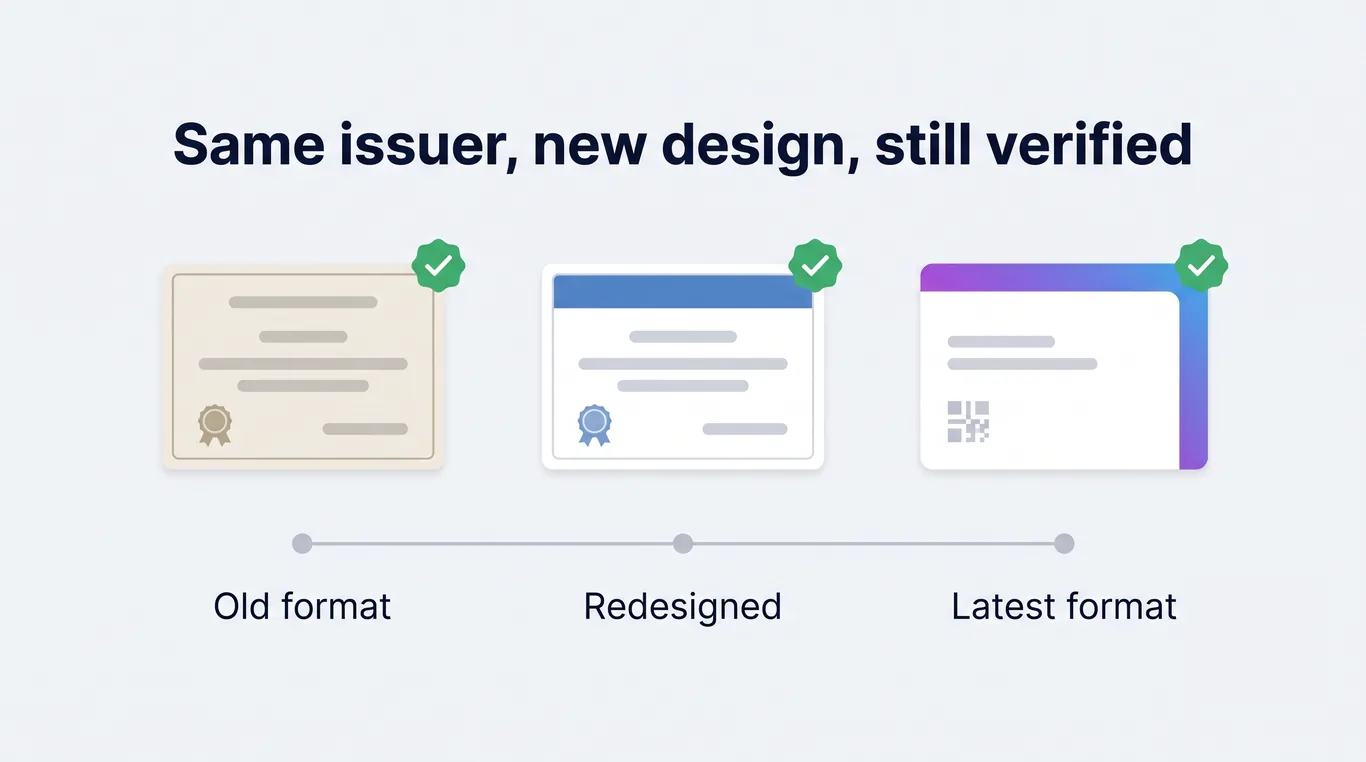
The same university certificate in three different designs across the years, each one screened and cleared
Issuers redesign certificates every few years. Screening should clear every genuine version.

When you evaluate any verification tool, ask one question: what happens the year an issuer changes its format?

Why Forensics Needs the Original File, Not a Photocopy

Forensic screening is built for the original file. A photocopy, a screenshot, a re-scan of a printout or a file re-saved through an editor is flagged "modified", even when nothing was faked.

This is the single most common surprise in a verification pilot. Tell candidates up front to upload the original digital file or a direct scan of the original document.

You can see the difference yourself: run an original PDF and a re-saved copy of it through our free document tampering checker.

Candidate instruction that saves a review queue: "Upload the original PDF you received, or a fresh scan of the original paper document. Do not upload a photocopy, a screenshot or a file you have edited, compressed or converted."

Why Forensics Misses the From-Scratch Fake

Forensics cannot tell you whether an issuer ever issued a document. A certificate typed fresh on a copied letterhead has no edit history to find.

This is not a hypothetical risk. In December 2025, Kerala Police seized more than one lakh fake certificates carrying the names of real universities, traced to a printing house.

Printed and scanned, such a certificate can look cleaner than a genuine one that was stapled, stamped and photocopied for years.

Generative AI adds a second route. A document generated in one pass was never edited after creation, so it may pass forensic screening too.

The honest conclusion: a clean forensic report means "not edited", never "genuine". Fake certificate detection that stops at forensics will miss this whole category.
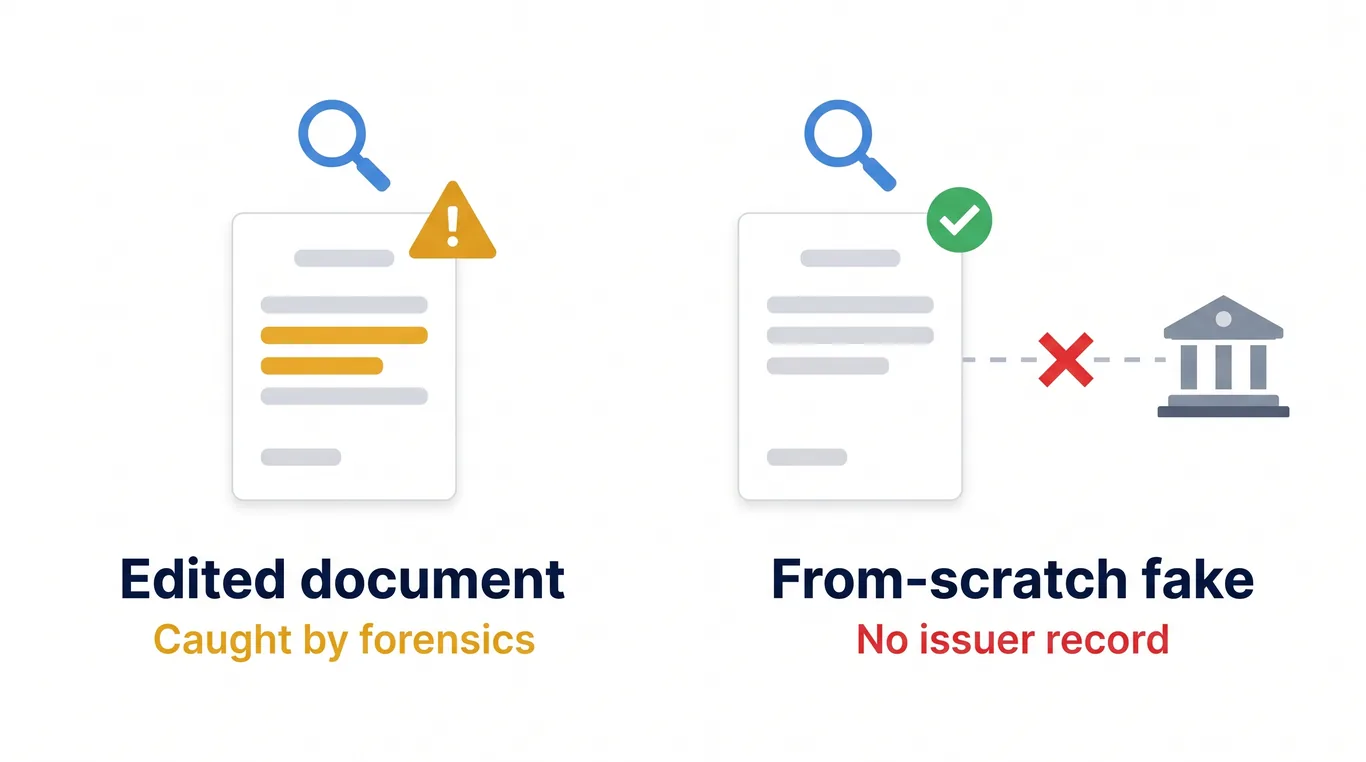
An edited genuine certificate caught by tamper screening, next to a from-scratch fake that passes screening but has no issuer record
Forensics catches the edited document. Only the issuer's record exposes the clean, from-scratch fake.

Forensics, source checks, one flow

Bring a real candidate file. We run all three checks live.

  • Tamper flags on every upload
  • DigiLocker and UAN, with consent
  • Cross-document mismatch checks
  • Pass, refer or fail per file
Book a Free Demo →

Or try a free tool first.

🔒 CERT-IN Certified🛡 ISO 27001🎟 Free trial tokens

What Source Verification Proves: Whether the Issuer Holds the Record

Source verification checks a claim against the issuer's own record, not against the uploaded file. If the record exists and matches, the document is backed by the body that issued it.

That makes it the only check that defeats a clean, from-scratch fake. The fake has no record behind it.

In India the main source channels are:

  • DigiLocker and the National Academic Depository: degrees and marksheets issued directly by participating universities and boards, pulled with the candidate's consent. See our DigiLocker document verification page.
  • UAN and EPFO records: employers, joining and exit dates from PF contributions, covered in our employment history verification API guide.
  • PAN, GSTIN and company registries: identity and business records confirmed against the issuing department.
  • Direct issuer confirmation: a letter or email from the university or employer, still the fallback for everything else.

DocuExprt connects to PAN, Aadhaar, GST and 30+ government database APIs, listed on our government verification API page.

Where Source Verification Runs Out: Coverage, Consent, Cost and Time

Source verification only works where a registry holds the record and the person consents to the check. Outside that, it has nothing to query.

The gaps show up quickly in real files:

  • Older records: many degrees issued before universities began uploading to DigiLocker and NAD are not there, and individuals cannot push their own old records in.
  • Private universities and small issuers: coverage varies widely by institution.
  • No API at all: hospitals, most private employers and local issuing offices publish no verification interface.
  • EPFO blind spots: contract roles, small establishments below the PF threshold and overseas jobs leave no passbook entry.
  • Consent friction: every check needs the person's informed consent, and requests sent by email are often ignored.
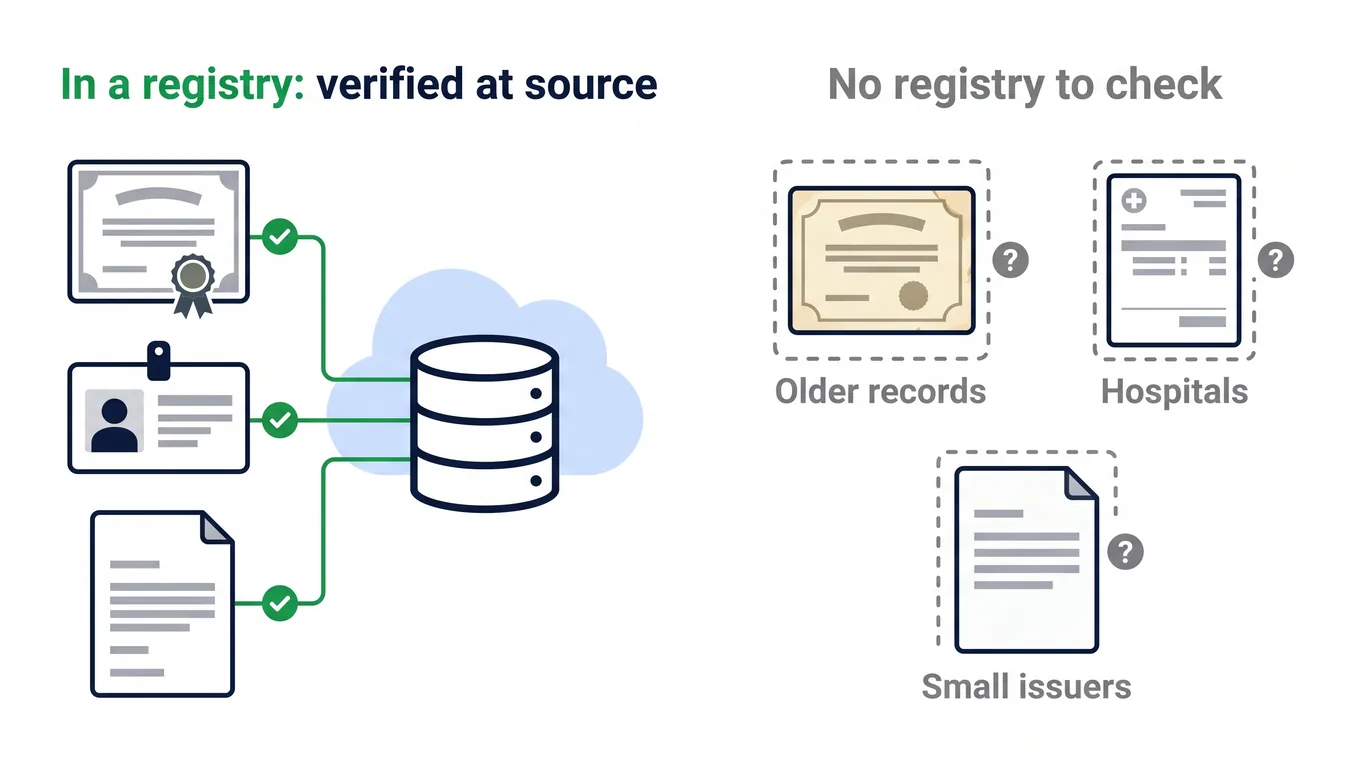
Documents connected to an official registry and verified, while older, hospital and small-issuer documents have no registry to query
Source checks only reach documents a registry holds. The rest need another route.

Where no registry exists, the fallback is the issuer letter. A background-verification firm told us university confirmations take 20 to 45 days, often carry a fee, and vary by institution.

Some of their clients still require that genuineness letter for compliance, whatever the automated result says.

Document Forensics vs Source Verification: Side-by-Side Comparison

The two checks answer different questions, so neither replaces the other. Forensics is fast and universal but cannot prove issuance; source verification proves issuance but only where a registry exists.

🔬 Document forensics

  • Proves: the file was or was not edited
  • Coverage: any document, any issuer
  • Speed: seconds per file
  • Misses: clean, from-scratch fakes
  • Consent: covers the file the person submitted
VS

🏛️ Source verification

  • Proves: the issuer holds a matching record
  • Coverage: only where a registry or API exists
  • Speed: real time by API; weeks by letter
  • Misses: anything outside the registry
  • Consent: explicit consent per check
FactorDocument forensicsSource verification
Question answeredWas this file altered?Did the issuer issue this?
Catches edited genuine documentsYesYes, if a field differs from the record
Catches from-scratch fakesOften notYes, where a record should exist
CoverageEvery document typeRegistries and APIs only
SpeedSecondsSeconds by API; 20-45 days by issuer letter
Cost profileLow, per documentPer API call; issuer fees for letters
Typical failure modeFalse flags on stamps and signatures"No record found" for genuine old documents
Evidence value in an auditShows the file was screenedShows the issuer confirmed it

Cross-Document Mismatch Checks: The Third Layer

Cross-document checks compare what several documents, and the applicant, say about the same fact. They catch lies that are internally clean in every single file.

A fabricated document still has to agree with everything else in the application. That is hard to fake consistently.

  • Declared vs documented marks: an admissions intermediary told us students' stated marks often differ from their marksheets.
  • Salary across three documents: offer letter, payslip and bank credit should reconcile. See our salary slip verification guide.
  • Employment dates: an experience letter's tenure against UAN joining and exit dates.
  • Identity fields: name, date of birth and father's name across ID, marksheet and certificate.
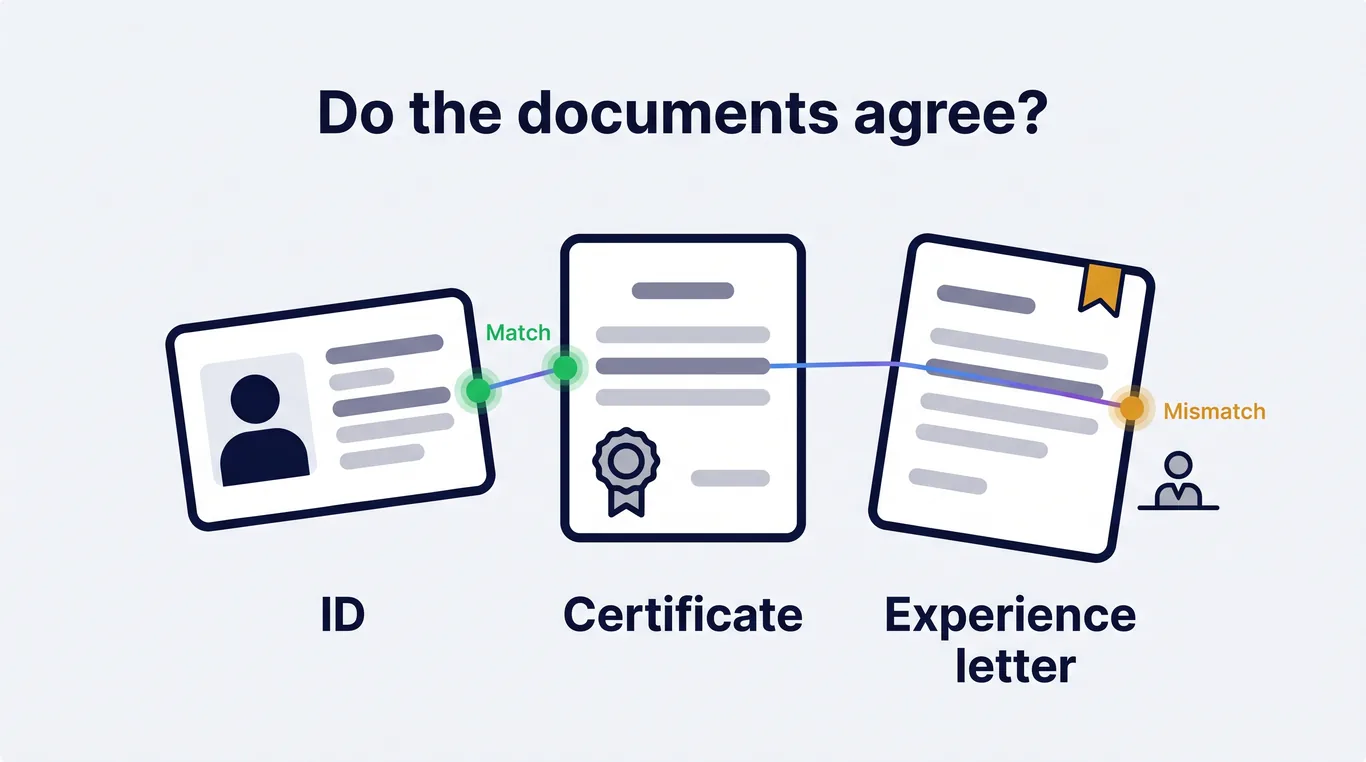
Three documents from one application linked together, with one fact that does not match flagged for review
Each file can look clean alone. Compared side by side, the mismatch shows.

A mismatch does not prove fraud. It tells the reviewer exactly which fact to confirm, which is faster than re-checking the whole file.

Shrink the issuer-letter queue

Tell us your document mix and monthly check volume.

  • Tamper screening on every file
  • PAN, Aadhaar, GST + 30+ govt DBs
  • Your own pass and refer thresholds
  • Audit logs for all actions
Talk to Our Team →

Or book a demo on your own files.

🔒 CERT-IN Certified🛡 ISO 27001🎟 Free trial tokens

Which Verification Check to Use for Each Document Type

Match the check to what exists behind the document. Use source verification wherever a registry covers it, and lean on forensics and cross-checks where none does.

DocumentForensicsSource checkCross-checkEscalate to issuer when
Degree / marksheetYesDigiLocker / NAD where coveredDeclared marks, name, DOBNot on DigiLocker, or flagged
Experience letterYesUAN / EPFO historyTenure vs UAN datesNo PF record, or dates conflict
PayslipYesForm 26AS or UAN, with consentOffer letter and bank creditFigures do not reconcile
PAN / Aadhaar / IDYesGovernment database or secure QRName and DOB across documentsRecord mismatch
Medical billYes, score-basedUsually none: hospitals rarely expose APIsPatient name, dates, amountsHigh risk score or large claim
Domicile / caste certificateYesDigiLocker where the state issues thereAddress across documentsNot on DigiLocker, or flagged

A crowdfunding platform we worked with could only use forensics on hospital bills. With no hospital API to query, a risk score decided which bills a person reviewed.

How a Layered Verification Workflow Shrinks the Issuer-Letter Queue

Run cheap, universal checks on every file first, and save slow issuer confirmation for the cases that fail or fall outside any registry. Automation speeds up first-level screening; it does not replace issuer confirmation where your clients require it.

Step 1Forensics + cross-check at intake
→
Step 2Source check where a registry exists
→
Step 3Pass, refer or fail
→
Step 4Issuer letter for referred files only

In DocuExprt this runs as one workflow that routes each file by its result, against pass and refer thresholds you set.

For a BGV firm, the gain is not skipping the university. It is sending the university only the files that need it, with the reason attached.

Positioning that holds up with compliance teams: automated checks are first-level screening. Where a client contract requires an issuer letter, the workflow still requests one, and the screening result travels with it.

Source checks are only as defensible as the channel they use and the consent behind them. Ask any provider where each record comes from, and keep the consent with the result.

A BGV firm serving multinational clients told us those clients ask one question first: is this UAN and ID data coming from an official channel, and is it legal to use?

It is the right question. Our HR document verification page states that PAN, Aadhaar and UAN checks run through official, authorised channels.

Government registries publish sanctioned integration routes too, such as DigiLocker's APIs on API Setu.

What the DPDP Act Means for Verification Consent

Under the Digital Personal Data Protection Act, 2023, verification data is personal data, so most checks rest on the person's informed consent for a stated purpose.

The DPDP Rules, 2025 were notified in November 2025 with an 18-month phased rollout. Most notice and consent obligations apply at the end of that window.

In practice that means four things for a verification workflow:

  • A notice naming each check you intend to run.
  • Consent tied to that purpose, not a blanket authorisation.
  • A consent channel people actually respond to. Email requests are often ignored; an OTP step is harder to miss.
  • An audit trail showing who verified what, when, and on what consent.

This is general information, not legal advice. Confirm your own obligations with counsel.

How to Tune Forensic Checks Without Flooding Reviewers

Treat a forensic flag as a reason to look, not a verdict. Tune the checks and thresholds to your document mix, and route anything above the threshold to a human reviewer.

Genuine documents trigger flags too. A recruitment client found that rubber stamps and wet signatures, added after printing, often read as "modified".

That is technically true. The stamp was added later. It is just not fraud.

Three settings keep the review queue useful:

  • Checks per document type: choose which checks apply to each document type, rather than reviewing noise.
  • Your own thresholds: a payslip and a medical bill need different pass and refer cut-offs.
  • A review queue with reasons: reviewers see why a file was flagged, then record a decision.

Every reviewer decision is also data. Over a few weeks it shows which flags are noise for your documents and which ones catch real edits.

Key Takeaways

  1. Forensics proves a file was not edited; it never proves a document is genuine.
  2. A from-scratch or AI-generated fake can pass every tamper check.
  3. Source verification proves issuance, but only where a registry holds the record.
  4. Older, private-university and hospital documents often have no registry to query.
  5. Cross-document checks catch lies that each file hides on its own.
  6. Screen every file fast, then send only flagged or uncovered files to the issuer.
  7. Choose screening that keeps working when issuers change their formats.
  8. Ask for the original file: photocopies and re-saved files are flagged as modified.

Frequently Asked Questions

What is the difference between document forensics and source verification?

Document forensics screens the file itself for signs that it was edited after it was issued. Source verification checks the claim against the issuer's own record, such as DigiLocker, UAN or a government database. Forensics shows whether a file was altered; source verification shows whether it was ever issued.

Can document forensics detect a completely fake certificate?

Not reliably. A certificate created from scratch or generated by AI has no edited region to find, so it can pass forensic checks. Catching it needs source verification or issuer confirmation, and cross-document checks often expose inconsistencies with the rest of the application.

What if a degree is not available on DigiLocker?

Many older degrees and some private-university records are not on DigiLocker or NAD. For these, run forensic and cross-document checks first, then request confirmation from the university for files that are flagged or that your client requires an issuer letter for.

Can document forensics verify a photocopy?

No. Forensic screening is designed for the original file. A photocopy, screenshot, re-scan or re-saved file is flagged as modified, even when the underlying document is genuine. Ask candidates to upload the original digital file or a direct scan of the original document.

Does automated verification replace university verification letters?

No. Automated forensics, cross-checks and registry lookups speed up first-level screening and reduce how many files need an issuer letter. Where a client or regulator requires a genuineness letter from the university, the letter is still needed.

Screen Fast, Confirm at Source

Forensics and source verification are not rivals. They answer different questions, and a fake that beats one rarely beats both.

Teams that layer them catch edited documents at intake, confirm what registries can confirm, and send the issuer only the files that truly need it.

Screen first, confirm at source

Bring a sample batch. We run it live on the demo.

  • 99% accuracy
  • CERT-IN certified, ISO 27001
  • Cloud, private cloud or on-premise
  • Role-based access and audit logs

Trusted by enterprises and government boards

Roche Products (India) Pvt. Ltd. logo
Elbrit Life Sciences Pvt. Ltd. logo
Haryana Knowledge Corporation Limited (HKCL) logo
Maharashtra Council of Agricultural Education and Research (MCAER) logo
State Board of Technical Education, Bihar (Patna) logo
SVKM's NMIMS Deemed-to-be University logo
CERT-IN CertifiedISO/IEC 27001:2013Data stays in India

Free trial tokens available for testing.

Aadhaar Masking Rules for Businesses: UIDAI and DPDP Act Compliance Guide

Aadhaar Masking Rules for Businesses: UIDAI and DPDP Act Compliance Guide

Open any onboarding folder in an Indian company and you will find Aadhaar cards. Full 12-digit numbers, front and back, sitting in shared drives and email threads.

For years that was treated as normal. Aadhaar masking rules said otherwise, but few teams read them.

That is changing fast. The DPDP Rules, 2025 name masking as a baseline security safeguard, and that obligation becomes enforceable on 13 May 2027.

UIDAI is also moving against the photocopy habit itself. It has approved a rule requiring private entities to register before they verify Aadhaar at all.

This guide explains what UIDAI and the DPDP Act actually require, where Aadhaar numbers hide in your files, and how to mask them at intake instead of cleaning up later.

Quick answer: what are the Aadhaar masking rules for businesses? Unless a law requires the full number, keep only the last 4 digits visible (XXXX XXXX 1234). UIDAI regulations bar publishing or displaying Aadhaar numbers and require any record made public to be redacted. The DPDP Rules, 2025 list masking among minimum security safeguards, with penalties up to ₹250 crore from May 2027.
⚖️
₹250 Cr
Max DPDP penalty for weak security safeguards
📅
13 May 2027
DPDP security and breach rules take effect
🔢
4 digits
All a masked Aadhaar shows
🏛️
₹1 Cr
Civil penalty ceiling under the Aadhaar Act

What Is Aadhaar Masking?

Aadhaar masking hides the first 8 digits of the 12-digit Aadhaar number and leaves only the last 4 visible. A masked number reads XXXX XXXX 1234.

UIDAI offers a masked Aadhaar download through myAadhaar. It stays valid for identity proof wherever the full number is not legally required.

Already have an unmasked card or PDF? Our Free Aadhaar Masking Tool masks it in your browser, and the file never leaves your device.

Masking is one of four techniques businesses confuse. They protect different things, and regulators use them for different purposes.

TechniqueWhat it doesTypical use
MaskingHides the first 8 digits, keeps the last 4Default for KYC copies, HR files, customer records
RedactionRemoves the number completely, often the whole fieldDocuments shared with third parties or published
TokenisationReplaces the number with a reference tokenSystems that must match records without seeing Aadhaar
Data vaultStores the full number encrypted, separate from other dataEntities legally allowed to keep the full number
Key point: A black rectangle drawn in a PDF editor is often not masking at all. If the text layer underneath survives, anyone can copy the full number out of the file.

What Do UIDAI Rules Require From Businesses?

UIDAI rules apply to any business that collects Aadhaar, not only banks and telecom firms. A hotel front desk and an HR team are covered too.

Three layers matter: the Aadhaar Act, UIDAI's regulations, and UIDAI circulars. The DPDP Act then sits on top of all three.

The Aadhaar Act, Section 29

Section 29(4) of the Aadhaar Act, 2016 bars publishing, displaying or posting an Aadhaar number publicly, except as regulations allow.

Since the 2019 amendment, UIDAI's adjudicating officer can levy civil penalties of up to ₹1 crore for violations.

The Sharing of Information Regulations, 2016

These regulations set the core duties for any business that is not a requesting entity. Regulation 5 says any entity collecting an Aadhaar number or a document containing it must:

🎯

Lawful purpose

Collect, store and use it only for a lawful purpose

📢

Tell the holder

Purpose, mandatory or not, and alternatives

✍️

Get consent

For collection, storage and use

🚫

No reuse

No other purpose or sharing without consent

Regulation 6 then adds the masking rule. No entity may make public any record containing Aadhaar numbers "unless the Aadhaar numbers have been redacted or blacked out through appropriate means, both in print and electronic form."

It also requires entities to keep any database of Aadhaar numbers secure and confidential. Read the full text in the UIDAI regulations.

The Aadhaar Data Vault

UIDAI's 2017 Data Vault circular requires entities permitted to store full Aadhaar numbers to keep them encrypted in a separate, access-controlled vault.

Every other system then works with a reference key, not the number. If you do not need a vault, you should not be keeping full numbers.

The 2025 Offline Verification Amendment

The Aadhaar (Authentication and Offline Verification) Amendment Regulations, 2025 created a formal registration framework for Offline Verification Seeking Entities (OVSEs).

In December 2025, UIDAI also approved a rule requiring hotels, event organisers and other private entities to register before verifying Aadhaar. The stated aim is to end the practice of collecting photocopies.

Registered entities are expected to use QR-based checks, API authentication or the new Aadhaar app instead of keeping copies.

A common myth: In May 2022 a UIDAI regional office told citizens to share only masked Aadhaar, and the government withdrew that advisory two days later. The withdrawal changed citizen guidance only. Regulations 5 and 6 still bind businesses.

Masking Aadhaar at onboarding volume?

Run a real KYC batch through DocuExprt on a call.

  • Bulk and API Aadhaar masking
  • UIDAI Secure QR decoding
  • DigiLocker pulls with consent
  • Tamper detection on every file
Book a Free Demo →

Or try a free tool first.

🔒 CERT-IN Certified🛡 ISO 27001🎟 Free trial tokens

What the DPDP Act Adds to Aadhaar Masking

An Aadhaar number is personal data under the Digital Personal Data Protection Act, 2023. So every DPDP duty applies on top of the UIDAI rules.

The DPDP Rules, 2025 were notified on 14 November 2025 with an 18-month runway. Most substantive duties, including security safeguards and breach notice, apply from 13 May 2027.

Rule 6 names masking directly

Rule 6 lists minimum security safeguards. The first is securing personal data "through its encryption, obfuscation or masking or the use of virtual tokens mapped to that personal data."

For Aadhaar, that turns masking from good practice into a named, auditable control.

Four more DPDP duties that touch Aadhaar files

  • Purpose limitation: process Aadhaar only for the purpose in your consent notice.
  • Data minimisation: if the last 4 digits answer the question, the full number is excess data.
  • Storage limitation: erase personal data once the purpose is served, unless a law requires retention.
  • Breach notice: report personal data breaches to the Data Protection Board and affected people.

❌ Unmasked intake

  • Breach scope: every leaked file exposes full Aadhaar numbers
  • Penalty exposure: up to ₹250 crore for weak safeguards
  • Erasure: copies in inboxes and drives you cannot find
  • Audit: no proof of who saw which number
VS

✅ Masked at intake

  • Breach scope: leaked files show 4 digits only
  • Penalty exposure: a documented Rule 6 safeguard
  • Erasure: one controlled store to delete from
  • Audit: logged access per user and action
QuestionUIDAI rulesDPDP Act and Rules
Who must complyAnyone collecting AadhaarEvery data fiduciary processing digital personal data
MaskingRedaction required before any record is made publicMasking listed as a minimum safeguard (Rule 6)
ConsentConsent for collection, storage and useItemised notice and specific consent
RetentionLawful purpose onlyErase when purpose is served
Maximum penalty₹1 crore civil penalty₹250 crore per breach category

Sector Rules: When You May Keep the Full Number

Masking is the default, but some laws do require the full number. The test is simple: can you name the law that makes you keep it?

Banks show how narrow the exception is. RBI's 2019 KYC amendment requires regulated entities to ensure customers who are not seeking DBT benefits redact or black out their Aadhaar number when submitting it as a KYC document.

So even in banking, the full number is the exception, tied to authentication under the Aadhaar Act.

Business scenarioWhat to keep
Bank or NBFC, Aadhaar used as an officially valid documentMasked copy plus verification result
Licensed AUA or KUA running authenticationFull number in an Aadhaar Data Vault only
Employer verifying a new hire's identityMasked copy, or verification result only
Employer seeding UAN where EPFO requires itFull number in the EPFO flow, masked everywhere else
Hotel, event or housing society check-inNothing beyond the QR or app verification outcome
Insurer, hospital or university admission fileMasked copy unless a specific law says otherwise
Rule of thumb: If you cannot point to the clause that needs the full number, keep the last 4 digits and the verification outcome, nothing more.

Where Aadhaar Numbers Hide in Your Files

Most masking failures are not policy failures. The policy says "mask Aadhaar", and the team masks the obvious number on the front of the card.

Our team uses the checklist below when reviewing onboarding files. Each item is a place where a full Aadhaar number survives a manual mask.

Two of these need a closer look.

QR codes. The current Secure QR is digitally signed and carries only the last 4 digits as part of a reference ID. Older Aadhaar prints used QR formats that could hold the full number in plain text, so masking the printed digits alone is not enough.

PDF text layers. e-Aadhaar and scanned files often carry machine-readable text. A mask must flatten the page so the hidden digits are removed from the file, not just covered.

How to Mask an Aadhaar Card Correctly: 4 Steps

For a single card, the process takes about a minute. The steps below close every gap shown above.

📤

Step 1: Upload both sides

Front, back or the full e-Aadhaar PDF

🔍

Step 2: Find every instance

Card, letter section and any older QR code

⬛

Step 3: Mask and flatten

Hide the first 8 digits, export as one image layer

🗑️

Step 4: Share and delete

Send the masked file, delete the original

Try it free: The Free Aadhaar Masking Tool runs steps 1 to 3 in your browser and exports a flattened PDF. Nothing is uploaded to a server.

How to Automate Aadhaar Masking at Intake

Manual masking works for one card. It breaks at onboarding volume, because every reviewer becomes a single point of failure.

The fix is to mask at the moment of intake, before a file reaches any shared drive or reviewer.

Verification and masking belong in one flow. You confirm the document is genuine first, then keep only what the purpose needs.

Verification-first platforms make this a pipeline step rather than a person with a cropping tool. DocuExprt decodes the UIDAI Secure QR on Aadhaar, pulls issued documents from DigiLocker with the holder's consent, and runs tamper detection on every file.

For masking itself, the DocuExprt Aadhaar masking tool blacks out the first 8 digits and exports a flattened PDF. Teams running KYC at volume use bulk masking or API access inside their onboarding workflow.

Around that, the controls auditors ask about come built in: role-based access control, audit logs with IP monitoring, encryption in transit and at rest, and an option for immediate deletion after processing.

🔍

Secure QR decoding

Checks the UIDAI-signed QR on Aadhaar

⬛

Bulk masking

Batch and API masking for KYC flows

🔐

Access control

Role-based access and audit logs

🗑️

No retention option

Immediate deletion after processing

For regulated teams: DocuExprt runs as SaaS, private cloud or on-premise, so Aadhaar data can stay inside your own network perimeter. See the enterprise verification guide for deployment details.

Make masking a step, not a chore

Tell us your onboarding volume and document mix.

  • Verify first, then mask
  • Role-based access and audit logs
  • Immediate deletion option
  • SaaS, private cloud or on-prem
Talk to Our Team →

Or book a demo on your own files.

🔒 CERT-IN Certified🛡 ISO 27001🎟 Free trial tokens

Aadhaar Masking Compliance Checklist

Use this list to test your current process before May 2027. Each item maps to a UIDAI regulation or a DPDP duty.

  • ✅ Every form that asks for Aadhaar states the purpose and offers an alternative ID.
  • ✅ Consent covers collection, storage and use, and is recorded.
  • ✅ You can name the law for every system that keeps the full number.
  • ✅ Full numbers, where allowed, sit in an encrypted vault, not in shared drives.
  • ✅ Masking covers the card back, e-Aadhaar letter and QR code, not just the front.
  • ✅ Masked PDFs are flattened so no text layer survives.
  • ✅ Original unmasked uploads are deleted after verification.
  • ✅ Reports, exports and dashboards show only the last 4 digits.
  • ✅ Access to Aadhaar records is role-based and logged.
  • ✅ Your breach response plan covers Aadhaar files and DPDP notice timelines.
Start here: Search your shared drives for files named "aadhaar". The count usually ends the debate about whether intake automation is needed.

Key Takeaways

  1. A masked Aadhaar shows only the last 4 digits: XXXX XXXX 1234.
  2. UIDAI's Regulation 5 requires a lawful purpose, notice and consent before you collect Aadhaar.
  3. Regulation 6 bars publishing Aadhaar numbers unless redacted, in print and electronic form.
  4. DPDP Rule 6 names masking as a minimum security safeguard from 13 May 2027.
  5. Weak safeguards can draw DPDP penalties of up to ₹250 crore.
  6. Keep the full number only where a named law requires it, and then only in a vault.
  7. Manual masking misses the card back, e-Aadhaar letters, older QR codes and PDF text layers.
  8. Masking at intake, after verification, is the only approach that scales.

Frequently Asked Questions

Is Aadhaar masking mandatory for businesses?

UIDAI regulations require Aadhaar numbers to be redacted before any record is made public and require entities to keep stored numbers secure and confidential. The DPDP Rules, 2025 add masking as a listed minimum safeguard from 13 May 2027. In practice, masking is mandatory wherever the full number is not legally required.

Can a company store a copy of an employee's Aadhaar card?

Only for a lawful purpose, after telling the employee why and getting consent, under UIDAI's Sharing of Information Regulations. A masked copy or a verification result is usually enough. The full number should sit only in flows that legally require it, such as EPFO UAN seeding.

Is a masked Aadhaar valid for KYC?

Yes, where the full number is not required for authentication. RBI's KYC rules require banks to ensure customers who are not seeking DBT benefits redact their Aadhaar number when submitting it as a KYC document. Verification can then rely on the Secure QR, DigiLocker or offline e-KYC.

What is the penalty for not masking Aadhaar?

Under the Aadhaar Act, UIDAI's adjudicating officer can impose civil penalties of up to ₹1 crore. Under the DPDP Act, failing to take reasonable security safeguards can draw up to ₹250 crore, and failing to report a breach up to ₹200 crore.

Does masking the printed number make an Aadhaar copy safe?

Not always. The number is printed on both sides of the card and more than once on e-Aadhaar, older QR codes can encode it, and PDFs can keep it in a hidden text layer. A safe mask covers every instance and flattens the file.

Do hotels need to register with UIDAI to verify Aadhaar?

UIDAI approved a rule in December 2025 requiring hotels, event organisers and other private entities to register before carrying out Aadhaar verification. Registered entities are expected to use QR-based checks, API authentication or the Aadhaar app instead of collecting photocopies.

Mask First, Then Keep Only What You Need

Aadhaar masking used to be a privacy courtesy. Under UIDAI's regulations and the DPDP Rules, it is now a control you will be asked to prove.

The deadline is fixed: 13 May 2027. The teams that move first will mask at intake, verify at source and delete the rest.

That is the same approach behind deployments such as SBTE Bihar, where 50,000+ documents were verified within a couple of days.

Get DPDP-ready before May 2027

Bring a sample batch. We run it live on the demo.

  • 50,000+ documents in days
  • 99% accuracy
  • PAN, Aadhaar, GST + 30+ govt DBs
  • CERT-IN certified security

Trusted by enterprises and government boards

Roche Products (India) Pvt. Ltd. logo
Elbrit Life Sciences Pvt. Ltd. logo
Haryana Knowledge Corporation Limited (HKCL) logo
Maharashtra Council of Agricultural Education and Research (MCAER) logo
State Board of Technical Education, Bihar (Patna) logo
SVKM's NMIMS Deemed-to-be University logo
CERT-IN CertifiedISO/IEC 27001:2013Data stays in India

Free trial tokens available for testing.

Mask a card now with the Free Aadhaar Masking Tool. Related reading: document verification for BFSI, background verification, insurance document verification and our free verification tools.

Salary Slip Verification: How to Cross-Check Payslips, Offer Letters and Bank Statements

Salary Slip Verification: How to Cross-Check Payslips, Offer Letters and Bank Statements

A candidate asks for a 40% hike on a current salary of ₹18 lakh a year, and salary slip verification looks like a formality.

The offer letter says ₹18 lakh. The last three payslips agree. Nothing looks wrong.

Then someone opens the bank statement. The monthly salary credit is about ₹1.05 lakh, not the ₹1.3 lakh the payslips show.

Each document passed review on its own. Only side by side did they disagree.

This guide shows how to cross-check the three documents behind every salary claim, what an edited payslip or bank statement looks like, and how to run the check at hiring volume.

Quick answer: how do you verify a salary slip? Reconcile it with the offer letter and the bank statement: net pay on the slip should match the salary credit, and gross minus deductions should equal net. Run tampering checks on each file, then confirm disputed figures through Form 26AS and UAN history with the candidate's consent.
📄

Offer letter

Declared CTC and employer

🧾

Payslips

Monthly gross, deductions, net pay

🏦

Bank statement

What was actually credited

🏛️

Source records

Form 26AS and UAN history

Why Salary Claims Slip Through Review

Salary verification usually means one reviewer looking at one document at a time.

A payslip is checked for a logo and a signature. A bank statement is checked for the right bank name. Nobody compares the numbers across them.

That gap matters because current salary anchors the offer. An inflated base inflates every hike negotiated on top of it.

The edit itself is easy. A PDF editor can change one figure on a payslip in a minute, and the result looks identical on screen.

Volume is also rising. Since the Code on Wages, 2019 came into force on 21 November 2025, employers must issue a wage slip to every employee, so more candidates arrive with payslips to show.

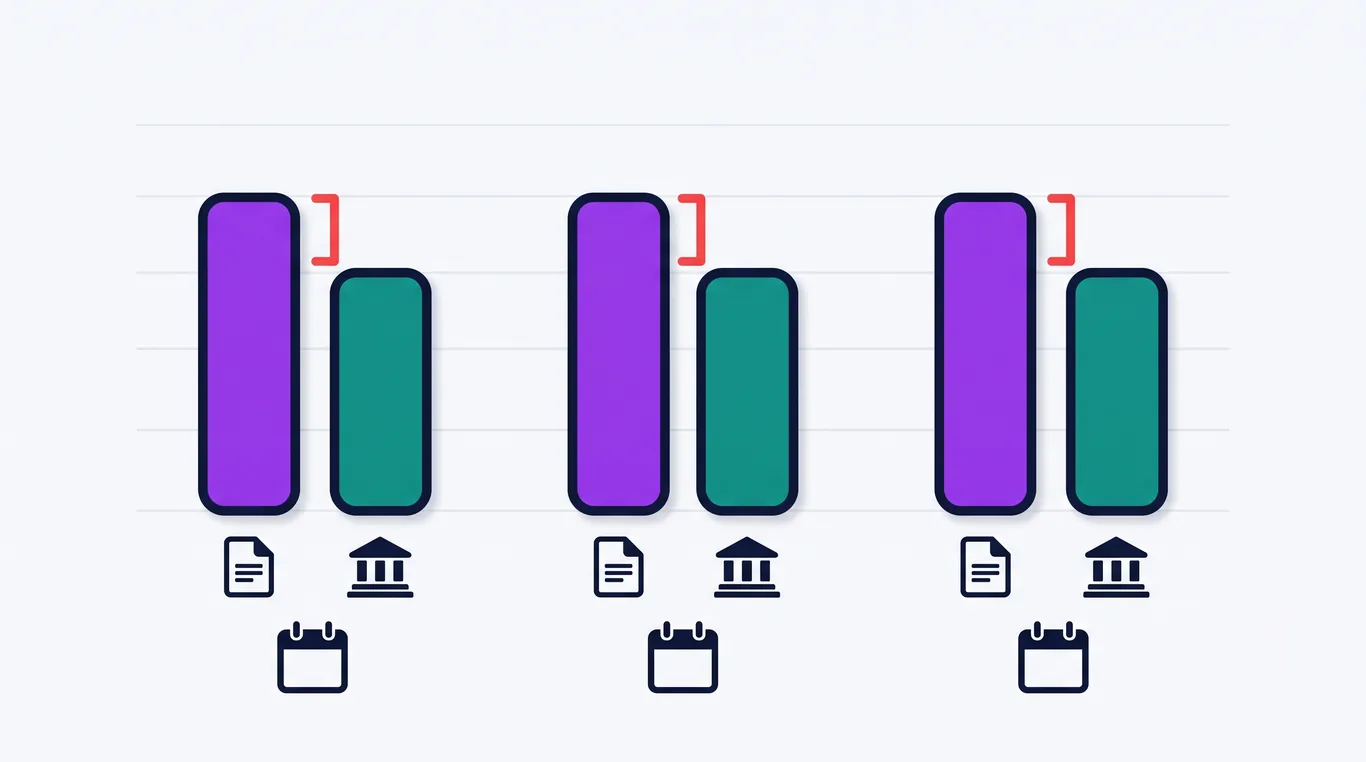
Paired bar chart showing salary slip net pay higher than the actual bank credit in each of three months
The inflated slip looks fine alone. Side by side with the bank credit, the gap repeats every month.

Verifying salaries at hiring volume?

Run your real candidate files through DocuExprt on a call.

  • Offer, payslip, bank cross-check
  • Tamper flags on every file
  • Verdict and risk score per document
  • Results to your ATS via API
Book a Free Demo →

Or try a free tool first.

🔒 CERT-IN Certified🛡 ISO 27001🎟 Free trial tokens

How Do You Verify a Salary Slip? The Three-Document Cross-Check

You verify a salary slip by reconciling it with two other documents. Each answers a different question, and each one checks the others.

  • The offer letter says what the employer promised.
  • The payslips say what the employer paid, before and after deductions.
  • The bank statement says what actually reached the candidate's account.

What to compare, field by field

FieldCompareWhat a normal gap looks like
Employer nameOffer letter, payslip header, bank credit narrationAbbreviations in the bank narration are normal
Monthly grossPayslip gross against CTC ÷ 12Gross sits below CTC ÷ 12, because CTC includes employer PF, gratuity and variable pay
Net payPayslip net against the salary creditShould match closely, month by month
Pay datePayslip period against credit dateA few days either side of month end
ArithmeticGross minus deductions against net payShould add up exactly
DeductionsPF, professional tax and TDS against salary levelPF is normally 12% of basic, often on a capped wage
Employer TANTAN on the salary slip against the deductor in Form 26ASShould be the same employer
UANUAN printed on the payslip against UAN recordsShould belong to the candidate and list this employer
CTC is not monthly pay. Flag the net-pay-to-credit gap, not the CTC-to-gross gap. Set a tolerance for the second, or every honest candidate gets flagged.
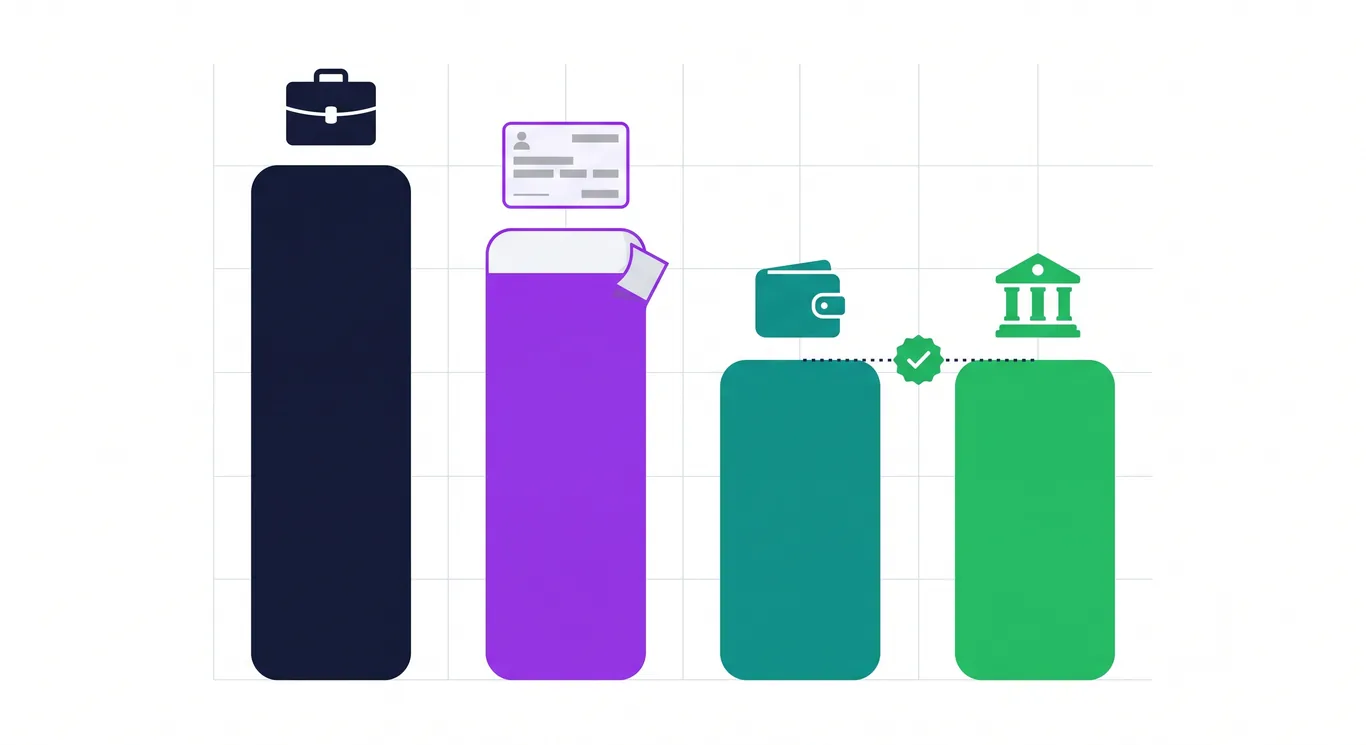
Bar chart of salary from CTC to gross to net pay, where net pay should equal the bank salary credit
CTC > gross > net is normal. Net pay and the bank credit should match.

Is a Salary Slip the Same as a Bank Statement?

No. A salary slip comes from the employer and shows what it paid: gross pay, deductions and net pay. A bank statement comes from the bank and shows what actually reached the account.

That is why HR teams and lenders ask for both. Net pay on the slip should match the salary credit on the statement every month. When they disagree, one of the two documents is wrong.

Salary slipBank statement
Issued byEmployer or payroll systemThe candidate's bank
ShowsGross pay, PF, tax and net paySalary credits, dates and narration
ProvesWhat the employer says it paidWhat was actually received

Can HR Verify a Fake Bank Statement?

Yes, but not by looking at the PDF. With the candidate's consent, get the statement from the source: directly from the bank, or through the RBI Account Aggregator framework.

A statement sent as a PDF can be edited like any other file. To screen a payslip first, try the free fake salary slip verifier.

How Can You Tell If a Salary Slip Is Fake?

Salary fraud often is not a forged document built from scratch. It is a real document with one number changed.

Automated tamper screening flags it, even when the page looks perfect.

❌ Signs of an edit

  • Figures: net or gross pay changed on an otherwise genuine slip
  • File: changed after it left the payroll or bank system
  • Cross-check: net pay does not match the bank credit
  • Branding: elements added after the document was issued
  • Balances: a bank running balance that no longer adds up
VS

✅ Signs of a clean file

  • Figures: agree with the offer letter and bank credit
  • File: unchanged since the issuing system produced it
  • Cross-check: net pay matches the bank credit every month
  • Branding: nothing added after issue
  • Balances: every line reconciles to the next

A clean file is not proof on its own, though. A document built from scratch can pass tamper screening.

You can test a sample file with the free PDF forensics viewer or the free document tampering checker.

Catch the edited figure in seconds

Tell us your hiring volume and document mix.

  • Configurable forensic checks
  • Form 26AS and UAN with consent
  • Only mismatches reach reviewers
  • Role-based access and audit logs
Talk to Our Team →

Or book a demo on your own files.

🔒 CERT-IN Certified🛡 ISO 27001🎟 Free trial tokens

Where Source Records Settle the Question

When the documents disagree, or look too clean to trust, go to records the candidate did not produce.

  • Form 26AS or the Annual Information Statement (AIS) lists the salary each employer paid and the tax it deducted, reported by the employer to the Income Tax department. It is the closest independent check on annual pay.
  • UAN employment history confirms the employer and the dates of joining and exit. It does not confirm salary, but it catches a payslip from an employer the candidate never worked for.
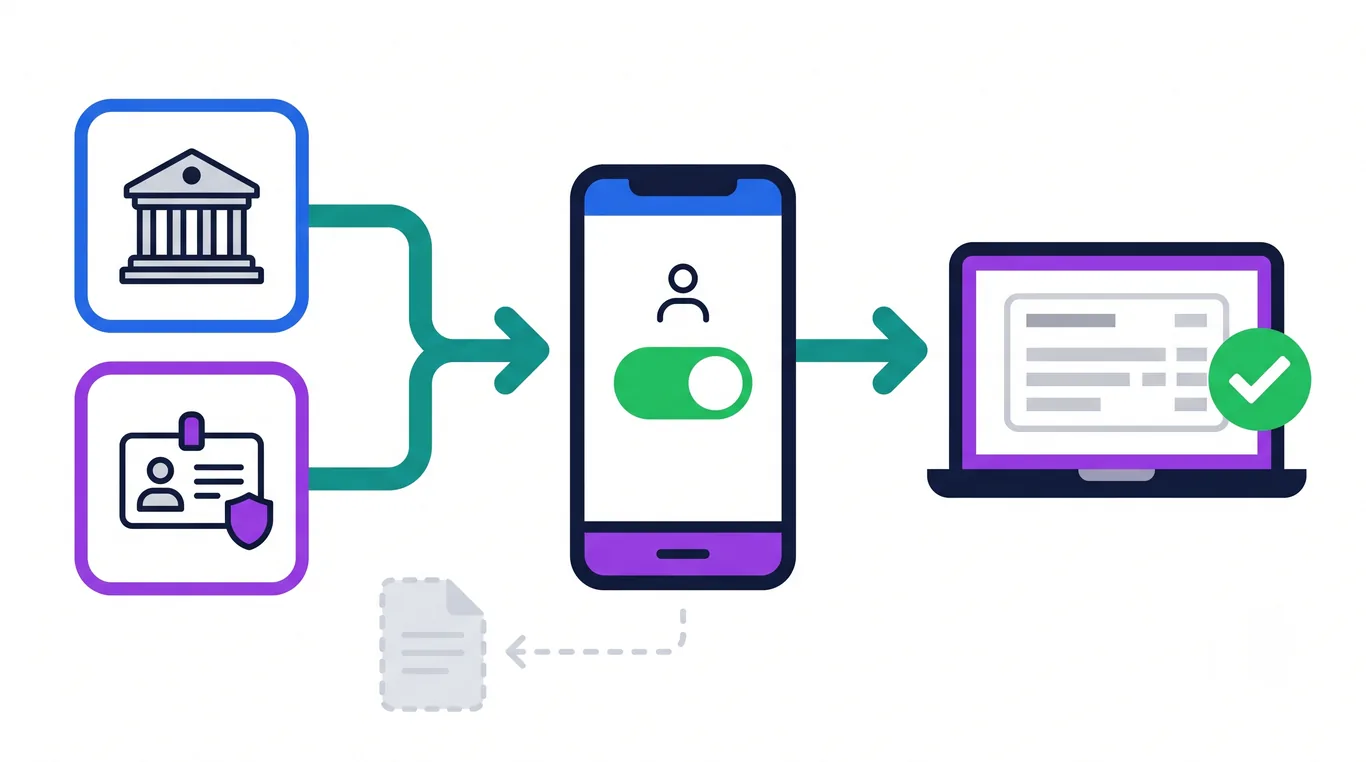
Tax and PF source records flowing through a candidate consent toggle to a verified salary check
Form 26AS confirms salary paid. UAN history confirms the employer. Both need the candidate's consent.

Both checks need the candidate's informed consent. Our guide to employment history verification through UAN covers the consent and data-source questions in detail.

Use documents to find the question, and source records to answer it. Cross-checking documents shows where the story breaks. Source records show which version is true.

Who Needs Salary Verification

The same three documents show up wherever income has to be proven. The stakes differ by team.

🏢 Enterprise hiring teams

Current salary sets the offer for lateral and senior hires. One inflated figure raises the cost of the hire for as long as the employee stays.

🤝 Background verification providers

Some clients now ask for salary checks alongside employment and education checks. Providers need them at volume, through an API, with an evidence trail per case.

🏦 Lenders and NBFCs

Payslips and bank statements are standard income proof for personal loans. An edited salary figure changes the loan amount a borrower qualifies for.

Our guide to document verification for BFSI covers the lending side in more depth.

Running Salary Verification at Hiring Volume

Doing this by hand takes a reviewer several documents and a calculator per candidate. At hundreds of hires a month, the check quietly gets skipped.

Automation turns it into a pipeline where reviewers only see the cases that break.

Step 1Collect with consent
→
Step 2Extract salary fields
→
Step 3Reconcile + forensics
→
Step 4Review only mismatches
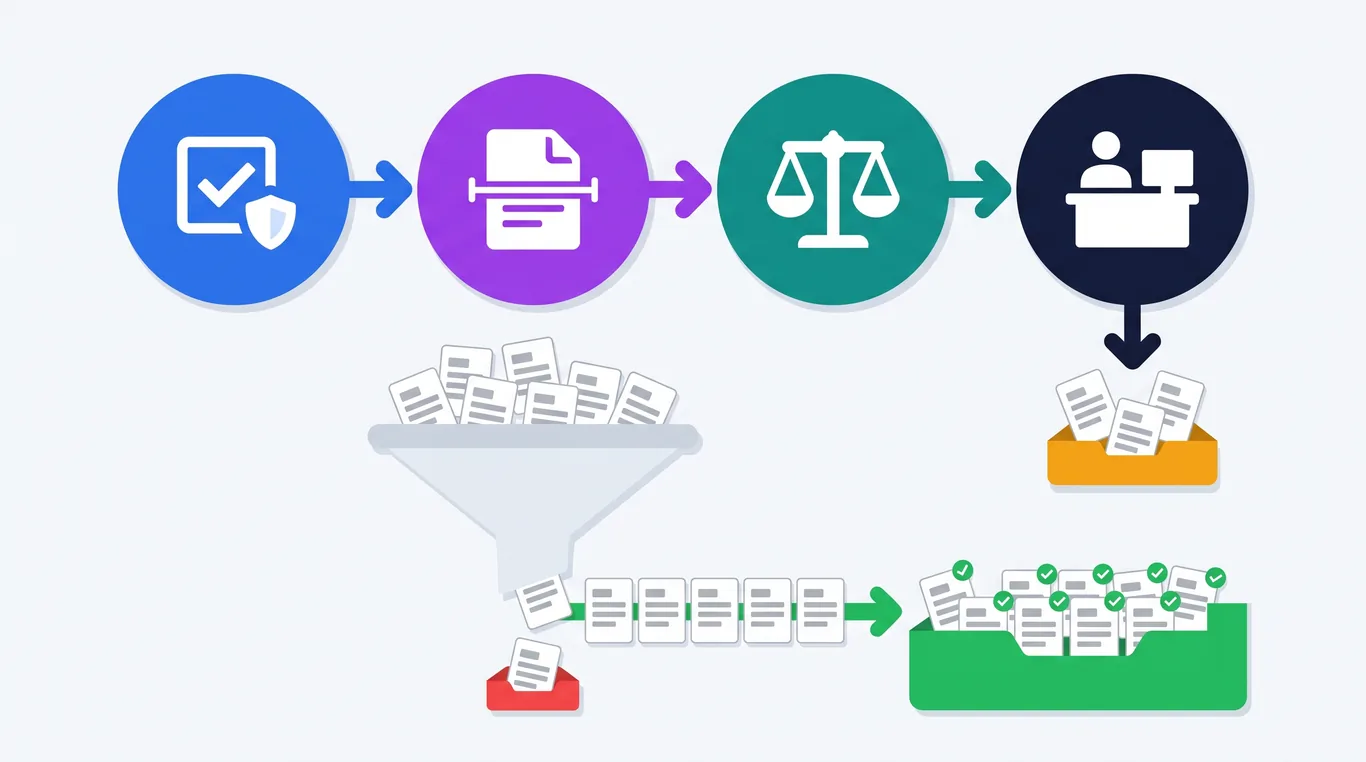
Four-step salary verification workflow: consent, extraction, reconciliation and a review queue for mismatches only
Consent, extract, reconcile, review. Reviewers only see the mismatches.

DocuExprt runs this as one workflow. It extracts the salary fields from the offer letter, payslips and bank statement, cross-verifies the amounts, and runs forensic checks on each file.

Each document gets a verdict and a risk score. Your team chooses which forensic checks apply and which flags go to manual review, and results return to your ATS as JSON through the API.

The same workflow can add Form 26AS and UAN checks where the candidate has consented. See how it fits into background verification automation and HR document verification.

Guardrails for a Fair Check

Salary verification touches sensitive financial data. A few rules keep it fair and defensible:

  • ✅ Take specific consent before collecting bank statements or running source checks.
  • ✅ Ask only for the months you need, usually the last three.
  • ✅ Treat a flag as a question for the candidate, not an automatic rejection.
  • ✅ Set tolerances for rounding, arrears and one-off payments.
  • ✅ Keep the evidence behind each decision, and delete what you no longer need.
Arrears, bonuses and mid-month joins cause honest mismatches. A reviewer who asks one question usually resolves them in minutes.

Key Takeaways

  1. Salary claims slip through because each document is reviewed alone.
  2. Cross-check three documents: offer letter, payslips and bank statement.
  3. Match net pay to the salary credit; do not expect gross to equal CTC ÷ 12.
  4. Payslip arithmetic should add up exactly, every month.
  5. Tamper screening and balances that do not add up expose edited files.
  6. A clean file is not proof; a document built from scratch can pass forensics.
  7. Form 26AS and UAN history settle disputes, with the candidate's consent.
  8. Automate the reconciliation so reviewers only see the mismatches.

Frequently Asked Questions

How do you verify a candidate's salary slip?

Cross-check the offer letter, recent payslips and the bank statement showing salary credits, and run tampering checks on each file. Where the documents disagree, confirm annual pay through Form 26AS and the employer through UAN history, with the candidate's consent.

How can you tell if a salary slip is fake?

Check whether gross minus deductions equals net pay, whether net pay matches the bank credit, and whether the PF and tax deductions fit the salary. Then run the file through tamper screening, which flags figures changed after the slip was issued.

Is a salary slip the same as a bank statement?

No. A salary slip is issued by the employer and shows gross pay, deductions and net pay. A bank statement is issued by the bank and shows the salary actually credited. Verifiers compare the two: net pay on the slip should match the monthly salary credit.

Why is payslip gross salary lower than CTC divided by 12?

CTC includes costs the employee does not receive monthly, such as the employer's PF contribution, gratuity and variable pay. A gap between CTC and monthly gross is normal; a gap between payslip net pay and the salary credited to the bank is not.

Can Form 26AS be used for salary verification?

Yes. Form 26AS shows the amount each employer paid and the tax deducted, as reported by the employer to the Income Tax department. It confirms annual pay independently of the candidate's documents, and should only be checked with the candidate's consent.

Can salary verification be automated?

Yes. An AI document verification workflow can extract salary fields from all three documents, reconcile them, run forensic checks and send only mismatches to a reviewer. DocuExprt returns a verdict and risk score per document to your ATS through the API.

What APIs are used for income and employment verification?

In India the main consent-based sources are Form 26AS or AIS for salary paid and tax deducted, UAN (EPFO) history for employers and dates, PAN verification for identity, and bank statements, shared directly or through the Account Aggregator framework, for salary credits. Document checks on offer letters and salary slips fill the gaps.

Salary Verification Is a Reconciliation Problem

An inflated salary rarely hides in one document. It hides in the gap between three.

Teams that reconcile the offer letter, payslips and bank statement, and confirm disputes at source, catch the edit before it becomes the base for an offer.

Stop inflated salaries at intake

Bring a sample batch. We run it live on the demo.

  • 3.5 lakh+ documents verified
  • 99%+ verification accuracy
  • PAN, Aadhaar, GST + 30+ govt DBs
  • Only exceptions reach your team

Trusted by enterprises and government boards

Roche Products (India) Pvt. Ltd. logo
Elbrit Life Sciences Pvt. Ltd. logo
Haryana Knowledge Corporation Limited (HKCL) logo
Maharashtra Council of Agricultural Education and Research (MCAER) logo
State Board of Technical Education, Bihar (Patna) logo
SVKM's NMIMS Deemed-to-be University logo
CERT-IN CertifiedISO/IEC 27001:2013Data stays in India

Free trial tokens available for testing.

How Bank Account Verification APIs Work

Bank account verification APIs connect your financial systems directly to banking infrastructure, validating account details in real time. There are two primary methods:

Penny Drop Verification

A small amount (typically ₹1) is deposited into the bank account. The banking system returns the account holder's name as registered with the bank. This provides the most authoritative name confirmation because it comes from the actual bank record.

Advantages:

  • Returns the exact account holder name from bank records
  • Confirms the account is active and can receive funds
  • Validates IFSC routing
  • Highest confidence level

Considerations:

  • Takes 5-30 seconds for the penny to process
  • The ₹1 deposit needs to be accounted for
  • Some banks have different response times

Pennyless / Database Verification

Validates account details against banking databases without transferring any money. Faster than penny drop but may not always return the full account holder name.

Advantages:

  • Near-instant response (under 2 seconds)
  • No money transfer involved
  • Higher throughput for bulk verification

Considerations:

  • Name matching may be less comprehensive than penny drop
  • Depends on database coverage

Penny Drop vs. Pennyless Comparison

Penny Drop Verification

  • Response time: 5-30 seconds
  • Name returned: Full name from bank records
  • Activity confirmation: Confirms account is active
  • Cost: Higher (transaction involved)
  • Best for: High-value payments, insurance claims
  • Confidence: Highest — physically tests the account
VS

Pennyless / Database Verification

  • Response time: 1-3 seconds
  • Name returned: Partial or full name (varies)
  • Activity confirmation: Confirms account exists
  • Cost: Lower (no transaction)
  • Best for: Bulk onboarding, quick checks
  • Confidence: Good — database lookup only
Parameter Penny Drop Pennyless
Response time 5-30 seconds 1-3 seconds
Account name returned Full name from bank records Partial or full name (varies)
Account activity confirmation Confirms account is active Confirms account exists
Cost Higher (transaction involved) Lower (no transaction)
Best for High-value payments, claims Bulk onboarding, quick checks

DocuExprt's Banking Verification APIs

DocuExprt provides four banking verification endpoints that cover account validation, routing verification, UPI identity checks, and statement analysis.

1. Bank Account Verification API

Validates account holder name, account status (Active/Inactive/Closed), account type (Savings/Current/NRE/NRO), IFSC validation, and name match confidence score. Uses penny drop via IMPS/NEFT.

2. IFSC Verification API

Validates bank name, branch, MICR code, full branch address, RTGS/NEFT/IMPS availability, and contact info. Catches routing errors from bank mergers and branch closures before they cause failed payments.

3. UPI Verification API

Accepts a UPI ID (Virtual Payment Address) and returns linked account holder name, verification status (Valid/Invalid), and bank handle identification. Essential for P2M and enterprise UPI payments.

4. Bank Statement Analysis API

AI-powered extraction from any bank's PDF statements in 20+ languages. Returns structured transactions, income analysis, EMI detection, spending patterns, and cash flow analysis for loan underwriting.

1. Bank Account Verification API

The core endpoint for beneficiary validation.

Input: Account Number + IFSC Code
Returns:

  • Account holder name (as registered with the bank)
  • Account status: Active / Inactive / Closed
  • Account type: Savings / Current / NRE / NRO
  • IFSC validation and bank details
  • Name match confidence score when cross-referenced with expected beneficiary name

How it works: DocuExprt performs a penny drop verification, depositing ₹1 into the account via IMPS/NEFT. The banking system processes the transaction and returns the registered account holder name. DocuExprt then runs a name matching algorithm to compare the returned name against the expected beneficiary name from your records.

Use cases:

  • Vendor payments: Verify every vendor bank account before first payment and periodically thereafter
  • Payroll disbursement: Validate employee bank accounts during onboarding, catch errors before salary day
  • Insurance claims: Confirm the claimant's bank account matches the policyholder's identity
  • Loan disbursement: Verify the borrower's account before releasing funds

2. IFSC Verification API

Validate payment routing information before initiating transfers.

Input: IFSC Code
Returns:

  • Bank name and branch name
  • MICR code
  • Full branch address
  • RTGS / NEFT / IMPS availability
  • Branch contact information

Use case: Before processing bulk payments, validate that every IFSC code in your payment file is correct and current. Bank mergers, branch closures, and IFSC changes happen regularly — an outdated IFSC means bounced payments, delays, and reconciliation headaches. This API catches routing errors before they become failed transactions.

3. UPI Verification API

Verify UPI ID ownership in India's dominant payment ecosystem.

Input: UPI ID (Virtual Payment Address — e.g., name@bankhandle)
Returns:

  • Linked account holder name
  • Verification status (Valid / Invalid)
  • Bank handle identification

Use case: With UPI processing 228.3 billion transactions in 2025 and P2M (person-to-merchant) transactions at 63% of volume, UPI IDs are increasingly used for business payments. Before sending funds to a UPI ID — whether for freelancer payments, small vendor settlements, or refunds — verify that the UPI ID belongs to the expected recipient. This prevents payment fraud where attackers substitute their UPI ID for the intended beneficiary's.

4. Bank Statement Analysis API

AI-powered extraction and analysis of bank statements for financial due diligence.

Input: Bank statement PDF (any bank, any format)
Returns:

  • Structured transaction data (date, description, debit, credit, balance)
  • Income analysis (regular salary credits, business income patterns)
  • Spending pattern categorization
  • EMI detection and loan obligation identification
  • Account summary (average balance, peak balance, lowest balance)
  • Cash flow analysis

Use case: Critical for loan underwriting and credit assessment. DocuExprt's AI extracts structured data from bank statements in any format — PDF, scanned image, or even photographed statements in 20+ languages. The extracted data feeds directly into credit models, replacing the manual process of reading through months of bank statements page by page.

See a Payment Check Run Live

One beneficiary, upload to verified payout.

  • Wrong accounts caught pre-payment
  • Bulk vendor onboarding checks
  • Only mismatches reach your team
  • Plugs into your existing ERP
Talk to Our Team →

Or book a demo on your own files.

🔒 CERT-IN Certified🛡 ISO 27001🎟 Free trial tokens

Building a Payment Verification Workflow

DocuExprt's visual workflow builder lets you create an automated payment verification pipeline that checks every outgoing payment before it clears.

Payment Verification Workflow Architecture

Step 1
Input Node
Invoice PDF, Payment file, API trigger, Manual entry
→
Step 2
AI Extraction
Extract bank info from documents (20+ languages)
→
Step 3
API Verification
Bank Account + IFSC + UPI verification
→
Step 4
Conditional Logic
Name match, status check, duplicate detection
→
Step 5
Output & Alerts
Approved, flagged, audit trail, email alerts

Step-by-Step Setup

Step 1: Configure Input Node

Set up the Input node to capture bank details from multiple sources:

  • Invoice upload: DocuExprt's AI automatically extracts bank account number, IFSC code, and beneficiary name from invoice PDFs — even handwritten or scanned invoices in regional languages
  • Payment file upload: Process bulk payment files (CSV/Excel) containing hundreds of beneficiary records
  • API trigger: Receive payment verification requests from your ERP or treasury management system
  • Manual entry: Web form for one-off verification requests from finance team members

Step 2: Configure Processing Nodes

Three parallel processing nodes handle the verification:

  1. AI Document Extraction — If input is an invoice or document, DocuExprt extracts the bank account number, IFSC code, beneficiary name, and payment amount automatically. Works with 20+ languages.
  2. Bank Account Verification API — Performs penny drop verification on the extracted account details. Returns account holder name and status.
  3. IFSC Verification API — Validates that the IFSC code is correct, current, and maps to the expected bank and branch.

Step 3: Configure Conditional Logic

The Conditional node applies three layers of verification:

  • Name Match Check: Compare the beneficiary name from the invoice/payment file against the account holder name returned by the bank. Match threshold: ≥90% = auto-approve, 70-89% = manual review, <70% = reject.
  • Account Status Check: If the account is inactive, closed, or unresponsive, auto-reject regardless of name match.
  • Duplicate Payment Check: Flag if the same beneficiary + amount combination was processed within the last 30 days — catches duplicate invoice fraud.

Step 4: Configure Output and Alerts

  • Approved payments: Push verified payment batch back to your ERP/treasury system for execution
  • Flagged payments: Route to finance team with specific reason codes (name mismatch details, inactive account, duplicate flag)
  • Audit trail: Complete log of every verification — input data, API responses, name match scores, approval/rejection decisions with timestamps
  • Email alerts: Immediate notification for high-value payment flags or bulk rejection patterns
AI Document Verification in Finance Sector

Industry Use Cases

Insurance Claims Disbursement

The challenge: Insurance companies process thousands of claims payouts monthly. Fraudulent claims with manipulated bank accounts, or legitimate claims with incorrectly entered bank details, result in misdirected payments that are difficult to recover.

DocuExprt solution:

  1. Claim approved → claimant bank details extracted from claim form
  2. Bank Account Verification API confirms account status and holder name
  3. Name matching cross-checks account holder against policyholder records
  4. Mismatch (e.g., claim submitted by policyholder but bank account belongs to a third party) triggers manual review
  5. Verified claims auto-processed for payment

Result: Payment fraud detected before disbursement, not after. Claims processing speed increases as 85%+ of payments clear automated verification without human intervention. Complete audit trail for IRDAI compliance.

Payroll Processing

The challenge: Enterprises with 1,000+ employees add 50-100 new joiners per month. Incorrect bank account details mean failed salary transfers, employee dissatisfaction, and manual reconciliation.

DocuExprt solution:

  1. New joiner submits bank details during onboarding (account number + IFSC + cancelled cheque)
  2. DocuExprt extracts details from the cancelled cheque using AI
  3. Bank Account Verification API validates the account and returns the registered name
  4. Name matching confirms the employee name matches the account holder
  5. Verified accounts are pushed to the HRMS payroll module
  6. Quarterly re-verification batch runs across all active employee accounts

Result: Zero failed salary transfers due to incorrect bank details. New joiner bank verification drops from 2-3 days (waiting for HR to manually verify) to under 30 seconds. Payroll team processes salary runs with confidence.

Lending & NBFC Operations

The challenge: NBFCs must verify borrower bank accounts before loan disbursement (RBI requirement). They also need bank statement analysis for credit underwriting. Manual processing of each application takes 3-5 days.

DocuExprt solution:

  1. Borrower submits bank account details + 6 months of bank statements
  2. Bank Account Verification API confirms account ownership
  3. Bank Statement Analysis API extracts and structures all transaction data
  4. AI analyzes income patterns, EMI obligations, spending behavior, and cash flow
  5. Credit report auto-generated with risk indicators
  6. Disbursement proceeds to verified account

Result: Loan processing time drops from 3-5 days to under 1 hour. Credit underwriting is data-driven instead of manual statement reading. Disbursement goes to verified accounts only, preventing misdirected funds.

Vendor Payment Processing

The challenge: Enterprises processing 200+ vendor payments monthly face ongoing risk of payment fraud — invoice manipulation, vendor account changes, and duplicate invoice submissions.

DocuExprt solution:

  1. Invoice received → AI extracts bank details and payment amount
  2. Bank account verification confirms the account matches the registered vendor
  3. If vendor's bank details have changed since last payment → flag for manual confirmation
  4. Duplicate invoice detection catches resubmitted or inflated invoices
  5. Verified payments batch-processed for execution

Result: Payment fraud eliminated at the verification stage. Finance teams process vendor payments 3x faster with automated verification handling the routine checks. Change-in-bank-details fraud — one of the most common B2B payment scams — is caught automatically.

Key Takeaways

  1. UPI fraud hit 6.32 lakh incidents in FY 2024-25 — an 85% increase, and only growing as digital payment volumes surge past 228 billion annual transactions
  2. Penny drop verification deposits ₹1 to confirm account holder name and account status — the most authoritative form of bank account verification
  3. DocuExprt provides 4 banking verification APIs — Bank Account, IFSC, UPI, and Bank Statement Analysis
  4. Name matching catches beneficiary fraud — automated comparison between expected beneficiary and actual account holder, with configurable confidence thresholds
  5. Bank Statement Analysis uses AI to extract structured financial data from any bank's statement format in 20+ languages — critical for loan underwriting
  6. The visual workflow builder creates end-to-end payment verification with duplicate detection, name matching, and auto-routing
  7. Vendor payment fraud prevention — automated detection of changed bank details, duplicate invoices, and beneficiary mismatches
  8. Complete audit trails for RBI compliance and internal controls

Run It on Your Own Payout File

Bring a real vendor list. We verify it on the call.

  • Payout and vendor workflows mapped
  • 30+ government databases, real time
  • Inspection-ready audit trails
  • Cloud, private cloud or on-premise

Trusted by enterprises and government boards

Roche Products (India) Pvt. Ltd. logo Elbrit Life Sciences Pvt. Ltd. logo Haryana Knowledge Corporation Limited (HKCL) logo Maharashtra Council of Agricultural Education and Research (MCAER) logo State Board of Technical Education, Bihar (Patna) logo SVKM's NMIMS Deemed-to-be University logo
CERT-IN CertifiedISO/IEC 27001:2013Data stays in India

Free trial tokens available for testing.

Frequently Asked Questions

1. How does bank account verification work via API?

Bank account verification via API works through two methods. Penny drop verification deposits ₹1 into the target account via IMPS/NEFT. The banking system processes the transaction and returns the registered account holder name, confirming the account is active and can receive funds. Pennyless verification queries banking databases to validate account details without transferring money - faster but may return less complete name information. DocuExprt supports both methods, with penny drop as the default for highest confidence.

2. What is penny drop verification vs database verification?

Penny drop verification physically deposits ₹1 into the bank account, triggering the banking system to return the registered account holder name. This confirms both that the account exists and that it is active and able to receive funds. Database (pennyless) verification checks account details against banking records without any money transfer. Penny drop provides higher confidence because it confirms active transaction capability, while database verification is faster and better suited for bulk onboarding scenarios where speed matters more than absolute name accuracy.

3. Can I verify UPI IDs before making payments?

Yes. DocuExprt's UPI Verification API accepts a UPI ID (Virtual Payment Address) and returns the linked account holder name and verification status. This is essential for enterprise use cases like freelancer payments, vendor settlements via UPI, and customer refunds. With UPI processing 228.3 billion transactions in 2025, UPI IDs are increasingly used for business payments - and verifying ownership before sending funds prevents payment fraud where attackers substitute their UPI ID for the intended recipient's.

4. How does bank statement analysis help in loan underwriting?

DocuExprt's Bank Statement Analysis API uses AI to extract structured data from bank statement PDFs in any format and language. It identifies regular salary credits (income verification), EMI deductions (existing loan obligations), spending patterns, average and minimum balances, and cash flow trends. This data feeds directly into credit models, replacing the manual process of analysts reading through months of statements. For NBFCs processing hundreds of loan applications, this reduces underwriting time from days to minutes while improving data accuracy and consistency.

5. Is bank account verification compliant with RBI guidelines?

Yes. RBI guidelines require financial institutions to verify beneficiary bank accounts before loan disbursement and mandate Know Your Customer (KYC) processes that include bank account validation. The RBI has also introduced MuleHunter.AI for mule account detection, signaling regulatory emphasis on payment verification. DocuExprt's bank account verification uses standard banking rails (IMPS/NEFT) for penny drop verification and maintains complete audit trails of every verification - timestamp, input data, bank response, and decision outcome - satisfying regulatory documentation requirements.

AI Document Verification for Insurance: Claims Processing, KYC & Fraud Detection

AI Document Verification for Insurance: Claims Processing, KYC & Fraud Detection

Introduction

India's insurance industry settled a record 32.6 million health claims in FY 2024-25, while the motor insurance market races toward Rs 1.83 lakh crore by 2030.

Behind every claim lies a stack of documents – policy forms, medical bills, FIRs, identity proofs, bank details – each requiring verification before a single rupee is disbursed. Here's the problem: 10-20% of insurance claims contain fraudulent elements, costing global insurers $308 billion annually.

In India alone, fraudulent health insurance claims drain an estimated Rs 600-800 crore from insurers every year. And with deepfake-enabled document fraud surging 3,000% since 2023, manual verification isn't just slow – it's dangerously inadequate. IRDAI's new Insurance Fraud Monitoring Framework 2025 (effective April 2026) mandates that every insurer establish fraud monitoring committees, implement Red Flag Indicators, and move from reactive detection to proactive prevention. The message is clear: automate or face regulatory action. This guide shows how AI-powered document verification transforms insurance operations – from claims processing and policyholder KYC to real-time fraud detection – while ensuring full IRDAI compliance.
32.6M
Health Claims Settled
FY 2024-25
$308B
Global Insurance Fraud
Cost Per Year
3,000%
Deepfake Document
Fraud Surge Since 2023
92-98%
AI Fraud Detection
Accuracy
63-90%
Faster Claims
Processing with AI

The Document Verification Challenge in Insurance

Insurance operations generate one of the highest document volumes of any industry. A single motor claim can involve 8-12 documents; a health insurance claim, 15-20. Multiply this across millions of annual claims, and the scale becomes staggering.

The Numbers That Define the Problem

Challenge Impact
Health claims volume 32.6 million claims settled in FY 2024-25
Fraud rate 10-20% of claims contain fraudulent elements
India fraud losses Rs 600-800 crore annually in health insurance alone
Global fraud cost $308.6 billion per year (Coalition Against Insurance Fraud)
Manual processing time 10+ days average per claim
Deepfake document surge 3,000% increase in AI-generated fraud since 2023
Digital document forgery 244% increase from 2023, 1,600% since 2021

Document Types Across Insurance Lines

Motor Insurance

Driving License (DL), Vehicle RC, FIR/police report, repair/damage estimates, bank account details, policy document

Health Insurance

Hospital bills, discharge summaries, diagnostic reports, prescriptions, PAN card (TDS), Aadhaar, bank details, pre-authorization forms

Life Insurance

Identity proof (PAN, Aadhaar, Passport), age proof, income documentation, medical exam reports, nominee details, death certificate (for claims)

Each document needs extraction, validation, and cross-verification – processes that manual teams handle at enormous cost with unacceptable error rates.

The Human Verification Bottleneck

Claims adjusters processing documents manually face three compounding problems:

Manual Verification

  • Speed: Average claims processing takes 10+ days
  • Accuracy: Human reviewers identify deepfakes correctly only 24.5% of the time
  • Scale: Cannot keep up with 90%+ digitally issued policies
  • Cost: Rs 800-1,200 per claim processing
  • Fraud Detection: Catches only 15-20% of actual fraud
  • KYC Time: 3-5 days for new policy issuance
  • Error Rate: 5-8% document error rate
  • Languages: Limited by team language skills
VS

AI-Powered Verification

  • Speed: Claims processed in 36 hours (63-90% faster)
  • Accuracy: AI achieves 92-98% fraud detection accuracy
  • Scale: Processes millions of documents without bottlenecks
  • Cost: Rs 150-300 per claim (60-80% reduction)
  • Fraud Detection: Catches 70-85% of actual fraud (3-5x better)
  • KYC Time: 4 hours (90% faster)
  • Error Rate: Less than 0.5% (10-15x improvement)
  • Languages: 20+ languages including regional Indian

How AI Transforms Insurance Document Verification

QR Code Verification for Insurance KYC Documents

Insurance KYC relies heavily on PAN cards, Aadhaar, and driving licenses — all of which now embed QR codes containing verified data from issuing authorities. DocuExprt adds a critical verification layer by automatically extracting and validating these QR codes:
  • PAN 2.0 Cards: Decode dynamic QR to verify cardholder name, PAN number, and DOB against OCR-extracted fields — catching altered PAN cards used for fraudulent policy applications
  • e-Aadhaar: Validate UIDAI Secure QR for offline identity verification during field agent-assisted policy issuance
  • Medical Certificates: Verify QR codes on digitally issued medical certificates and hospital discharge summaries used in health claim processing
This dual-layer approach (OCR + QR) is particularly effective against the 3,000% surge in deepfake-enabled document fraud since 2023 — where visual elements are sophisticated enough to fool human reviewers, but QR data cryptographically proves the document's origin.

Verify Claims Documents in Seconds

30-75 minutes of manual scrutiny, done in under 30.

  • Policy, bills and ID in one pass
  • Cross-checked at government source
  • Dual-layer forgery detection
  • IRDAI-ready audit trails
Book a Free Demo →

Or try a free tool first.

🔒 CERT-IN Certified🛡 ISO 27001🎟 Free trial tokens

Claims Document Automation

AI-powered document extraction fundamentally changes claims processing economics. Instead of a claims adjuster manually reading each medical bill, repair invoice, or hospital discharge summary, AI extracts structured data from unstructured documents in seconds.

What AI extraction handles:

  • Medical bills: Line-item extraction of procedures, costs, hospital details, dates
  • Repair invoices: Part descriptions, labor charges, garage details, damage assessment
  • FIRs and police reports: Incident details, dates, locations, involved parties
  • Bank statements: Transaction verification for income/expense claims

DocuExprt's AI extraction engine processes documents in 20+ languages – critical for India's multilingual insurance market where claims originate in Hindi, Tamil, Telugu, Gujarati, Marathi, and more. The platform extracts structured data from PDFs, scanned images, and even photographed documents with AI-powered accuracy.

Policyholder KYC with Government APIs

IRDAI mandates KYC for every new insurance relationship – no exceptions since January 2023. The accepted methods include Aadhaar-based eKYC, Digital KYC, CKYC, and Video KYC. DocuExprt integrates with 30+ government databases to automate the entire KYC lifecycle: Government API Coverage Table

Verification Type Government Database Insurance Use Case
PAN Verification NSDL/Income Tax Identity check, TDS compliance on large claims
Aadhaar eKYC UIDAI Biometric identity verification for new policies
Bank Account IMPS/NEFT Beneficiary verification for claim payouts
DL Verification SARATHI/RTO Motor insurance underwriting and claims
RC Verification VAHAN/RTO Vehicle ownership confirmation for motor policies
Passport MEA High-value policy verification, NRI customers
GSTIN GSTN Corporate/group insurance policyholder KYB

Multi-factor verification workflow: Instead of verifying each document in isolation, DocuExprt's agentic workflow builder chains verifications together. Submit a motor claim, extract claimant identity, verify PAN, check DL validity, confirm RC ownership, validate bank account, fraud scan, then approve or flag.  


Fraud Detection Using AI Document Forensics

Insurance fraud is evolving faster than traditional investigation teams can adapt. AI-generated medical records, digitally altered repair invoices, and deepfake identity documents are now cheap to produce and increasingly difficult to detect visually.

DocuExprt's AI Fraud Detection Capabilities

Document Tampering Detection

Pixel-level analysis for altered dates, amounts, and details. Font consistency checks across sections. Metadata forensics and digital signature verification.

Duplicate & Pattern Detection

Cross-reference claims across submissions. Pattern matching to identify organized fraud rings. Anomaly scoring based on claim amount, frequency, and document characteristics.

Government DB Cross-Verification

Real-time PAN via NSDL, Aadhaar via UIDAI, DL via SARATHI, RC via VAHAN, Bank Account via IMPS. Verify every document against the source of truth.

AI-Generated Document Detection

Deepfake document identification using AI image forensics. Statistical analysis of pixel patterns for machine-generated content. 92-98% accuracy vs. 24.5% for humans.

Insurance-Specific Workflows in DocuExprt

DocuExprt's visual no-code workflow builder uses 5 node types (Input, Processing, Conditional, Output, Evaluation) to create insurance-specific automation pipelines. Here are the three most impactful workflows:

Workflow 1: New Policy KYC Automation

Input
Document Upload
→
Processing
AI Extraction
→
Verification
PAN Verification API
→
Verification
Aadhaar eKYC API
→
Verification
Bank Account Check
→
Conditional
KYC Score Check
→
Output
Auto-Approve or Manual Review
Impact: Reduces policy issuance time from 3-5 days to under 4 hours. Eliminates 80% of manual KYC processing while catching invalid or fraudulent identity documents at submission.

Workflow 2: Motor Claims Verification

Input
Claim Submission
→
Processing
Extract Claim Data
→
Verification
DL via SARATHI
→
Verification
RC via VAHAN
→
Verification
Bank Account Check
→
Evaluation
Fraud Scan
→
Conditional
Clean / Suspicious / Invalid
→
Output
Approve / Flag / Reject
Impact: Motor claims that took 10-15 days can be processed in hours. Automatically catches expired DLs, ownership mismatches, and vehicles with outstanding challans – common red flags in staged accident claims.

Workflow 3: Health Insurance Claims Processing

Input
Medical Bills Upload
→
Processing
AI Extraction (20+ Languages)
→
Verification
Hospital/Provider Check
→
Verification
PAN Check (TDS)
→
Verification
Bank Verification
→
Evaluation
Anomaly Detection
→
Conditional
Amount & Risk Check
→
Output
Fast-Track / Review / SIU
Impact: Small claims are auto-processed (improving customer NPS), large claims get pre-verified documentation (speeding reviewer decisions), and suspicious claims are flagged with AI-generated evidence packets for investigation teams.

Expiry-Based Triggers for Policy Management

DocuExprt's trigger system adds another layer of automation:
  • Policy expiry alerts: Notify agents 30/15/7 days before policy renewal
  • Document validity monitoring: Flag when a policyholder's DL, PAN, or other documents expire
  • Compliance calendar: Automated reminders for IRDAI filing deadlines and audit preparation

IRDAI Compliance: The 2025 Fraud Monitoring Mandate

IRDAI's Insurance Fraud Monitoring Framework Guidelines, 2025 (effective April 1, 2026) represent the most significant regulatory shift in insurance fraud management. Key requirements every insurer must meet:

On-Premise Deployment for IRDAI Compliance

IRDAI's data privacy guidelines 2024 and the upcoming Insurance Fraud Monitoring Framework (effective April 2026) increase the regulatory burden on insurers handling sensitive policyholder data. For large insurers processing millions of documents annually, on-premise deployment ensures:
  • Policyholder PII stays on-premise — no customer data transferred to external servers during document verification
  • Full audit trail on local infrastructure — satisfying IRDAI's requirement for comprehensive fraud monitoring documentation
  • Integration with existing claims management systems via API within the insurer's network
  • Air-gapped processing for sensitive claims (e.g., high-value marine, reinsurance, or litigation-pending claims)

See Claims Automation End to End

One claim file, upload to settlement decision.

  • Claims triaged in minutes
  • Fraud signals flagged early
  • Only exceptions reach adjusters
  • Every decision timestamped
Talk to Our Team →

Or book a demo on your own files.

🔒 CERT-IN Certified🛡 ISO 27001🎟 Free trial tokens

Mandatory Framework Components

Fraud Monitoring Committee (FMC)

Requirement: Board-level committee with KMP oversight.
How AI Helps: Automated dashboards and audit-ready reports generated from every verification.

Red Flag Indicators (RFIs)

Requirement: Insurer-specific fraud detection signals.
How AI Helps: AI anomaly scoring generates RFIs automatically from document analysis patterns.

Predictive Architecture

Requirement: Systems that identify fraud before it occurs.
How AI Helps: Real-time government database verification catches invalid documents at submission.

Zero Tolerance Policy

Requirement: Board-approved anti-fraud policy.
How AI Helps: Complete audit trail with every verification logged – timestamps, scores, and outcomes.

Reporting Mechanism

Requirement: Standardized fraud reporting to IRDAI.
How AI Helps: Exportable verification logs with timestamps, scores, and outcomes ready for regulatory submission.
IRDAI Requirement What It Means How AI Verification Helps
Fraud Monitoring Committee (FMC) Board-level committee with KMP oversight Automated dashboards and audit-ready reports
Red Flag Indicators (RFIs) Insurer-specific fraud detection signals AI anomaly scoring generates RFIs automatically
Predictive Architecture Systems that identify fraud before it occurs Real-time government database verification catches invalid documents at submission
Zero Tolerance Policy Board-approved anti-fraud policy Complete audit trail with every verification logged
Reporting Mechanism Standardized fraud reporting to IRDAI Exportable verification logs with timestamps, scores, and outcomes

KYC Compliance for Insurance

Since January 2023, IRDAI mandates KYC for all insurance classes – Life, General, and Health – for every new relationship, regardless of premium amount. Accepted digital methods:
  • Aadhaar-based eKYC (OTP or biometric)
  • Digital KYC (document upload + verification)
  • CKYC (Central KYC Registry lookup)
  • Video KYC (video-based identification process)
DocuExprt supports all four methods through its API-first architecture, enabling insurers to implement compliant digital KYC without rebuilding their existing systems.

ROI for Insurance Companies

The business case for AI document verification in insurance is compelling and well-documented.

Quantified Benefits

Metric Manual Process AI-Automated Improvement
Claims processing time 10+ days 36 hours 63-90% faster
Processing cost per claim Rs 800-1,200 Rs 150-300 60-80% reduction
Fraud detection rate 15-20% of actual fraud 70-85% of actual fraud 3-5x improvement
KYC completion time 3-5 days 4 hours 90% faster
Document error rate 5-8% <0.5% 10-15x improvement

Industry Benchmarks

  • 82% of global insurers have integrated AI-driven claims processing (2025)
  • AI fraud detection ROI: 200-1,000% with average payback under 7 months
  • AI in insurance market: $14.99 billion in 2025, projected to reach $246.3 billion by 2035 (32.3% CAGR)
  • India InsurTech market: $0.9 billion in 2024, expected to reach $11.9 billion by 2033 (29.1% CAGR)

The Cost of Inaction

With IRDAI's April 2026 compliance deadline approaching, insurers who haven't automated face:
  • Regulatory risk: Non-compliance with Fraud Monitoring Framework mandates
  • Competitive disadvantage: AI-enabled competitors processing claims in hours vs. your days
  • Growing fraud exposure: Deepfake documents that human teams cannot reliably detect
  • Customer churn: 67% of policyholders cite slow claims settlement as their primary dissatisfaction driver

Key Takeaways

  1. India's insurance industry processed 32.6 million health claims in FY 2024-25 – and document verification bottlenecks cost insurers Rs 600-800 crore in fraud annually.
  2. IRDAI's 2025 Fraud Monitoring Framework (effective April 2026) mandates fraud monitoring committees, Red Flag Indicators, and predictive fraud detection architectures.
  3. AI reduces claims processing time by 63-90%, from 10+ days to 36 hours, while cutting processing costs by 60-80%.
  4. AI detects fraudulent documents with 92-98% accuracy – compared to just 24.5% for human reviewers examining high-quality deepfakes.
  5. Digital document forgery has surged 1,600% since 2021, making AI-powered verification a necessity, not an option.
  6. DocuExprt integrates 30+ government APIs (PAN, Aadhaar, DL, RC, Bank Account, Passport) for real-time cross-verification in a single workflow.
  7. Insurance-specific workflows automate policy KYC, motor claims, and health claims end-to-end with conditional routing and fraud scoring.
  8. The India InsurTech market is growing at 29.1% CAGR, reaching $11.9 billion by 2033 – insurers investing in AI verification now capture first-mover advantage.

Run It on Your Own Claim Files

Bring a real claim. We process it on the call.

  • Claims, KYC and onboarding mapped
  • 30+ government databases, real time
  • IRDAI-ready audit trails
  • Cloud, private cloud or on-premise

Trusted by enterprises and government boards

Roche Products (India) Pvt. Ltd. logo Elbrit Life Sciences Pvt. Ltd. logo Haryana Knowledge Corporation Limited (HKCL) logo Maharashtra Council of Agricultural Education and Research (MCAER) logo State Board of Technical Education, Bihar (Patna) logo SVKM's NMIMS Deemed-to-be University logo
CERT-IN CertifiedISO/IEC 27001:2013Data stays in India

Free trial tokens available for testing.

Frequently Asked Questions

How does AI detect fraudulent insurance documents?

AI uses multiple techniques: pixel-level image forensics to detect tampering (altered dates, amounts, or details), metadata analysis to identify editing software used, font consistency checks, and real-time cross-verification against government databases (PAN via NSDL, Aadhaar via UIDAI, DL via SARATHI). AI models achieve 92-98% fraud detection accuracy, far exceeding the 24.5% rate of human reviewers examining sophisticated deepfakes.

Can DocuExprt automate both life and general insurance document verification?

Yes. DocuExprt's platform handles document verification across all insurance lines – life, health, motor, and general. The visual workflow builder creates customized pipelines for each insurance type, while 30+ government API integrations cover identity verification (PAN, Aadhaar), vehicle checks (DL, RC), banking verification, and business KYB (GSTIN, CIN). The platform supports 20+ languages for multilingual document extraction.

What government APIs are relevant for insurance KYC?

The core APIs for insurance KYC include: PAN verification (identity + TDS compliance), Aadhaar eKYC (biometric identity), Bank Account verification (beneficiary validation for claim payouts), Driving License verification (motor insurance underwriting), RC verification (vehicle ownership), and Passport verification (NRI/high-value policies). DocuExprt provides all these through a single API integration, eliminating the need to manage multiple government database connections.

How does motor insurance claims verification work with RTO APIs?

Motor claims verification uses two key RTO databases: SARATHI for Driving License verification (confirms DL validity, issue date, vehicle class authorization) and VAHAN for Registration Certificate verification (confirms vehicle ownership, registration status, outstanding challans). DocuExprt's workflow chains these verifications together – extract claim data, verify DL, confirm RC ownership, check bank details, run fraud scan – flagging mismatches like expired DLs, ownership discrepancies, or vehicles with pending violations.

What is the ROI of AI document verification for insurance companies?

Insurance companies implementing AI document verification typically see: 60-80% reduction in per-claim processing costs (₹800-1,200 to ₹150-300), 63-90% faster claims processing (10 days to 36 hours), 3-5x improvement in fraud detection rates, and 90% faster KYC completion. Industry data shows AI fraud detection systems deliver 200-1,000% ROI with average payback periods under 7 months. With IRDAI's April 2026 compliance deadline, the regulatory ROI adds further urgency.


AI Document Verification for BFSI: KYC, AML and Regulatory Compliance

AI Document Verification for BFSI: KYC, AML and Regulatory Compliance

Indian banks and financial institutions reported frauds worth ₹48,021 crore in FY 2025-26, up 46.4% from ₹32,803 crore the year before.

The number of cases actually fell sharply, from 23,722 to 10,114. Much of the value increase came from 314 legacy cases worth ₹30,199 crore that were reclassified and reported afresh.

That detail matters more than the headline. Fraud is being caught later, at larger sizes, and often years after the documents that enabled it were first accepted.

Every one of those cases began with a document that someone approved.

The regulatory response has been direct. The RBI issued the Know Your Customer (Amendment) Directions, 2025 on 12 June 2025, with an implementation deadline of 1 January 2026, followed by the Digital Lending Directions, 2025 in May 2025.

Both deadlines have passed. Banks and NBFCs are in the examination phase, not the preparation phase.

This guide covers how AI document verification changes BFSI operations across customer KYC, business KYB, loan processing and AML compliance, using real-time checks against government databases.

🚨
₹48,021 cr
Bank fraud reported in FY 2025-26
⏱
Under 30 sec
Automated scrutiny of a full applicant document set
✅
30+
Government databases verified in real time
🛡
92-98%
Document fraud detection with dual-layer checks

Verify BFSI Documents in Seconds

30-75 minutes of manual scrutiny, done in under 30.

  • KYC and re-KYC on autopilot
  • PAN, Aadhaar, GSTIN, bank - live
  • Dual-layer forgery detection
  • Audit trails built for RBI
Book a Free Demo →

Or watch the 2-minute demo.

🔒 CERT-IN Certified🛡 ISO 27001🎟 Free trial tokens

Why BFSI Document Verification Is Under Pressure

Banking, financial services and insurance is the most document-intensive regulated sector in India.

Every account opening, loan application, policy issuance and corporate relationship generates a stack of documents that must be collected, read, verified and retained.

Three forces are squeezing that process at once: tighter regulation, larger fraud, and rising compliance cost.

The regulatory stack has tightened

The June 2025 KYC amendment reshaped how banks must handle identity verification and re-verification.

Regulator / LawMandateEffect on document verification
RBIKYC (Amendment) Directions, 2025Digital KYC and V-CIP accepted; risk-based periodic updates; implementation due 1 Jan 2026
RBIDigital Lending Directions, 2025KYC must link to a Key Fact Statement; borrower data stored in India; purpose-limited collection
SEBIKYC Registration Agency normsUnified KYC across capital market intermediaries
IRDAIDigital onboarding guidelinesInsurance KYC held to banking-grade standards
PMLA 2002AML/CFT obligationsCustomer Due Diligence and Enhanced Due Diligence, with retained evidence

Two changes carry the most operational weight.

Periodic KYC is now explicitly risk-tiered. Updates are required at least once every two years for high-risk customers, every eight years for medium-risk, and every ten years for low-risk customers.

The outreach trail is auditable. Regulated entities must issue three advance intimations before the due date and three reminders after it, including at least one letter in each set.

Where most manual programmes fail: the verification itself may be correct, but the institution cannot produce evidence of the notice sequence when an inspector asks for it.

Manual KYC is expensive at every scale

The cost of compliance is no longer a back-office rounding error.

MetricFigure
Average annual AML/KYC operations spend per firm$72.9 million
Manual KYC cost per client$1,500 to $3,000
Banks losing clients due to slow onboarding70%
Onboarding applications abandoned over KYC/AML friction1 in 5
Estimated annual lost business from abandonment$3.3 billion

Read those last three rows together. Slow verification is not only a compliance risk, it is a customer acquisition problem.

A customer who opens a neobank account in five minutes will not wait five days for a traditional bank.

The institutions that automate document verification win on acquisition as well as on audit.

Customer KYC: Identity Verification at Scale

Customer KYC is the foundation of every BFSI relationship and the single largest document bottleneck.

Automating it means replacing visual document inspection with real-time confirmation against the database that issued the document.

That distinction is the whole game. A forged PAN card can look perfect and still fail a lookup against the issuing record.

💳 PAN-based verification

PAN is the primary financial identity check in India. It is required for bank accounts, demat accounts, insurance policies and loan applications.

CheckWhat it confirms
PAN verification (detailed)Name, date of birth, and PAN status: active, inactive or deactivated
PAN-Aadhaar linking statusWhether the PAN is linked to Aadhaar, a standing compliance requirement
Phonetic name matchingConfirms identity when names differ across documents
PAN to TDS challanTax deduction and deposit history for income corroboration
PAN to employment statusActive employment signal via provident fund contributions

Phonetic name matching solves a problem that costs Indian banks real conversions.

Names routinely differ across documents through transliteration, initials, or the placement of a father's name.

"Rajesh Kumar Sharma" on a PAN card and "R. K. Sharma" on a bank statement are usually the same person. Exact string matching rejects them; phonetic matching resolves them and routes only genuine mismatches to a human.

🔑 Aadhaar eKYC

Aadhaar verification underpins digital KYC in India, and every BFSI regulatory framework now assumes it.

MethodUse caseTypical risk tier
OTP-based Aadhaar verificationStandard account openingLow-risk customers
Face-Aadhaar matching via DigiLockerHigh-assurance identity proofEnhanced due diligence
Aadhaar address verificationAddress proof without a physical visitAll tiers
Aadhaar to UAN lookupEmployment cross-checkAnti-fraud layering

DigiLocker-based retrieval matters more than it first appears.

A document pulled directly from DigiLocker arrives with its issuer's digital signature intact, so there is no scanned copy to tamper with in the first place.

🏦 Bank account cross-verification

Wherever money will eventually move, the destination account should be verified before onboarding completes. This is the step that prevents disbursement and payout fraud.

CheckWhat it confirms
Bank account verificationAccount exists, is active, and the holder name matches
IFSC verificationBranch validity and correct routing
UPI verificationHandle validity and the linked account
Penny dropA ₹1 credit confirms the account is live and the name matches

The bank account verification API confirms account validity and beneficiary name in seconds.

Matching that name against the customer's PAN and Aadhaar records catches the common fraud pattern where an applicant supplies someone else's account for disbursement.

The measurable difference: manual scrutiny of one applicant's full document set takes 30 to 75 minutes. Automated scrutiny of the same set completes in under 30 seconds.

See KYC Automation for Banking

One account opening, upload to auto-approval.

  • Onboarding in minutes, not days
  • Verified at source, not on screen
  • Only real exceptions reach you
  • Every step timestamped
Watch the 2-Min Demo →

Or book a demo on your own files.

🔒 CERT-IN Certified🛡 ISO 27001🎟 Free trial tokens

Business KYB: Corporate and Vendor Verification

BFSI institutions do not only onboard individuals. They take on corporate clients, vendors, channel partners and institutional investors, each requiring a different verification path.

Know Your Business, or KYB, is where document verification shifts from confirming a person to mapping a corporate structure.

💼 GSTIN verification for corporate clients

GSTIN verification is the first check on any corporate relationship. It answers whether the entity is real and currently compliant.

Data pointWhat it reveals
Registration statusActive, cancelled or suspended, an immediate red flag
Filing historyCompliance track record over time
Business constitutionProprietorship, partnership, LLP or company
Registered addressLocation confirmation against submitted documents

Filing history is the underused signal here.

A business that has filed GST returns consistently for three years is a materially different credit risk from one registered last quarter with gaps in its filings.

For corporate lending, that history feeds risk scoring directly rather than sitting in a PDF nobody reads.

🕵 Director lookup and shell company detection

For corporate credit, trade finance and institutional relationships, the individuals behind the entity matter as much as the entity itself.

CheckWhat it detects
Director lookup (DIN)Director identity, cross-directorships, disqualification status
CIN to PANLinks company registration to its tax identity
PAN to CINReverse lookup, finding every company tied to a PAN
MCA charge checkExisting charges, meaning loans or mortgages against the company
TDS complianceTax deduction and deposit history

Here is the pattern these checks surface.

A loan applicant's directors hold positions across fifteen companies, most with no active GST filings and no employees, and several share a registered address.

No single document reveals that. It only appears when you map directorships across every registered entity, which is exactly what manual verification cannot do at speed.

The bidirectional PAN-to-CIN and CIN-to-PAN lookups let a bank build the full corporate network around a borrower, which also satisfies related-party identification requirements for guarantors and collateral providers.

🏭 MSME verification for priority sector lending

Indian banks carry mandatory priority sector lending targets, with specific sub-targets for MSMEs. Verifying MSME status is both a credit input and a reporting obligation.

  • ✅ Udyam registration status confirms valid MSME registration and classification
  • ✅ Investment and turnover thresholds validate the Micro, Small or Medium tier
  • ✅ Manufacturing versus services determines which criteria apply
Why it matters: misclassification is not a harmless error. Incorrect MSME tagging distorts priority sector reporting and surfaces as a finding during RBI audits.

Loan Document Processing and Credit Assessment

Loan processing is where verification touches revenue directly.

Every application arrives as a document stack that must be read, verified and cross-referenced before a decision.

The document load by loan type

Loan typeCore documentsManual turnaroundCritical check
PersonalPAN, Aadhaar, salary slips, bank statements3-5 daysIncome and identity
HomeAbove plus sale deed, property papers, NOC7-15 daysTitle and legal due diligence
BusinessGSTIN, financials, ITR, bank statements5-10 daysBusiness legitimacy and health
MSMEAbove plus Udyam certificate, project report5-10 daysClassification and viability
VehiclePAN, Aadhaar, income proof, RC for used vehicles2-5 daysIdentity, income, registration

Three layers of automation

Automated loan processing works in three stages, and skipping any one of them leaves a gap.

Layer 1: extraction. AI reads structured data from every document regardless of format, whether PDF, scan or phone photograph.

Support for 20+ languages including Indian regional scripts matters most for property deeds and regional bank statements.

Layer 2: government verification. Each extracted field is checked against the authoritative source.

Borrower PAN against the income tax record, Aadhaar against UIDAI, business GSTIN against the GST portal, employment against EPFO via UAN, and vehicle RC against the transport database.

Layer 3: cross-verification. The system compares claims across documents rather than validating each in isolation.

That third layer catches what the first two miss:

  • ✅ Income declared on the application against salary slips, bank credits and EPFO records
  • ✅ Business revenue claimed against GST filing data and actual bank turnover
  • ✅ Identity consistency across PAN, Aadhaar and every supporting document
  • ✅ Employment continuity and tenure from UAN history

Collateral documents

Secured lending adds another layer. Property deeds, vehicle registrations, machinery invoices and inventory records all need extraction and verification.

Property documents are the hardest case, since they often arrive in regional languages with dense legal formatting.

Extraction has to pull ownership details, property description, encumbrance information and registration data from documents in Hindi, Marathi, Telugu, Tamil, Kannada and other state languages.

AML Compliance and Fraud Detection

Anti-money laundering obligations under the Prevention of Money Laundering Act, 2002 require Customer Due Diligence, Enhanced Due Diligence and ongoing monitoring.

Document verification is the evidentiary base for all three.

Fraud detection needs two layers

Neither image analysis nor database lookup is sufficient alone. Together they close most of the gap.

❌ Visual Inspection Only

  • Method: a trained officer looks at the document
  • Catches: obvious edits, poor print quality, wrong templates
  • Misses: a well-made forgery with a fabricated but plausible number
  • Speed: minutes per document, and it degrades with fatigue
  • Evidence: an officer's judgement, hard to defend in an audit
VS

✅ Dual-Layer Verification

  • Method: image forensics plus a lookup against the issuing database
  • Catches: tampering, overlays, metadata edits, invalid QR and signatures
  • Also catches: clean documents carrying data that does not exist at source
  • Speed: seconds per document, at constant quality
  • Evidence: the API response itself, timestamped and retained

Layer one: image forensics. Pixel-level analysis detects compression artefacts, noise inconsistencies and manipulation traces.

Font and typography analysis identifies text overlays. Metadata reveals creation and editing history. Watermark, QR and digital signature checks confirm document integrity, including PAN 2.0 dynamic QR and UIDAI Secure QR decoding.

Layer two: government database cross-verification. A well-made forgery can defeat visual inspection. It cannot make a fabricated PAN number exist in the issuing record.

DocumentVerified againstFraud caught
PAN cardIncome tax recordFabricated numbers, name mismatches, inactive PANs
AadhaarUIDAIForged cards, demographic mismatches
GSTIN certificateGST portalNon-existent or cancelled registrations
Bank detailsBanking APIsFabricated or third-party accounts
Driving licenceTransport databaseFake, expired or suspended licences
Employment proofEPFO via UANInvented employment history

Image forensics flags documents that look wrong. Government verification confirms whether the data corresponds to reality.

Together they reach 92-98% document fraud detection.

For a deeper treatment of the forensic layer, see AI document fraud detection.

Audit trails for regulatory examination

Verification without evidence is not compliance. Every action needs a timestamped, immutable record.

A complete audit record captures:

  • ✅ Document received timestamp and source channel
  • ✅ Extraction results with per-field confidence scores
  • ✅ Government API responses, including failures and specific mismatches
  • ✅ Decision taken, with reason codes
  • ✅ Named user for any manual override
  • ✅ The full chain from submission to final outcome
The most underestimated saving: during an RBI inspection or PMLA audit, this converts weeks of evidence assembly into a query. It is often worth more than the per-document processing gain.

Suspicious activity documentation

When verification flags indicators that may warrant reporting, the supporting file should assemble itself.

That means a consolidated discrepancy report across all documents, the specific government API mismatches, forensic findings with visual evidence, and a timeline of every verification step, ready for review before any FIU-IND filing decision.

The filing decision stays with the compliance officer. The evidence pack should not take three days to build.

Build Inspection-Ready KYC Workflows

Bring one workflow. We map it live on the call.

  • 30+ government checks, one pipeline
  • No-code builder for compliance teams
  • Auto-approve, queue or reject
  • Audit trail written at every step
Book a Free Demo →

Or watch the 2-minute demo.

Trusted by enterprises and government boards

Roche Products (India) Pvt. Ltd. logo
Elbrit Life Sciences Pvt. Ltd. logo
Haryana Knowledge Corporation Limited (HKCL) logo
Maharashtra Council of Agricultural Education and Research (MCAER) logo
State Board of Technical Education, Bihar (Patna) logo
SVKM's NMIMS Deemed-to-be University logo
CERT-IN CertifiedISO/IEC 27001:2013Data stays in India

Building BFSI Verification Workflows

Verification steps only deliver value when they are chained into a pipeline with decision logic.

A visual no-code workflow builder lets compliance teams design those pipelines without engineering tickets.

Workflow 1: customer account opening

Step 1Upload
PAN + Aadhaar
→
Step 2Extract
Fields + confidence
→
Step 3Verify
PAN, linking, eKYC, bank
→
Step 4Score
KYC risk band
→
Step 5Route
Auto-approve / EDD queue / reject

High confidence auto-approves and generates the KYC record. Medium confidence goes to the enhanced due diligence queue. A mismatch triggers rejection and a compliance alert.

Workflow 2: loan processing

Step 1Upload
Application + documents
→
Step 2Identity
PAN + Aadhaar
→
Step 3Income
UAN + bank statement analysis
→
Step 4Cross-check
Claims across documents
→
Step 5Decide
Approve / underwriter / reject

Applications within threshold auto-approve and initiate disbursement. Borderline cases go to an underwriter queue. Anything outside is rejected with a risk report attached.

Workflow 3: corporate KYB

Step 1Upload
GSTIN + CIN + directors
→
Step 2Entity
GSTIN detailed verification
→
Step 3Structure
CIN-to-PAN + director lookup
→
Step 4Exposure
MCA charges + TDS compliance
→
Step 5Route
Onboard / RM review / committee

Low corporate risk onboards automatically. Medium risk routes to the relationship manager. High risk escalates to the compliance committee.

Triggers for ongoing compliance

One-time verification is not enough under a risk-tiered periodic KYC regime. Trigger-based automation handles the recurring obligations:

  • ✅ Re-KYC scheduling aligned to the two, eight and ten year risk tiers
  • ✅ Notice sequencing for the required three intimations and three reminders, each logged
  • ✅ Document expiry alerts before identity documents or licences lapse
  • ✅ Threshold alerts when activity crosses monitoring limits
Worth singling out: notice sequencing is a common inspection finding and one of the easiest obligations to automate away entirely.

What to Evaluate Before You Buy

Not every verification platform suits a regulated institution. Five criteria separate the viable from the risky.

  • ✅ Government source coverage. Confirm which databases are reached directly and which go through a reseller, because that determines both latency and liability.
  • ✅ Deployment model. SaaS, private cloud and on-premise should offer the same features. Institutions handling sensitive portfolios often need the deployment inside their own perimeter.
  • ✅ Security certification. Ask for evidence. DocuExprt is CERT-IN certified for software security and ISO/IEC 27001:2013 certified for information security management, as listed on the features page.
  • ✅ Data residency. Under the Digital Lending Directions, borrower data must remain in India. Confirm where documents are processed and stored.
  • ✅ Audit export. Verify that trails can be exported in the format your inspectors request, not just viewed in a dashboard.

The enterprise buyer's guide covers these criteria in more depth, including implementation timelines.

On cost, published figures for the finance sector show $210,000 in annual savings with a 1.7 month payback, alongside a 60-80% reduction in cost per check.

Institutions that want to model this against their own volumes should start with the hidden costs of manual document processing.

🎯
99%+
Verification accuracy in a single deployment cycle
📚
3.5 lakh+
Documents processed in that cycle
💰
$210,000
Annual savings, published finance sector figure
⏳
1.7 months
Payback period on the same deployment

Key Takeaways

  1. Bank fraud reported in FY 2025-26 reached ₹48,021 crore across 10,114 cases, up 46.4% in value even as case volume more than halved, with legacy reclassification driving much of the increase.
  2. The RBI's KYC (Amendment) Directions, 2025 took effect on 1 January 2026. Institutions are now in the examination phase, where evidence of process matters as much as the process itself.
  3. Periodic KYC is risk-tiered at two, eight and ten years, with a mandatory sequence of three intimations and three reminders that must be evidenced during inspection.
  4. Slow verification costs customers, not just compliance points. 70% of banks report losing clients to slow onboarding, and one in five applications is abandoned over KYC friction.
  5. Manual scrutiny of one applicant's document set takes 30 to 75 minutes. Automated scrutiny of the same set completes in under 30 seconds.
  6. Business KYB requires structural checks, not just document checks. Director lookup, MCA charge checks and bidirectional PAN-CIN mapping expose shell company and related-party patterns that no single document reveals.
  7. Effective fraud detection needs both layers. Image forensics catches tampering; government database verification catches documents that are clean but false, reaching 92-98% detection together.
  8. Audit trail automation is the most underestimated saving. Converting inspection evidence assembly from weeks of manual retrieval into a query is often worth more than the per-document processing gain.

Frequently Asked Questions

How does AI document verification help banks meet RBI KYC norms?

It addresses the KYC (Amendment) Directions, 2025 in three ways. First, it enables digital KYC at scale by extracting data from identity documents and verifying it against the issuing government records in real time, which supports the RBI's acceptance of non-face-to-face onboarding. Second, it automates risk-tiered periodic re-KYC through trigger-based scheduling aligned to the two, eight and ten year cycles, including the required sequence of three intimations and three reminders. Third, it maintains a timestamped audit trail of every verification, score and decision, which is what an inspector actually asks to see. Verification runs against authoritative sources rather than relying on visual document inspection.

Can one platform handle both retail and corporate banking verification?

Yes. Retail KYC uses PAN verification, Aadhaar eKYC, bank account validation and cross-referencing between them. Corporate KYB uses GSTIN verification with filing history, director lookup with cross-directorship mapping, CIN-to-PAN verification, MCA charge checks and Udyam status verification. Both paths are built in the same no-code workflow builder, with conditional logic routing individual and corporate applicants down the appropriate branch. This matters operationally, because running retail and corporate verification on separate systems creates two audit trails that inspectors then ask you to reconcile.

Which government verification APIs matter most for BFSI compliance?

They fall into four groups. Identity: PAN verification, PAN-Aadhaar linking status, Aadhaar eKYC, Face-Aadhaar matching via DigiLocker, passport, voter ID and driving licence verification. Banking: bank account verification, IFSC and UPI validation. Business KYB: GSTIN and GSTIN detailed, CIN-to-PAN, PAN-to-CIN, director lookup, MCA charge check, TDS compliance and Udyam registration status. Employment: Aadhaar-to-UAN and UAN-to-employment-history for income corroboration. DocuExprt integrates 30+ of these sources into a single platform so multiple checks can be chained in one workflow.

How does AI detect document fraud in banking?

Through two complementary layers. Image forensics analyses pixel patterns, compression artefacts, font consistency, metadata and edges to identify tampering, and it validates QR codes, watermarks and digital signatures. The second layer is government database cross-verification, which is the stronger of the two. A perfectly forged PAN card still fails when the number is checked against the issuing record, because the data either exists with matching details or it does not. Mismatches are flagged automatically with the specific discrepancy identified, so investigators start with a finding rather than a suspicion.

What is the realistic ROI of automating KYC?

It comes from four places. Throughput: applicant document scrutiny drops from 30-75 minutes to under 30 seconds, which reduces the manual review headcount needed per thousand applications. Retention: with 70% of banks losing clients to slow onboarding and one in five applications abandoned, faster verification converts applicants who would otherwise leave. Loss avoidance: stronger fraud detection at the point of entry reduces exposure that currently surfaces years later as reclassified cases. Audit efficiency: inspection evidence that took weeks to assemble becomes a query. Published figures for finance sector deployments show $210,000 in annual savings with a 1.7 month payback and a 60-80% reduction in cost per check.

The Way Forward

BFSI verification is shifting from a document-handling task to a data-verification discipline.

The question is no longer whether a document looks genuine, but whether its data matches the record held by the authority that issued it.

That shift is already priced into the regulation. Risk-tiered re-KYC, evidenced notice sequences and data residency requirements all assume systems that can produce proof on demand.

Institutions still running manual scrutiny face a widening gap on three fronts at once: inspection readiness, fraud exposure, and the customers they lose while a file sits in a queue.

DocuExprt gives BFSI institutions AI extraction across 20+ languages, real-time verification against 30+ government databases, automated KYC, KYB and loan workflows, dual-layer fraud detection at 92-98%, and audit trails built for regulatory examination.

The platform is CERT-IN certified and ISO/IEC 27001:2013 certified, with SaaS, private cloud and on-premise deployment at full feature parity.

It has processed 3.5 lakh+ documents at 99%+ verification accuracy in a single deployment cycle.

Run It on Your Own Documents

Bring a real applicant file. We run it on the call.

  • KYC, KYB and loan workflows mapped
  • 30+ government databases, real time
  • Inspection-ready audit trails
  • Cloud, private cloud or on-premise
Request a Custom Demo →

Free trial tokens available for testing.

Trusted by enterprises and government boards

Roche Products (India) Pvt. Ltd. logo
Elbrit Life Sciences Pvt. Ltd. logo
Haryana Knowledge Corporation Limited (HKCL) logo
Maharashtra Council of Agricultural Education and Research (MCAER) logo
State Board of Technical Education, Bihar (Patna) logo
SVKM's NMIMS Deemed-to-be University logo
CERT-IN CertifiedISO/IEC 27001:2013Data stays in India

Related reading: document scrutiny in finance, government API verification, AI document verification for insurance, employment history verification API.