Salary Slip Verification: How to Cross-Check Payslips, Offer Letters and Bank Statements

Salary Slip Verification: How to Cross-Check Payslips, Offer Letters and Bank Statements

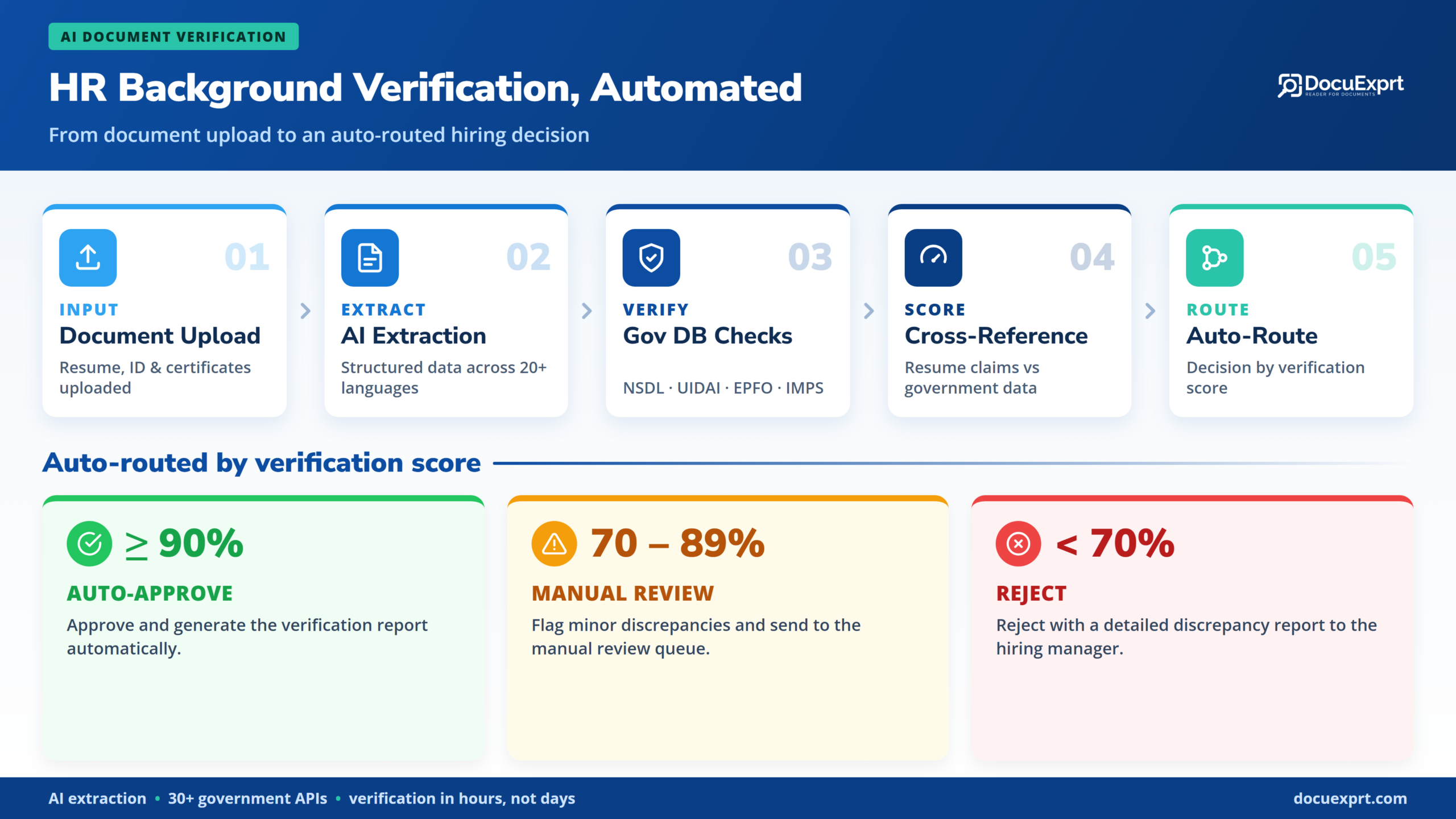
A candidate asks for a 40% hike on a current salary of ₹18 lakh a year, and salary slip verification looks like a formality.

The offer letter says ₹18 lakh. The last three payslips agree. Nothing looks wrong.

Then someone opens the bank statement. The monthly salary credit is about ₹1.05 lakh, not the ₹1.3 lakh the payslips show.

Each document passed review on its own. Only side by side did they disagree.

This guide shows how to cross-check the three documents behind every salary claim, what an edited payslip or bank statement looks like, and how to run the check at hiring volume.

Quick answer: how do you verify a salary slip? Reconcile it with the offer letter and the bank statement: net pay on the slip should match the salary credit, and gross minus deductions should equal net. Run tampering checks on each file, then confirm disputed figures through Form 26AS and UAN history with the candidate's consent.
📄

Offer letter

Declared CTC and employer

🧾

Payslips

Monthly gross, deductions, net pay

🏦

Bank statement

What was actually credited

🏛️

Source records

Form 26AS and UAN history

Why Salary Claims Slip Through Review

Salary verification usually means one reviewer looking at one document at a time.

A payslip is checked for a logo and a signature. A bank statement is checked for the right bank name. Nobody compares the numbers across them.

That gap matters because current salary anchors the offer. An inflated base inflates every hike negotiated on top of it.

The edit itself is easy. A PDF editor can change one figure on a payslip in a minute, and the result looks identical on screen.

Volume is also rising. Since the Code on Wages, 2019 came into force on 21 November 2025, employers must issue a wage slip to every employee, so more candidates arrive with payslips to show.
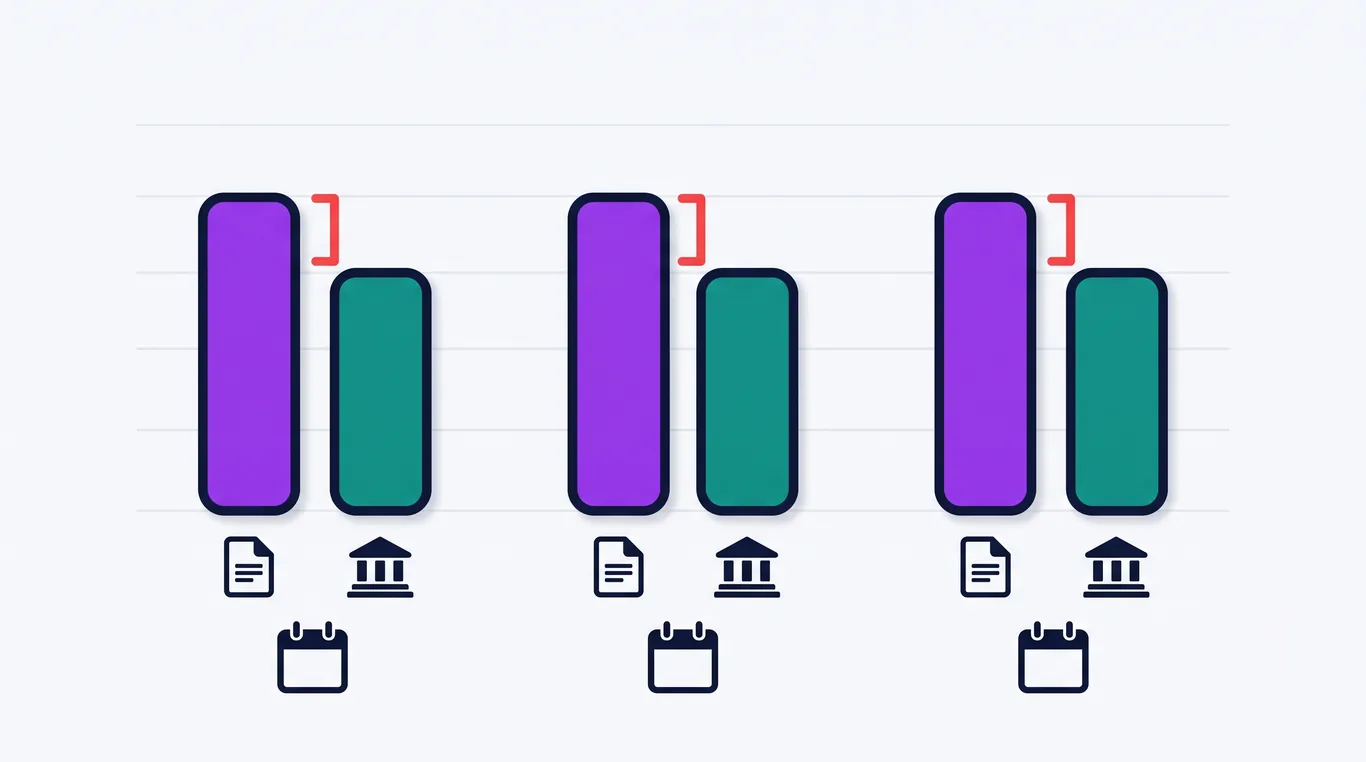
Paired bar chart showing salary slip net pay higher than the actual bank credit in each of three months
The inflated slip looks fine alone. Side by side with the bank credit, the gap repeats every month.

Verifying salaries at hiring volume?

Run your real candidate files through DocuExprt on a call.

  • Offer, payslip, bank cross-check
  • Tamper flags on every file
  • Verdict and risk score per document
  • Results to your ATS via API
Book a Free Demo →

Or try a free tool first.

🔒 CERT-IN Certified🛡 ISO 27001🎟 Free trial tokens

How Do You Verify a Salary Slip? The Three-Document Cross-Check

You verify a salary slip by reconciling it with two other documents. Each answers a different question, and each one checks the others.

  • The offer letter says what the employer promised.
  • The payslips say what the employer paid, before and after deductions.
  • The bank statement says what actually reached the candidate's account.

What to compare, field by field

FieldCompareWhat a normal gap looks like
Employer nameOffer letter, payslip header, bank credit narrationAbbreviations in the bank narration are normal
Monthly grossPayslip gross against CTC ÷ 12Gross sits below CTC ÷ 12, because CTC includes employer PF, gratuity and variable pay
Net payPayslip net against the salary creditShould match closely, month by month
Pay datePayslip period against credit dateA few days either side of month end
ArithmeticGross minus deductions against net payShould add up exactly
DeductionsPF, professional tax and TDS against salary levelPF is normally 12% of basic, often on a capped wage
Employer TANTAN on the salary slip against the deductor in Form 26ASShould be the same employer
UANUAN printed on the payslip against UAN recordsShould belong to the candidate and list this employer
CTC is not monthly pay. Flag the net-pay-to-credit gap, not the CTC-to-gross gap. Set a tolerance for the second, or every honest candidate gets flagged.
Bar chart of salary from CTC to gross to net pay, where net pay should equal the bank salary credit
CTC > gross > net is normal. Net pay and the bank credit should match.

Is a Salary Slip the Same as a Bank Statement?

No. A salary slip comes from the employer and shows what it paid: gross pay, deductions and net pay. A bank statement comes from the bank and shows what actually reached the account.

That is why HR teams and lenders ask for both. Net pay on the slip should match the salary credit on the statement every month. When they disagree, one of the two documents is wrong.

Salary slipBank statement
Issued byEmployer or payroll systemThe candidate's bank
ShowsGross pay, PF, tax and net paySalary credits, dates and narration
ProvesWhat the employer says it paidWhat was actually received

Can HR Verify a Fake Bank Statement?

Yes, but not by looking at the PDF. With the candidate's consent, get the statement from the source: directly from the bank, or through the RBI Account Aggregator framework.

A statement sent as a PDF can be edited like any other file. To screen a payslip first, try the free fake salary slip verifier.

How Can You Tell If a Salary Slip Is Fake?

Salary fraud often is not a forged document built from scratch. It is a real document with one number changed.

Automated tamper screening flags it, even when the page looks perfect.

❌ Signs of an edit

  • Figures: net or gross pay changed on an otherwise genuine slip
  • File: changed after it left the payroll or bank system
  • Cross-check: net pay does not match the bank credit
  • Branding: elements added after the document was issued
  • Balances: a bank running balance that no longer adds up
VS

✅ Signs of a clean file

  • Figures: agree with the offer letter and bank credit
  • File: unchanged since the issuing system produced it
  • Cross-check: net pay matches the bank credit every month
  • Branding: nothing added after issue
  • Balances: every line reconciles to the next

A clean file is not proof on its own, though. A document built from scratch can pass tamper screening.

You can test a sample file with the free PDF forensics viewer or the free document tampering checker.

Catch the edited figure in seconds

Tell us your hiring volume and document mix.

  • Configurable forensic checks
  • Form 26AS and UAN with consent
  • Only mismatches reach reviewers
  • Role-based access and audit logs
Talk to Our Team →

Or book a demo on your own files.

🔒 CERT-IN Certified🛡 ISO 27001🎟 Free trial tokens

Where Source Records Settle the Question

When the documents disagree, or look too clean to trust, go to records the candidate did not produce.

  • Form 26AS or the Annual Information Statement (AIS) lists the salary each employer paid and the tax it deducted, reported by the employer to the Income Tax department. It is the closest independent check on annual pay.
  • UAN employment history confirms the employer and the dates of joining and exit. It does not confirm salary, but it catches a payslip from an employer the candidate never worked for.
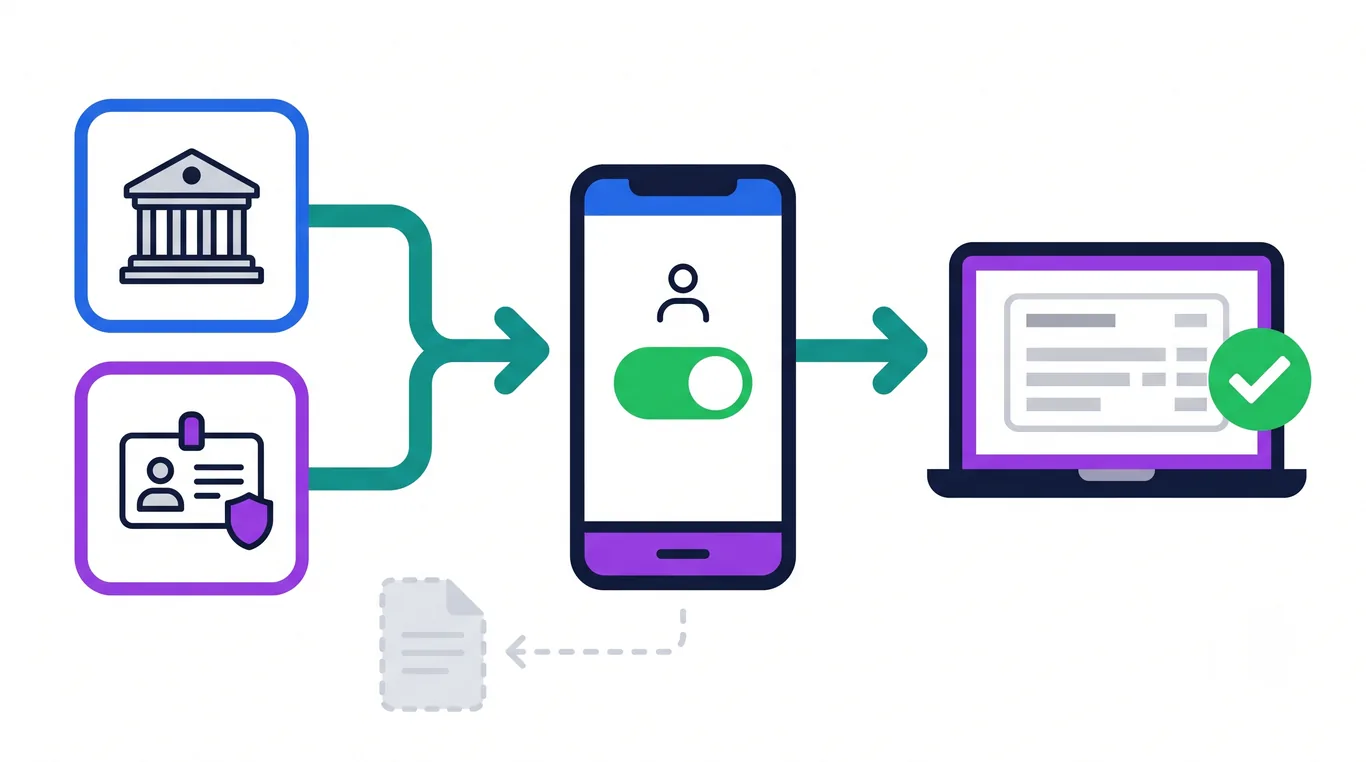
Tax and PF source records flowing through a candidate consent toggle to a verified salary check
Form 26AS confirms salary paid. UAN history confirms the employer. Both need the candidate's consent.

Both checks need the candidate's informed consent. Our guide to employment history verification through UAN covers the consent and data-source questions in detail.

Use documents to find the question, and source records to answer it. Cross-checking documents shows where the story breaks. Source records show which version is true.

Who Needs Salary Verification

The same three documents show up wherever income has to be proven. The stakes differ by team.

🏢 Enterprise hiring teams

Current salary sets the offer for lateral and senior hires. One inflated figure raises the cost of the hire for as long as the employee stays.

🤝 Background verification providers

Some clients now ask for salary checks alongside employment and education checks. Providers need them at volume, through an API, with an evidence trail per case.

🏦 Lenders and NBFCs

Payslips and bank statements are standard income proof for personal loans. An edited salary figure changes the loan amount a borrower qualifies for.

Our guide to document verification for BFSI covers the lending side in more depth.

Running Salary Verification at Hiring Volume

Doing this by hand takes a reviewer several documents and a calculator per candidate. At hundreds of hires a month, the check quietly gets skipped.

Automation turns it into a pipeline where reviewers only see the cases that break.
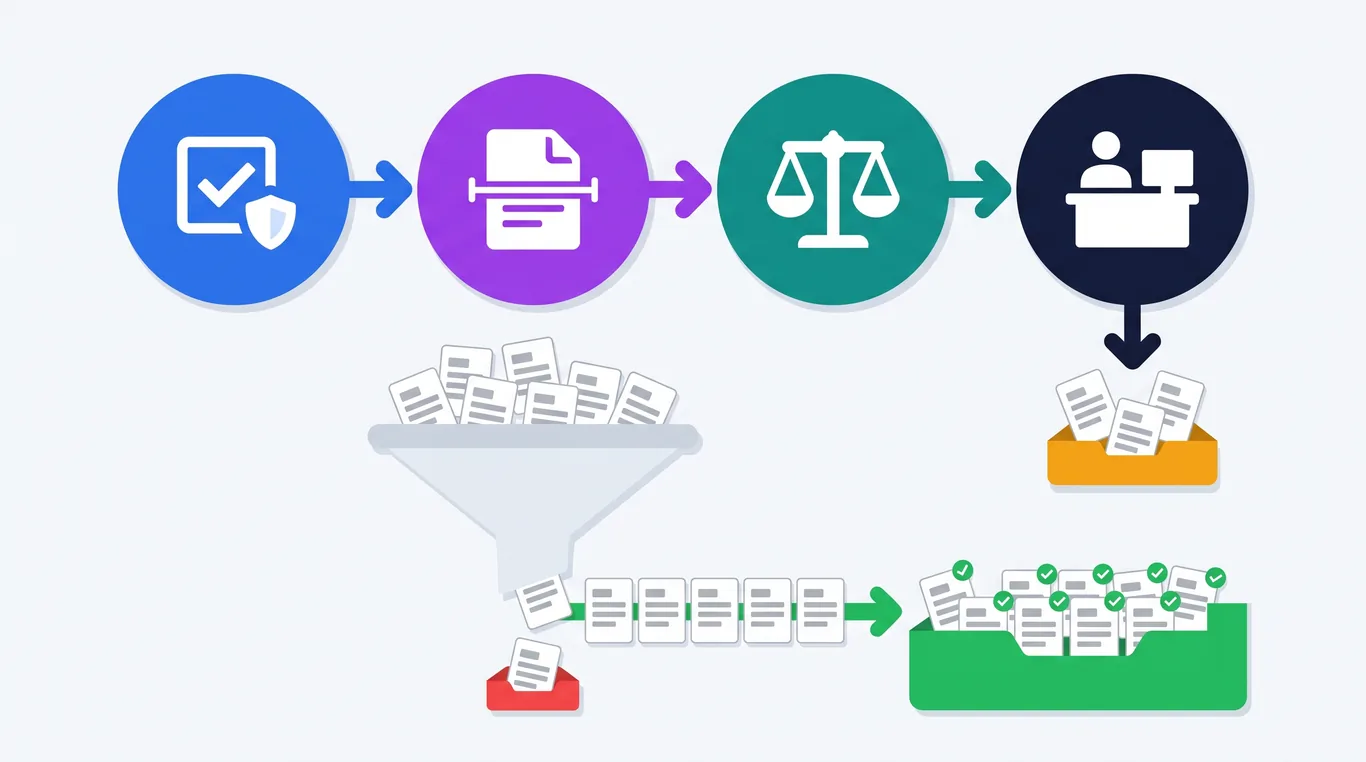
Step 1Collect with consent
→
Step 2Extract salary fields
→
Step 3Reconcile + forensics
→
Step 4Review only mismatches
Four-step salary verification workflow: consent, extraction, reconciliation and a review queue for mismatches only
Consent, extract, reconcile, review. Reviewers only see the mismatches.

DocuExprt runs this as one workflow. It extracts the salary fields from the offer letter, payslips and bank statement, cross-verifies the amounts, and runs forensic checks on each file.

Each document gets a verdict and a risk score. Your team chooses which forensic checks apply and which flags go to manual review, and results return to your ATS as JSON through the API.

The same workflow can add Form 26AS and UAN checks where the candidate has consented. See how it fits into background verification automation and HR document verification.

Guardrails for a Fair Check

Salary verification touches sensitive financial data. A few rules keep it fair and defensible:

  • ✅ Take specific consent before collecting bank statements or running source checks.
  • ✅ Ask only for the months you need, usually the last three.
  • ✅ Treat a flag as a question for the candidate, not an automatic rejection.
  • ✅ Set tolerances for rounding, arrears and one-off payments.
  • ✅ Keep the evidence behind each decision, and delete what you no longer need.
Arrears, bonuses and mid-month joins cause honest mismatches. A reviewer who asks one question usually resolves them in minutes.

Key Takeaways

  1. Salary claims slip through because each document is reviewed alone.
  2. Cross-check three documents: offer letter, payslips and bank statement.
  3. Match net pay to the salary credit; do not expect gross to equal CTC ÷ 12.
  4. Payslip arithmetic should add up exactly, every month.
  5. Tamper screening and balances that do not add up expose edited files.
  6. A clean file is not proof; a document built from scratch can pass forensics.
  7. Form 26AS and UAN history settle disputes, with the candidate's consent.
  8. Automate the reconciliation so reviewers only see the mismatches.

Frequently Asked Questions

How do you verify a candidate's salary slip?

Cross-check the offer letter, recent payslips and the bank statement showing salary credits, and run tampering checks on each file. Where the documents disagree, confirm annual pay through Form 26AS and the employer through UAN history, with the candidate's consent.

How can you tell if a salary slip is fake?

Check whether gross minus deductions equals net pay, whether net pay matches the bank credit, and whether the PF and tax deductions fit the salary. Then run the file through tamper screening, which flags figures changed after the slip was issued.

Is a salary slip the same as a bank statement?

No. A salary slip is issued by the employer and shows gross pay, deductions and net pay. A bank statement is issued by the bank and shows the salary actually credited. Verifiers compare the two: net pay on the slip should match the monthly salary credit.

Why is payslip gross salary lower than CTC divided by 12?

CTC includes costs the employee does not receive monthly, such as the employer's PF contribution, gratuity and variable pay. A gap between CTC and monthly gross is normal; a gap between payslip net pay and the salary credited to the bank is not.

Can Form 26AS be used for salary verification?

Yes. Form 26AS shows the amount each employer paid and the tax deducted, as reported by the employer to the Income Tax department. It confirms annual pay independently of the candidate's documents, and should only be checked with the candidate's consent.

Can salary verification be automated?

Yes. An AI document verification workflow can extract salary fields from all three documents, reconcile them, run forensic checks and send only mismatches to a reviewer. DocuExprt returns a verdict and risk score per document to your ATS through the API.

What APIs are used for income and employment verification?

In India the main consent-based sources are Form 26AS or AIS for salary paid and tax deducted, UAN (EPFO) history for employers and dates, PAN verification for identity, and bank statements, shared directly or through the Account Aggregator framework, for salary credits. Document checks on offer letters and salary slips fill the gaps.

Salary Verification Is a Reconciliation Problem

An inflated salary rarely hides in one document. It hides in the gap between three.

Teams that reconcile the offer letter, payslips and bank statement, and confirm disputes at source, catch the edit before it becomes the base for an offer.

Stop inflated salaries at intake

Bring a sample batch. We run it live on the demo.

  • 3.5 lakh+ documents verified
  • 99%+ verification accuracy
  • PAN, Aadhaar, GST + 30+ govt DBs
  • Only exceptions reach your team

Trusted by enterprises and government boards

Roche Products (India) Pvt. Ltd. logo
Elbrit Life Sciences Pvt. Ltd. logo
Haryana Knowledge Corporation Limited (HKCL) logo
Maharashtra Council of Agricultural Education and Research (MCAER) logo
State Board of Technical Education, Bihar (Patna) logo
SVKM's NMIMS Deemed-to-be University logo
CERT-IN CertifiedISO/IEC 27001:2013Data stays in India

Free trial tokens available for testing.

Document Verification for HR: Automate Employee Background Checks with AI

Document Verification for HR: Automate Employee Background Checks with AI

Introduction

India's hiring market is growing, but so is hiring fraud. In FY 2024, employment verification discrepancies surged 44% across key industries, rising from 9.9% in FY21 to 14.26% in FY24.

Over 56% of Indian hiring managers reported detecting at least one case of resume fraud in 2024. And in December 2025, police busted a nationwide racket and seized more than 1 lakh fake academic certificates linked to 22 universities, with an estimated 1 million already in circulation – complete with logos, seals, holograms, and institutional formatting indistinguishable from legitimate documents.

The cost of getting this wrong? A single bad hire costs Indian companies Rs. 8-12 lakhs ($10,000-$15,000 USD) in wasted payroll, training, recruitment, and productivity loss.

Across industries, 86% of employers report facing discrepancies during background checks, yet most still rely on manual verification processes that take 5-15 business days per candidate.

With the Digital Personal Data Protection (DPDP) Act 2023 tightening consent requirements and EPFO moving to fully digital UAN verification in 2026, HR teams need automated, API-driven document verification, not spreadsheet-based manual checks.

This guide shows how AI-powered document verification transforms HR operations from employee onboarding and background checks to moonlighting detection and ongoing compliance, while cutting verification time from weeks to hours.

44%
Surge in employment verification discrepancies, FY21 to FY24
56%
Hiring managers who detected resume fraud in 2024
Rs. 8-12L
Cost of a single bad hire to an Indian company
1M+
Fake academic certificates uncovered in 2025

Verify New Hires in Seconds

Education, employment and ID, checked at source.

  • Degree and marksheet verification
  • UAN-based employment history
  • PAN, Aadhaar and address checks
  • Every check timestamped
Book a Free Demo →

Or try a free tool first.

🔒 CERT-IN Certified🛡 ISO 27001🎟 Free trial tokens

The Broken State of HR Document Verification

Every new hire generates a stack of documents – resumes, identity proofs, academic certificates, employment letters, bank details, address proofs.

For an enterprise processing 500-5,000 employee documents per quarter, the manual verification burden is enormous. And the consequences of failure are severe.

The Numbers That Define the Problem

Challenge Impact
Resume discrepancy rate 30% in IT sector; 14.26% across industries (FY24)
Hiring managers detecting fraud 56% reported at least one case in 2024
Employers facing BGV discrepancies 86% report discrepancies during background checks
Employment discrepancy growth 44% increase from FY21 to FY24
Cost of a bad hire Rs. 8-12 lakhs ($10K-$15K) per incident
Fake certificates uncovered (2025) 1 lakh+ seized in one raid (est. 1 million in circulation)
Education verification discrepancies 10-13% of all BGV checks
Manual verification time 5-15 business days per candidate

The Five Categories of HR Document Fraud

1. Resume Inflation
Exaggerated job titles, inflated tenures, and fabricated responsibilities - a high-incidence pattern in BFSI, including undisclosed exits and fabricated past employers.
2. Fake Academic Certificates
Counterfeit credentials with authentic-looking logos, seals, and holograms. Roughly 10-13% of education-related checks in India uncover discrepancies.
3. Moonlighting and Dual Employment
Two simultaneous PF contributions to one UAN signal an employee holding multiple full-time roles - impractical to catch manually across thousands of staff.
4. Forged Employment Letters
Fabricated experience certificates and entire employment histories from companies that may not exist or where the candidate never worked.
5. Identity Document Fraud
Forged PAN cards, tampered Aadhaar documents, and fake address proofs used during onboarding - each carrying compliance and legal risk.

Why Manual Verification Fails

Traditional HR verification involves phone calls to previous employers, emails to universities, and physical document inspections. This process fails on three fronts:

  1. Speed: 5-15 business days per candidate means delayed onboarding, lost candidates to competitors, and operational gaps
  2. Scale: IT/ITES companies processing 100+ candidates per week cannot manually verify each document
  3. Accuracy: Human reviewers cannot detect sophisticated digital forgeries – AI-generated certificates with authentic-looking seals and holograms are visually indistinguishable from real ones

Manual Verification

  • 5-15 business days per candidate
  • Cannot scale to 100+ candidates per week
  • Misses AI-generated forgeries with fake seals and holograms
  • Detects only 40-60% of actual fraud
  • 15-20% data entry error rate
VS

AI-Automated with DocuExprt

  • 2-4 hours per candidate
  • Bulk-processes 100+ document sets in parallel
  • AI forensics flag pixel-level tampering and seal anomalies
  • Detects 92-98% of actual fraud
  • Under 1% data entry error rate

See an Onboarding Check Run

One candidate packet, upload to a verified file.

  • All documents in one pass
  • Forged certificates flagged
  • Only exceptions reach HR
  • Plugs into your existing HRMS
Talk to Our Team →

Or book a demo on your own files.

🔒 CERT-IN Certified🛡 ISO 27001🎟 Free trial tokens

AI-Powered HR Document Verification with DocuExprt

DocuExprt transforms HR document verification from a manual, multi-day process into an automated workflow that completes in minutes. The platform combines AI-powered document extraction with real-time government database verification through 30+ pre-built API integrations.

Employment History Verification via Government APIs

The most reliable way to verify employment claims isn't calling previous employers – it's checking government databases directly.

Verification Type API What It Reveals
EPFO Employment History UAN-to-Employment-History Complete PF contribution records – every employer, tenure, and salary bracket
Current Employment Status PAN-to-Employment-Status Whether candidate is currently employed elsewhere (moonlighting detection)
UAN Validation Aadhaar-to-UAN Links Aadhaar to UAN for identity-employment cross-verification
Employment Continuity UAN-to-UAN Cross-reference multiple UAN numbers for the same individual

How it works: A candidate claims 5 years at Company X and 3 years at Company Y. DocuExprt's Employment History Verification API pulls the actual EPFO records associated with their UAN revealing every PF contribution, actual employer names, joining/leaving dates, and salary brackets. If the resume claims don't match the government records, the system automatically flags the discrepancy.

Moonlighting detection: When two PF contributions from different employers appear simultaneously on the same UAN, it is a definitive indicator of dual employment. DocuExprt's PAN-to-Employment-Status API checks whether a candidate or existing employee has active PF contributions from another employer – catching moonlighting that phone-based verification would never reveal.

Identity Document Verification

Every new hire requires identity verification – and with the DPDP Act 2023, this verification must be accurate, documented, and consent-based.

Document API Integration HR Use Case
PAN Card PAN Verification Financial identity, TDS compliance, Form 16 validation
Aadhaar Aadhaar eKYC Biometric identity verification, address confirmation
Passport Passport Verification International hires, overseas assignment eligibility
Driving License DL-Advanced Roles requiring driving (logistics, field sales, delivery)
Voter ID Voter-ID-Card-Verification Additional identity and address proof
Bank Account Bank Account Verification Payroll setup, salary account confirmation

DocuExprt verifies each document against the issuing government database in real-time – not just checking if the document "looks right," but confirming that the PAN number exists in the NSDL database, the Aadhaar is valid with UIDAI, and the bank account is active and belongs to the named individual.

Academic Certificate Verification

With 10-13% of education-related background checks revealing discrepancies and more than 1 lakh fake certificates seized in a single 2025 raid, academic verification is non-negotiable.

DocuExprt's AI-powered academic verification:

  • Intelligent extraction: AI extracts structured data from marksheets, degree certificates, diplomas, and transcripts – including university name, registration number, dates, grades, and specializations
  • Multi-language support: Processes academic documents in 20+ languages including Hindi, Telugu, Tamil, Gujarati, Marathi, Bengali, and Kannada – critical for regional university documents
  • Forgery detection: AI-powered image forensics identifies pixel-level tampering, font inconsistencies, seal/hologram anomalies, and metadata discrepancies
  • Cross-document validation: Compares extracted data across all submitted documents – if the resume says "MBA from IIM Ahmedabad, 2019" but the marksheet shows a different year, institution, or specialization, the system flags it instantly

QR Code Authentication for Academic Certificates

India's fake degree crisis reached unprecedented scale in December 2025, with police seizing more than 1 lakh counterfeit academic certificates complete with logos, seals, and holograms indistinguishable from legitimate documents. Traditional OCR and visual inspection cannot detect these sophisticated forgeries. See our guide to fake degree and marksheet detection.

QR code verification solves this. The University Grants Commission (UGC) now mandates QR codes on all degree certificates issued by recognized universities. These QR codes contain cryptographically signed data linking back to the issuing institution's database.

DocuExprt's QR verification workflow for HR teams:

  1. Candidate uploads academic certificate (PDF or image)
  2. DocuExprt AI detects the embedded QR code
  3. QR data is decoded — degree type, institution, year, candidate name
  4. OCR extracts the same fields from the document face
  5. Cross-validation flags any mismatches between QR and OCR data
  6. Results feed into the background verification workflow for approval/rejection

This catches forgeries that even expert human reviewers miss because while logos and seals can be replicated, the QR code's cryptographic signature cannot be faked without the university's private key.

Key stat: 56% of Indian hiring managers reported detecting at least one case of resume fraud in 2024. QR verification eliminates the guesswork.

Catch Fake Credentials Early

Image forensics plus verification at the source.

  • Tampered documents detected
  • Checked against issuing records
  • Discrepancy named, not guessed
  • Audit trail for every hire
See It on Your Data →

Or try a free tool first.

🔒 CERT-IN Certified🛡 ISO 27001🎟 Free trial tokens

Resume Data Extraction and Cross-Verification

DocuExprt doesn't just verify individual documents – it cross-references every claim across the entire document set:

  1. AI extraction: Pulls structured data from resumes – experience timeline, education history, skills, certifications, previous employers
  2. Government verification: Cross-checks employment claims against EPFO records via UAN APIs
  3. Gap detection: Identifies unexplained gaps in employment history and flags them for review
  4. Consistency checks: Compares dates, employers, designations, and qualifications across resume, offer letters, experience certificates, and government records
  5. Discrepancy scoring: Assigns a verification confidence score to each candidate based on the number and severity of matches/mismatches

How Do You Automate Background Check Form Collection With PDFs?

Collect every document through one intake point instead of an email chain. Each PDF (ID, address proof, marksheets, experience letters, consent form) is classified on arrival, its fields are extracted, and missing or unreadable documents are flagged for follow-up.

Your BGV team then works only on exceptions, with every file already sorted and matched against the candidate's form data.

Building an Employee Onboarding Verification Workflow

DocuExprt's visual no-code workflow builder uses 5 node types (Input, Processing, Conditional, Output, Evaluation) to create end-to-end employee verification pipelines. Here's the complete onboarding verification workflow:

Workflow: New Hire Background Verification

DocuExprt_HR_Verification_Workflow_ProcessFlow

How Each Step Works

Step 1: Document Collection

Candidate uploads all documents through a secure portal or email – resume, PAN card, Aadhaar, academic certificates, previous employment letters, bank details. DocuExprt's input node accepts PDFs, scanned images, and photographs.

Step 2: AI Data Extraction

The processing node extracts structured data from every document simultaneously. Resume experience parsed into timeline format. PAN number, Aadhaar number, and bank details extracted. Certificate details (university, year, grade) captured – all in seconds, across 20+ languages.

Step 3: Government Database Verification

Each extracted data point is verified against the relevant government API:

– PAN → NSDL database (does this PAN exist? Does the name match?)

– Aadhaar → UIDAI (is this Aadhaar valid? Does the demographic data match?)

– UAN → EPFO (what is the actual employment history?)

– Bank Account → IMPS/NEFT (is this account active and owned by this person?)

Step 4: Cross-Verification and Scoring

The evaluation node compares all data points:

– Resume employment claims vs. EPFO records

– Resume education claims vs. certificate data

– Identity consistency across all documents

– Employment gap analysis

Step 5: Conditional Routing

Based on the verification score, candidates are automatically routed to approval, review, or rejection – with detailed reports generated at each stage.

Bulk Processing for Mass Hiring

IT/ITES companies and BPOs conducting campus drives or mass hiring events need to process hundreds of candidates simultaneously. DocuExprt's bulk processing capability:

  • Upload 100+ candidate document sets at once
  • Parallel API verification across all candidates
  • Dashboard view of verification status for entire hiring batch
  • Export verification reports in bulk for compliance documentation
  • Trigger-based notifications when verifications complete or discrepancies are found

Trigger System for Ongoing Compliance

Verification doesn't end at onboarding. DocuExprt's trigger system automates ongoing document management:

  • Document expiry alerts: Notify HR when an employee's driving license, passport, or professional certification is about to expire
  • Periodic re-verification: Schedule annual or quarterly re-verification for sensitive roles (BFSI, healthcare)
  • Moonlighting monitoring: Periodic UAN checks to detect dual employment post-onboarding
  • Compliance calendar: Automated reminders for regulatory filing deadlines

Industry-Specific HR Verification Needs

BFSI HR Compliance

The banking and financial services sector faces the strictest employee verification requirements:

  • RBI and SEBI mandates: Background verification is mandatory for all employees handling customer funds or sensitive financial data
  • PAN and Aadhaar verification: Required for KYC compliance – every BFSI employee must have verified identity documents on file
  • Annual re-verification: Regulatory best practice for ongoing compliance monitoring
  • Criminal record checks: Required for positions with fiduciary responsibility
  • BFSI-specific fraud: The Workforce Fraud Files 2025 highlights high incidence of employment history discrepancies in BFSI – inflated tenures, undisclosed exits, and fabricated past employers

DocuExprt's workflow handles BFSI-specific requirements by chaining PAN verification → Aadhaar eKYC → UAN employment history → Bank account verification → GSTIN verification (for contractual/vendor employees) in a single automated pipeline.

IT/ITES Mass Hiring

India's IT sector processes thousands of hires quarterly, making manual verification physically impossible:

  • Volume: Large IT companies hire 10,000-50,000 employees annually; each requires full BGV
  • Speed: Offer-to-joining timelines of 2-4 weeks leave no room for 15-day manual verification
  • Campus hiring: Processing 500+ candidates from a single campus drive
  • Contractor verification: IT companies engaging 30-40% contractual workforce need the same verification rigour
  • Integration needs: Verification data must flow into ATS systems (Workday, SAP SuccessFactors, Darwinbox) and HRMS platforms

DocuExprt's API-first architecture enables direct integration with existing HR tech stacks, feeding verified candidate data directly into onboarding workflows without manual data re-entry – eliminating the 65% of false negatives caused by human data entry errors.

Healthcare Hiring

Patient safety makes healthcare employee verification non-negotiable:

  • Medical license verification: Confirm medical council registration numbers and validity
  • Qualification verification: Verify MBBS, MD, nursing, pharmacy, and allied health degrees
  • Background checks for patient-facing roles: Criminal and identity verification mandatory
  • Regulatory compliance: State medical council and National Medical Commission requirements
  • Multi-language documentation: Medical certificates from regional universities across India

ROI for HR Teams

The business case for automated HR document verification is clear and the cost of NOT automating is growing.

90-95%
Faster verification per candidate
60-80%
Lower cost per background check
92-98%
Document fraud detection accuracy
<1%
Data entry error rate, down from 15-20%

Quantified Benefits

Metric Manual Process AI-Automated Improvement
Verification time per candidate 5-15 business days 2-4 hours 90-95% faster
Cost per background check Rs. 2,000-5,000 Rs. 300-800 60-80% reduction
Document discrepancy detection 40-60% of actual fraud 92-98% of actual fraud 2-3x improvement
Employee onboarding time 3-4 weeks 3-5 days 75% faster
HR staff time per verification 2-4 hours 10-15 minutes 90% reduction
Data entry error rate 15-20% <1% 15-20x improvement

Market Context

  • Global background screening market: $14.72 billion in 2025, projected to reach $25.92 billion by 2030
  • AI adoption in Indian HR: 68% of mid-to-large enterprises now use AI-assisted verification (up from 32% in 2023)
  • AI-driven cost reduction: 40-60% lower verification costs with improved accuracy
  • Document accuracy with AI/ML: 99.5% – eliminating manual errors that cause false negatives

The Cost of Not Automating

Risk Financial Impact
Bad hire (wasted salary, training, recruitment) Rs. 8-12 lakhs per incident
Compliance violation (DPDP Act, industry regulations) Rs. 10 lakhs – Rs. 250 crore penalties
Delayed onboarding → lost candidates 3-5% candidate drop-off per day of delay
Fraudulent employee in sensitive role Reputational damage + legal liability
Moonlighting employee (productivity, IP risk) Rs. 5-15 lakhs in productivity loss

Break-Even Analysis

A standard manual BGV costs Rs. 2,000-5,000 per candidate. An automated BGV via DocuExprt costs Rs. 300-800 per candidate. For a company hiring 500 employees per year:

  • Manual cost: Rs. 10-25 lakhs annually
  • Automated cost: Rs. 1.5-4 lakhs annually
  • Annual savings: Rs. 8.5-21 lakhs plus faster onboarding, better fraud detection and full compliance documentation
Net result: A company hiring 500 employees a year cuts BGV spend from Rs. 10-25 lakhs to Rs. 1.5-4 lakhs, an annual saving of Rs. 8.5-21 lakhs, while shrinking onboarding from 3-4 weeks to 3-5 days.

Key Takeaways

  1. Employment verification discrepancies in India surged 44% from FY21 to FY24 – with 56% of hiring managers detecting resume fraud in 2024 and 86% of employers facing BGV discrepancies.
  2. More than 1 lakh fake academic certificates were seized in December 2025 – a nationwide operation that produced counterfeit credentials with authentic-looking seals, holograms, and institutional formatting.
  3. A single bad hire costs Indian companies ₹8-12 lakhs – in wasted payroll, training, recruitment, and productivity loss. Manual BGV's 5-15 day timeline makes the problem worse by delaying onboarding.
  4. EPFO's UAN system enables real-time employment history verification – revealing every employer, tenure, and salary bracket from government records, independent of what candidates claim on resumes.
  5. Moonlighting detection is now automated – PAN-to-Employment-Status and dual UAN contribution checks identify employees holding multiple full-time positions simultaneously.
  6. AI-powered verification achieves 92-98% fraud detection accuracy – compared to 40-60% for manual processes, while reducing verification costs by 60-80%.
  7. DocuExprt's no-code workflow builder automates the entire onboarding pipeline – from document collection and AI extraction to government API verification, cross-referencing, and conditional routing.
  8. 68% of mid-to-large Indian enterprises have adopted AI-assisted verification – up from 32% in 2023. The global background screening market is growing from $14.72B to $25.92B by 2030.

Run It on Real Candidate Files

Bring one onboarding batch. We run it on the call.

  • Onboarding workflows mapped live
  • 30+ government databases, real time
  • Audit trail for every hire
  • Cloud, private cloud or on-premise

Trusted by enterprises and government boards

Roche Products (India) Pvt. Ltd. logo Elbrit Life Sciences Pvt. Ltd. logo Haryana Knowledge Corporation Limited (HKCL) logo Maharashtra Council of Agricultural Education and Research (MCAER) logo State Board of Technical Education, Bihar (Patna) logo SVKM's NMIMS Deemed-to-be University logo
CERT-IN CertifiedISO/IEC 27001:2013Data stays in India

Free trial tokens available for testing.

Frequently Asked Questions

How can AI automate employee background checks?

AI automates background checks through three capabilities: intelligent document extraction (pulling structured data from resumes, certificates, and ID documents using OCR and NLP), real-time government database verification (checking PAN via NSDL, Aadhaar via UIDAI, employment history via EPFO/UAN, bank accounts via IMPS), and automated cross-referencing (comparing claims across all submitted documents and flagging discrepancies). DocuExprt's platform chains these steps into a single workflow that completes in hours instead of the 5-15 days required for manual verification.

What documents should be verified during employee onboarding?

A comprehensive onboarding verification should cover: identity documents (PAN card, Aadhaar – verified against NSDL and UIDAI databases), employment history (verified via UAN/EPFO records, not just reference calls), academic certificates (degree, marksheet, professional certifications – checked for forgery using AI forensics), bank account details (verified for payroll setup), address proof, and role-specific documents (driving license for logistics roles, passport for international assignments, medical licenses for healthcare). DocuExprt automates verification of all these document types through 30+ government API integrations.

Can DocuExprt integrate with our existing HRMS/ATS?

Yes. DocuExprt's API-first architecture enables direct integration with HRMS platforms (Darwinbox, greytHR, Keka, SAP SuccessFactors, Workday) and ATS systems. Verification data flows directly into your existing onboarding workflows through REST APIs, eliminating manual data re-entry. The platform also supports bulk processing for mass hiring events – upload 100+ candidate document sets simultaneously and receive parallel API verification results. Cloud storage integrations (Amazon S3, Azure Blob, GCP) enable seamless document storage within your existing infrastructure.

How does employment history verification work via UAN?

The Universal Account Number (UAN) is a unique identifier assigned by EPFO to every employee contributing to the Provident Fund. DocuExprt's UAN-to-Employment-History API pulls the complete EPFO record for a given UAN – revealing every employer who contributed PF, exact joining and leaving dates, salary brackets, and contribution amounts. This data is independent of what the candidate claims – it comes directly from government records. If a resume claims 5 years at Company X, but EPFO records show only 2 years, the system flags the discrepancy automatically. The PAN-to-Employment-Status API can also detect active dual employment (moonlighting).

Is AI-based background verification legally valid in India?

Yes, AI-based background verification is legally valid when conducted with proper consent and data handling practices. The Digital Personal Data Protection (DPDP) Act 2023 requires employers to obtain explicit, documented consent before conducting any background check – which DocuExprt's platform handles through consent workflow nodes. Government API verifications (PAN, Aadhaar, UAN) are conducted through official, authorized channels. The platform maintains complete audit trails with timestamps, verification scores, and outcomes for every check – meeting the documentation requirements of labour law, industry-specific regulations (RBI/SEBI for BFSI), and the DPDP Act. All verification data is stored with enterprise-grade encryption and access controls.

Employment Verification APIs for HR and BGV Teams

Employment Verification APIs for HR and BGV Teams

Employment verification for HR and BGV teams

Employment verification APIs help HR teams, staffing companies and background verification providers compare a candidate's declared work history with records returned by supported verification sources. DocuExprt brings these checks into a configurable workflow, so your team can review discrepancies and pass results to its existing systems.

Four stages: collect candidate records and consent, check supported sources, compare details, and review results.
Collect candidate records and consent, check supported sources, compare details, then send results for review. View full-size illustration.

Use this guide to understand the available checks, the information needed to run them, and where a reviewer should step in. For the broader solution, explore background verification automation or HR document verification and onboarding.

HR operations

Compare declared employment with available source records and organize exceptions for review.

Staffing and BGV teams

Build a repeatable verification process across candidate batches and client requirements.

Integration teams

Connect verification steps to your HRMS or ATS using the supported API and workflow options.

Choose the check that fits your workflow

Verification stepBusiness questionReview before use
UAN employment historyHow do available employment records compare with the candidate's declared history?Confirm source coverage, returned fields and gaps for the candidate.
PAN employment statusIs an employment-status check available for this case?Confirm the supported source, inputs and meaning of the returned status.
Aadhaar-to-UAN and UAN checksCan the supported lookup or validation help prepare the employment check?Confirm required authorization, input requirements and source availability.
Name matchingDo names across the submitted and returned records align?Review spelling variations and uncertain matches rather than rejecting automatically.
Matching records: record the evidence. Different dates: ask a reviewer to reconcile. Missing records: use another verification method.
Illustrative examples: retain matching evidence, reconcile date differences, and seek another verification method when a record is missing. View full-size illustration.

What your team reviews

Illustrative review outcome — fictional example, not an API response or a hiring decision.

ItemExample outcomeNext step
Employer recordA returned employer record matches the declared organization.Record the source and the check timestamp.
Employment datesThe returned dates differ from the dates supplied by the candidate.Ask the reviewer to reconcile the difference with the candidate.
Missing recordNo record is returned for one declared role.Request another verification method; a missing record alone does not prove false information.

Coverage and exception handling

Source availability, candidate records and enabled checks affect what can be returned. Do not assume complete work-history coverage for every candidate. Plan for missing records, delayed updates, name differences and temporary source failures. Overlapping dates are a review signal, not proof of misconduct.

Confirm the required authorization and candidate-consent process before running checks. Route uncertain results to a designated reviewer; retain the evidence needed for your organization's process. For deployment and integration choices, see the enterprise document verification platform.

Planning an integration? Bring your expected monthly verification volume, required checks and HRMS/ATS details. Request an employment verification demo to review coverage, a sample result and the integration approach. Use synthetic or appropriately authorized sample data.

Review Your Employment Verification Workflow

Explore supported UAN and PAN checks for your HR or BGV process.

  • Review available source records
  • Flag discrepancies for review
  • Plan for missing records
  • Discuss your reporting needs
Book a Free Demo →

Or try a free tool first.

🔒 CERT-IN Certified🛡 ISO 27001🎟 Free trial tokens

Why Employment History Verification Matters for Enterprise HR

The Cost of Getting It Wrong

A single bad hire at the mid-management level costs organizations between $50,000 and $240,000 when you factor in recruitment costs, onboarding, lost productivity, severance, and rehiring. For senior roles, that figure can exceed $500,000.

But the real risk is not just financial. In regulated industries like banking, insurance, healthcare, government, an unverified hire can trigger compliance violations, regulatory penalties, and reputational damage that far exceeds the hiring cost.

Resume Fraud Has Reached Crisis Levels

The numbers tell the story:

Metric Data Point
Candidates who misrepresent resumes 64.2% have lied at least once
Fraudulent candidates who receive offers 63% get offered the job
Employers who never discover the fraud 96% of lying candidates go undetected
HR teams with strong fraud-prevention controls Only 31%
Candidates willing to use AI to fabricate resumes 73.4% would consider it
Recruiters who have spotted candidate deception 91% (Greenhouse 2025 study)

The gap between detection capability and fraud sophistication is widening. Nearly two-thirds (62%) of hiring professionals believe candidates are now better at faking identities with AI help than HR teams are at detecting deception.

Manual Verification Is Broken

Traditional employment verification methods have fundamental limitations:

  • Phone-based reference checks take 3-7 business days per candidate and depend on former employers answering
  • Letter-based verification can take 2-4 weeks and is easily forged
  • Manual EPFO checks require candidates to produce physical documents that can be fabricated
  • No real-time cross-verification between claimed experience and actual records

For organizations processing 50+ hires per month, manual verification becomes a bottleneck that either slows hiring or gets skipped entirely creating the compliance gaps that regulators exploit.

Regulatory Compliance Is Non-Negotiable

In India's BFSI sector, RBI and SEBI mandate robust employee screening for anyone in positions of financial responsibility or with access to sensitive customer data. Key requirements include:

  • Fit and Proper criteria for directors and key functionaries at banks and NBFCs
  • KYC staff screening — employees handling KYC must themselves be verified
  • Third-party vendor verification for anyone accessing customer data
  • Audit trail maintenance — regulatory audits sample random employee records, and missing verification documentation triggers serious compliance findings
  • DPDP Act compliance — explicit consent, purpose limitation, and data minimization for all candidate data processing

How Employment Verification APIs Work

Employment verification APIs connect your HR systems directly to government databases, returning verified employment records in real time. Here is the core architecture:

Step 1
Candidate Data Input
→
Step 2
API Request
→
Step 3
Gov Database Query
→
Step 4
Verified Response
→
Step 5
Cross-Verification
→
Step 6
Final Report

The Three Government Database Layers

Layer 1: EPFO / UAN
Database

Complete list of employers, dates of joining and leaving, member IDs, PF contribution history, and exit reasons for every formal-sector employee in India.

Layer 2: Income Tax / PAN Database

Form 26AS data showing TDS deductions by employers, current employment status, and income declarations that cross-reference with claimed salary history.

Layer 3: UIDAI / Aadhaar Database

UAN lookup when candidates don't know their UAN number, plus identity confirmation through demographic matching.

API vs. Manual Verification Comparison

Parameter Manual Verification API-Based Verification
Turnaround time 3-14 business days 2-30 seconds
Accuracy Depends on reference quality Direct government database match
Scalability 5-10 verifications/day/person Thousands per hour
Fraud detection Limited to obvious inconsistencies Cross-database anomaly detection
Moonlighting detection Nearly impossible Overlapping PF records flagged for review
Cost per verification Rs. 500 - Rs. 2,000 Rs. 10 - Rs. 50
Audit trail Paper-based, inconsistent Automated, timestamped, complete

How to Check Employment History Using UAN

There are two routes. The candidate can view their own Service History on the EPFO member portal, or an employer or BGV provider can fetch the same record through a consent-based API check.

Both read the same EPFO data. The difference is who handles it on the way to you.

Route 1: The candidate checks it on the EPFO member portal

Every member can see their own record on the EPFO Unified Member Portal.

  1. Log in with the UAN, password and the one-time password sent to the registered mobile.
  2. Open the View menu and choose Service History.
  3. Read the list of establishments linked to the UAN, with member IDs and dates of joining and exit.
  4. Download or capture the page and share it with the employer.

That last step is the weak point. A shared screenshot or PDF is a document, not a source check, and it can be edited before it reaches you.

Treat it as a claim to verify, not as proof. If you must accept one, run it through a document tampering check first.

Route 2: The employer or BGV provider checks it through an API

The candidate approves the check, and the API returns the employment record straight into your system. No candidate-handled file sits in between.

The returned history is then compared against the resume automatically, so reviewers see only the mismatches.

EPFO member portalConsent-based API
Who runs itThe candidate, with their own loginThe employer or BGV provider, after candidate consent
What you receiveA screenshot or PDFA structured record from the source
Tampering riskFile can be edited before you see itNo file passes through the candidate
Comparison with resumeManual, line by lineAutomatic, mismatches flagged
ScaleOne candidate at a timeBatches through the API

When UAN data will not answer the question

UAN records only show employment that was reported to EPFO. Plan a second check for these cases:

  • Employers outside EPF coverage, such as smaller establishments, overseas roles and informal work.
  • Older PF accounts never linked to the candidate's current UAN.
  • Employees never enrolled in EPF, which can include some higher-salaried staff.
  • Recent roles where the employer's filings have not caught up yet.

For these gaps, a PAN and Form 26AS check, forensic checks on relieving letters and salary slips, or direct employer confirmation fill in the picture.

A missing record is a reason to verify another way. It is not proof that the candidate lied.

UAN employment records come from the returns employers file with EPFO. Checking them is lawful when the candidate knows about the check, has agreed to it, and the data is used only for verification.

The legal risk sits with vendors who skip those steps, not with the check itself.

What the DPDP Act means for employment checks

Under India's Digital Personal Data Protection (DPDP) Act, 2023, a candidate's employment and identity records are personal data.

The Act includes a "legitimate use" ground for employment purposes. Whether it covers pre-hire checks run by a third-party vendor is not settled, so most enterprises and BGV providers take explicit, check-specific consent anyway.

The DPDP Rules, 2025 were notified in November 2025, with most business obligations applying from May 2027. Consent records built today will need to hold up then.

Five questions to ask any employment verification vendor

Buyers serving multinational and regulated clients now ask these before signing. Any vendor should answer all five in writing.

  1. Where does each check's data come from? Ask for the route, check by check.
  2. Is consent captured before every check? And is it stored with the result?
  3. Does any check work without the candidate knowing? Treat that as a red flag, especially for Aadhaar-linked lookups.
  4. What is retained, and for how long? Documents, results and logs.
  5. What certifications cover the platform? Security audits and ISO 27001 at minimum.

DocuExprt runs employment checks on a consent-first workflow. The consent flag, source and timestamp are logged with each result, so your audit file shows who agreed to what.

During an evaluation, ask the team to walk through the source route for each check you plan to use.

Getting candidates to say yes to the consent request

Candidates hesitate when an unfamiliar company asks for access to their records. This is common when a BGV provider sends the request on an employer's behalf.

Deployments that get high consent rates do four things:

  • Warn candidates early. HR mentions the check at offer stage and names who will send it.
  • Name the hiring company in the request, not only the vendor.
  • Say which records will be checked and why, in one or two lines.
  • Never ask for an OTP or password. Candidates approve access themselves.
✓ FREE TOOL · NOTHING LEAVES YOUR BROWSER
Can you actually verify thatA UAN and employment-check planner

Pick what you need to establish about a candidate and what you already hold. The planner tells you which checks will stand up, which will only be partial, and what you are still missing — before you raise a single verification request.

1. What do you need to establish?Select every claim you have to stand behind.
2. What do you hold for this candidate?Only tick what you actually have in hand today.
3. UAN format checkFormat only. This runs in your browser and contacts no one, least of all EPFO.

A Universal Account Number is 12 digits long.

4. ConsentEvery check below needs the candidate's informed consent first.

Pick at least one thing to establish and one item you hold, then press Plan the checks.

This planner is a decision aid built from how each record type works. It does not contact EPFO, the Income Tax department or any employer, it stores nothing, and it is not legal advice. Confirm your own obligations under the DPDP Act before running checks.

Running these checks by hand, one candidate at a time?

Book a DocuExprt demoSee the verification APIs below

DocuExprt's Employment Verification APIs

DocuExprt provides five employment verification API endpoints that cover the full spectrum of employment history checks:

1. UAN-To-Employment-History API

The flagship employment verification endpoint. Input a UAN number and receive the complete EPFO employment history.

Input: UAN Number
Returns:

  • Employee name (as registered with EPFO)
  • All employer names and establishment IDs
  • Date of joining and date of exit for each employer
  • Member IDs across employers
  • PF filing status and contribution history
  • Exit reason codes

Primary use case: Validate a candidate's claimed work experience against official EPFO records. If a candidate claims 5 years at Company X but EPFO records show only 2 years, the discrepancy is flagged automatically.

2. PAN-To-Employment-Status API

Input a PAN number and verify current employment status through income tax records.

Input: PAN Number
Returns:

  • Current employment status
  • TDS deduction history (Form 26AS data)
  • Income declarations cross-referenced with employment claims

Primary use case: Detect moonlighting and dual employment. If a candidate claims to be unemployed but Form 26AS shows active TDS deductions from another employer, you know immediately. Since the pandemic, moonlighting investigations have grown 4X since 2019 — this API catches what HR interviews cannot.

3. Aadhaar-To-UAN Lookup

When a candidate doesn't know their UAN number (common for blue-collar and early-career workers), this API bridges the gap.

Input: Aadhaar-linked details
Returns: Associated UAN number(s)

Primary use case: Enable employment history verification for candidates who only have their Aadhaar number available. Chain this with the UAN-To-Employment-History API for complete verification.

4. UAN-To-UAN Verification

Validates that a UAN number is genuine and active within the EPFO system.

Input: UAN Number
Returns: UAN validity status, associated details

Primary use case: Quick validation before running the full employment history lookup. Filters out fake or inactive UAN numbers.

5. Name Match API

Cross-references names across multiple documents and database records to catch identity discrepancies.

Input: Name strings from different sources
Returns: Match confidence score, variation analysis

Primary use case: Verify that the name on the resume, PAN card, Aadhaar card, and EPFO records all belong to the same person. Catches identity fraud where candidates use another person's employment history.

See an API Check Run Live

One candidate, UAN lookup to verified history.

  • Aadhaar-to-UAN resolution
  • Full employment history returned
  • Only mismatches need review
  • Plugs into your existing ATS
Talk to Our Team →

Or book a demo on your own files.

🔒 CERT-IN Certified🛡 ISO 27001🎟 Free trial tokens

Building an Employment Verification Workflow in DocuExprt

DocuExprt's visual workflow builder lets you create a complete employment verification pipeline using five node types without coding. Here is a production-ready workflow architecture:

Workflow Architecture: Employee Background Verification

Employment Verification Workflow
Input Node
Candidate Data
  • Resume / CV
  • PAN Number
  • UAN Number
  • Aadhaar
Processing Nodes
API Calls & Extraction
  • AI Extract name, exp
  • UAN → History API
  • PAN → Status API
  • Name Match
Conditional Node
Cross-Verification
  • Resume vs EPFO data
  • Match? → Verified
  • Mismatch? → Flagged
Output Node
Generated Reports
  • PDF Report
  • Pass/Fail Status
  • Flag List
  • Audit Log
Evaluation Node
Confidence Scoring
  • Confidence scoring
  • Anomaly detection
  • Auto-decisioning

Step-by-Step Workflow Setup

Step 1: Configure Input Node

Set up the Input node to accept candidate data from multiple sources:

  • File upload: Resume/CV in PDF, image, or scanned document format
  • Form fields: PAN number, UAN number (optional), Aadhaar number (optional)
  • Bulk upload: CSV file with multiple candidate records for batch processing
  • API trigger: Incoming webhook from your ATS (Applicant Tracking System)

Step 2: Configure Processing Nodes

Add four processing nodes in parallel:

  1. AI Document Extraction — DocuExprt's AI extracts candidate name, claimed employers, job titles, tenure dates, and education from the uploaded resume. Works with 20+ languages including Hindi, Telugu, Tamil, and Gujarati.
  2. UAN-To-Employment-History API — Fetches the complete EPFO employment history using the candidate's UAN number.
  3. PAN-To-Employment-Status API — Checks current employment status and TDS history via the PAN number.
  4. Name Match — Cross-references the candidate name from the resume against names in EPFO and PAN records.

Step 3: Configure Conditional Node

The Conditional node is where DocuExprt's agentic AI makes autonomous decisions:

  • IF resume claims match EPFO records (employer names, dates within ±30 days) → Route to "Verified" output
  • IF minor discrepancies exist (date differences of 30-90 days, minor name variations) → Route to "Review Required" output
  • IF major discrepancies exist (missing employers, fabricated tenure, identity mismatch) → Route to "Failed" output with flagged issues
  • IF PAN-To-Employment-Status shows active employment elsewhere → Flag "Moonlighting Detected"

Step 4: Configure Output Node

Generate structured verification reports:

  • PDF verification report with pass/fail/flag status for each check
  • Discrepancy summary highlighting specific mismatches between resume and records
  • Compliance audit trail with timestamps, data sources, and API response logs
  • Integration output — push results back to your HRMS or ATS via webhook

Step 5: Configure Evaluation Node

Set confidence scoring thresholds:

  • High confidence (>95%): Auto-approve, no human review needed
  • Medium confidence (70-95%): Route to HR team for manual review with pre-populated discrepancy notes
  • Low confidence (<70%): Auto-reject with detailed reason codes

Industry Use Cases

BFSI Employee Onboarding

RBI and SEBI mandate background verification for all employees with financial responsibility. Verification turnaround drops from 7-14 days to under 2 minutes. HR teams process 100+ verifications per day instead of per month.

IT/ITES Mass Hiring

500 candidate verifications that would take a 5-person team 2 weeks complete in under 4 hours. Moonlighting detection catches dual-employment cases that interviews never surface.

Government & Defence Contractors

Complete 10-year employment history verified and documented in minutes. Audit-ready reports satisfy defense procurement compliance requirements. Immutable audit logs for every verification.

Background Verification Companies

BGV companies reduce per-verification costs by 60-80% while delivering results in seconds instead of days. API-first architecture means zero manual intervention for standard checks. Token-based pricing, not per-seat.

BFSI Employee Onboarding Workflow

The challenge: RBI and SEBI mandate background verification for all employees with financial responsibility. Banks and NBFCs processing 100+ new hires per quarter need verification that is both thorough and fast.

The workflow:

  1. New hire submits resume + PAN + UAN via the HRMS integration
  2. DocuExprt extracts claimed experience and runs parallel API checks
  3. Employment history is cross-verified against EPFO records
  4. Active employment status is checked to ensure the candidate has resigned from their previous role
  5. Verification report is generated with compliance-ready audit trail

The result: Verification turnaround drops from 7-14 days to under 2 minutes. Compliance documentation is auto-generated for regulatory audits. HR teams process 100+ verifications per day instead of per month.

IT/ITES Mass Hiring Workflow

The challenge: Large IT companies process hundreds of candidates per week during campus recruitment drives and lateral hiring cycles. Manual verification at this scale either becomes the hiring bottleneck or gets skipped.

The workflow:

  1. Batch upload candidate CSV from ATS (500+ candidates)
  2. DocuExprt processes all candidates in parallel using bulk API calls
  3. Candidates are auto-sorted into Verified / Review / Failed categories
  4. HR team only manually reviews the 10-15% flagged candidates
  5. Results are pushed back to ATS with verification status

The result: 500 candidate verifications that would take a 5-person team 2 weeks complete in under 4 hours. Moonlighting detection catches dual-employment cases that interviews never surface.

Government & Defence Contractors Workflow

The challenge: Security clearance requires complete employment history cross-verification for 10+ year periods. Every gap must be accounted for. Audit trails must be tamper-proof.

The workflow:

  1. Extended employment history pulled for the full EPFO tenure
  2. Every employer in the candidate's history is verified against EPFO establishment records
  3. Gaps between employments are flagged for follow-up
  4. All verification data is stored with immutable audit logs
  5. Role-based access control ensures only authorized personnel view sensitive records

The result: Complete 10-year employment history verified and documented in minutes. Audit-ready reports satisfy defense procurement compliance requirements.

Background Verification Companies Workflow

The challenge: BGV companies are intermediaries that need to process verifications at scale for their enterprise clients. They need API-first architecture, white-label capabilities, and token-based pricing.

The workflow:

  1. Client submits verification requests via API
  2. DocuExprt processes UAN, PAN, and Aadhaar lookups
  3. Results are returned via webhook or API polling
  4. Token-based pricing means BGV companies pay per verification, not per seat

The result: BGV companies reduce per-verification costs by 60-80% while delivering results in seconds instead of days. API-first architecture means zero manual intervention for standard checks.

Integration Guide

REST API Endpoints

DocuExprt's employment verification APIs follow standard REST conventions with JSON request/response formats:

Authentication: API key-based authentication with workspace-level isolation

Available Endpoints

Endpoint Method Input Response Time
UAN-To-Employment-History POST UAN Number 2-10 seconds
PAN-To-Employment-Status POST PAN Number 2-5 seconds
Aadhaar-To-UAN POST Aadhaar Details 3-8 seconds
UAN-To-UAN (Validation) POST UAN Number 1-3 seconds
Name-Match POST Name Strings <1 second

Illustrative API Request (UAN-To-Employment-History)

The examples below illustrate a possible integration. Confirm the current endpoint, authentication, request fields and response schema with DocuExprt before implementation. They are not a guarantee of fields returned for every candidate.

{
  "uan_number": "1001XXXXXXXX",
  "consent": "Y",
  "reason": "employment_verification"
}

Illustrative API Response

{
  "status": "success",
  "data": {
    "employee_name": "Rajesh Kumar",
    "uan": "1001XXXXXXXX",
    "employment_history": [
      {
        "employer": "ABC Technologies Pvt Ltd",
        "establishment_id": "DLCPM0012345",
        "member_id": "PY/DLH/0012345/001/0001234",
        "date_of_joining": "2019-06-15",
        "date_of_exit": "2022-03-31",
        "exit_reason": "resignation"
      },
      {
        "employer": "XYZ Financial Services Ltd",
        "establishment_id": "MHBAN0067890",
        "member_id": "PY/MH/0067890/001/0005678",
        "date_of_joining": "2022-04-18",
        "date_of_exit": null,
        "exit_reason": null
      }
    ],
    "total_employers": 2,
    "pf_filing_status": "active"
  },
  "request_id": "req_abc123xyz",
  "timestamp": "2026-03-05T10:30:00Z"
}

Integration Options

  • Direct API calls — Use from any language/framework with HTTP support
  • Webhook callbacks — Register webhooks for async processing of bulk requests
  • No-code workflow builder — Build complete verification pipelines without writing code
  • Cloud storage integration — Input from and output to Amazon S3, Azure Blob, GCP, or local folders
  • HRMS/ATS connectors — Push/pull data from your existing HR systems

Pricing Model

DocuExprt uses token-based pay-per-document pricing. Each API call consumes tokens based on the complexity of the verification:

  • No monthly minimums or seat-based licensing
  • Volume discounts for enterprise accounts
  • Free trial tokens available for testing

Key Takeaways

  1. Resume fraud affects 64%+ of candidates — manual verification cannot keep pace with AI-generated fabrications
  2. API-based verification reduces turnaround from weeks to seconds by connecting directly to EPFO, Income Tax, and UIDAI databases
  3. DocuExprt provides 5 employment verification APIs — UAN-To-Employment-History, PAN-To-Employment-Status, Aadhaar-To-UAN, UAN validation, and Name Match
  4. The visual workflow builder lets you create end-to-end verification pipelines with conditional logic and auto-decisioning without coding requirement
  5. Moonlighting detection through PAN-To-Employment-Status catches dual employment that interviews and reference checks miss
  6. BFSI compliance — auto-generated audit trails satisfy RBI and SEBI verification mandates
  7. Bulk processing handles 500+ candidates in hours, not weeks — critical for IT/ITES mass hiring
  8. Token-based pricing means you pay per verification, not per seat — cost-effective at any scale

Plan Your Employment Verification Pilot

Bring your workflow, verification volume and integration requirements.

  • Background check workflows mapped
  • 30+ government databases, real time
  • Audit trail for every check
  • Cloud, private cloud or on-premise

Trusted by enterprises and government boards

Roche Products (India) Pvt. Ltd. logo Elbrit Life Sciences Pvt. Ltd. logo Haryana Knowledge Corporation Limited (HKCL) logo Maharashtra Council of Agricultural Education and Research (MCAER) logo State Board of Technical Education, Bihar (Patna) logo SVKM's NMIMS Deemed-to-be University logo
CERT-IN CertifiedISO/IEC 27001:2013Data stays in India

Free trial tokens available for testing.

Frequently Asked Questions

1. How accurate is employment history verification via UAN?

UAN-based employment verification pulls data directly from the EPFO government database, making it the most authoritative source for formal-sector employment records in India. The data returned - employer names, joining/exit dates, member IDs - comes from official PF filings made by employers. Records are only as complete as those filings, so roles with employers outside EPF coverage, unlinked older accounts and delayed filings will not appear. Treat a missing record as a reason to verify another way, not as proof of a false claim. DocuExprt's Name Match API adds an additional layer by cross-referencing names across documents to catch identity discrepancies.

2. What data is returned by the Employment History API?

The UAN-To-Employment-History API returns: employee name as registered with EPFO, a complete list of employers with establishment IDs, dates of joining and leaving each employer, member IDs for each employment, PF filing status (active/inactive), and exit reason codes. It covers employers that filed PF returns against the candidate's UAN; older accounts never linked to the current UAN may not appear.

3. Can I verify employment history in bulk?

Yes. DocuExprt supports bulk verification through two methods: (1) CSV batch upload through the web interface - upload a spreadsheet with hundreds of UAN numbers and receive a consolidated verification report, and (2) API-based batch processing - submit multiple verification requests programmatically and receive results via webhooks. Organizations processing 500+ verifications routinely use the bulk workflow to verify entire recruitment batches in a single operation.

4. How does DocuExprt detect moonlighting and dual employment?

DocuExprt's PAN-To-Employment-Status API checks income tax records (Form 26AS) to reveal TDS deductions from multiple employers simultaneously. If a candidate claims to be available for full-time employment but their PAN records show active TDS deductions from another organization, the system flags it as a moonlighting indicator. This is combined with UAN-based checks that reveal overlapping PF contributions from multiple establishments during the same time period.

5. How does DocuExprt's employment verification compare to manual background checks?

The core differences are speed, cost, and reliability. Manual background checks take 3-14 days per candidate, cost ₹500-₹2,000 per verification, and depend on former employers responding to phone calls or letters. DocuExprt's API-based verification completes in 2-30 seconds, costs a fraction of manual checks through token-based pricing, and returns data directly from government databases - eliminating the reliance on third-party responses. For enterprises processing 50+ hires per month, this translates to 95%+ time savings and significantly higher detection rates for resume fraud.

6. Is it legal to check someone's employment history through UAN?

Yes, when the candidate knows about the check, has agreed to it, and the data is used only for verification. Under the DPDP Act, 2023 employment records are personal data, so most employers and BGV providers take explicit, check-specific consent and store it with the result. Be wary of any vendor that claims to run checks without the candidate's knowledge.

7. Can a candidate check their own UAN service history?

Yes. The candidate logs in to the EPFO Unified Member Portal with their UAN, opens the View menu and selects Service History. It lists every establishment linked to the UAN with joining and exit dates. A screenshot of that page can be edited, though, so employers should verify it at the source rather than accept the file.

How AI Is Redefining Document Verification in Recruitment

How AI Is Redefining Document Verification in Recruitment

About Haryana Knowledge Corporation Ltd. (HKCL)

Haryana Knowledge Corporation Ltd. (HKCL) is a government-supported entity that plays a pivotal role in implementing IT-driven solutions across education, skill development, and public administration in Haryana.

It operates as a technology partner for several government initiatives and is known for driving digital transformation at scale.

One of its major collaborations is with the Haryana Kaushal Rozgar Nigam Limited (HKRNL), a government body responsible for facilitating temporary employment opportunities across various departments.

HKCL was entrusted with managing the end-to-end document verification process for all HKRNL applicants, ensuring the process was not only efficient but also transparent and bias-free.

This partnership placed HKCL at the center of a monumental verification task, prompting the need for an AI-powered solution to streamline operations at scale.

The Challenge

Challenges Faced By HKCL

Imagine being tasked with verifying over 7 million documents, each critical to someone’s future. This was the reality for Haryana Knowledge Corporation Ltd. (HKCL) as they managed the recruitment process for Haryana Kaushal Rozgar Nigam Limited (HKRNL).

With approximately 8,00,000 candidates submitting 7–8 documents each, the manual verification process was not only time-consuming but also prone to human error. The sheer volume led to delays, inconsistencies, and a significant drain on resources.​

But what if a solution existed that could analyze, verify, and filter thousands of documents in minutes, not months?

Enter DocuExprt, an AI-powered document verification platform that’s redefining how institutions like HKCL manage scale, speed, and accuracy.

What follows is not just a case study, it’s a glimpse into the future of document intelligence powered by artificial intelligence.

Embracing AI with DocuExprt

To tackle this monumental task, HKCL turned to DocuExprt, an AI-powered document verification platform. DocuExprt’s technology automates the extraction and comparison of data from various documents, ensuring accuracy and efficiency.

By leveraging machine learning algorithms, the platform can identify discrepancies between submitted documents and application data, flagging inconsistencies for review.​

Key Features of DocuExprt’s AI Verification

Key Features of DocuExprt At HKCL

Automated Data Extraction:

DocuExprt uses advanced OCR and ML models to extract data from structured (like PDFs) and semi-structured (like scanned images) documents even if quality varies.

Error Detection & Mismatch Alerts:

It automatically compares the extracted document data with the information provided in application forms, flagging mismatches or missing fields.

AI-Generated Remarks:

When discrepancies are found, the system generates remarks for review, helping operators take quicker decisions without scanning every line manually.

Filtered Merit List Generation:

The system can instantly filter candidate lists based on predefined criteria such as category, gender, age, or academic percentage—automating shortlist creation.

The Impact: Efficiency and Accuracy at Scale

Outcome of Auto - Document Verification

HKCL witnessed a significant transformation. The AI-driven approach not only expedited the verification process but also enhanced accuracy, reducing the likelihood of errors that could affect candidate outcomes.

The success has paved the way for scaling the solution to process all 800,000 candidate applications, totaling over 7 million documents.​

What HKCL Had to Say About Us?

The HKCL official teams appreciated the platform’s capabilities and acknowledged its potential to eliminate manual intervention, thereby significantly reducing time, errors, and human effort in handling such a massive scale of document verification.

AI in Document Verification

The challenges faced by HKCL are not unique. Organizations worldwide struggle with the complexities of document verification. DocuExprt is tackling these challenges by offering:​

Speed:
Automated processes significantly reduce verification time.​

Accuracy:
Machine learning algorithms minimize human error.​

Scalability:
AI systems can handle vast volumes of data without compromising performance.​

According to a report by Fortune Business Insights, the global identity verification market size was valued at $11.97 billion in 2024 and is projected to grow to $39.82 billion by 2032, exhibiting a CAGR of 16.4% during the forecast period.

​Fortune Business Insights

Why This Matters: The Future of Document Verification

HKCL’s experience is just one example of how AI is changing the landscape of document verification in large-scale environments.

DocuExprt represents a new era of document verification where institutions no longer need to choose between scale and accuracy.

AI-Powered Document Verification in Government Departments.
  • Reduce the time required to review and manage documents.
  • Reduce the need for manual labor and minimise errors.
  • Enhanced accuracy and ensure all documents are verified.

Book a Free Demo

Explore Deep Dives

  1. Overcoming Document Management Challenges in Government Departments with DocuExprt

Conclusion: A New Era of Verification

HKCL’s collaboration with DocuExprt proves that even the most complex verification workflows can be streamlined, secured, and scaled using intelligent automation.

By embracing technologies like DocuExprt, they not only enhance operational efficiency but also ensure greater accuracy and fairness in recruitment processes.

As AI continues to evolve, so too will the possibilities for faster, fairer, and more efficient verification across industries, from education to recruitment and beyond.