Document Forensics vs Source Verification: What Each Proves (and What It Doesn’t)

Document Forensics vs Source Verification: What Each Proves (and What It Doesn’t)

A verification firm we spoke to this year turned down an automated checking tool after one question.

"What happens when the experience certificate is entirely fake, but looks genuine?"

He meant a letter made from scratch. Nothing edited, nothing pasted in. Just a clean file on a letterhead the company never issued.

Every tamper check passes that document, because nothing in it was ever altered.

This guide explains what document forensics proves, what source verification proves, where each one fails, and how to combine them so your team confirms at the issuer only when it has to.

Quick answer: document forensics vs source verification. Document forensics proves whether a file was altered after it was created. Source verification proves whether the issuer actually holds a matching record. Forensics cannot catch a clean, from-scratch fake; source verification cannot run where no registry or API exists. Most teams need both, plus cross-document checks.
🔬

Forensics

Was this file edited?

🏛️

Source check

Does the issuer hold this record?

🔗

Cross-check

Do the documents agree?

✉️

Issuer letter

Last resort for flagged cases

What Document Forensics Proves: Whether a File Was Altered

Document forensics examines the file itself for signs that it was changed after creation. It answers one question well: has someone edited this document?

It needs no outside database, so it runs on every upload, in seconds, for any document type.

In practice, forensic screening catches the edits that make up most document fraud:

  • Changed figures: marks, salary amounts, CGPA or percentages altered on a genuine document.
  • Altered dates and names: a tenure stretched, a passing year moved, a name swapped.
  • Added elements: a seal, signature, photo or logo inserted after the document was issued.
  • Re-processed files: a document opened and saved again in an editor after it left the issuer.

For common fraud patterns, see our guide to AI document fraud detection, and for academic records, how to detect fake marksheets and AI-edited certificates.

Where forensics wins: it is the only check available when no issuer registry exists, and it catches the most common fraud, a genuine document with one number changed.

Why Issuer Format Changes Should Not Break Verification

Good forensic screening keeps working when an issuer redesigns its certificate. If a tool depends on a stored copy of every "correct" layout, each redesign breaks it until someone updates the library.

That matters more than it sounds. Universities and boards change certificate formats every few years.

Old formats also stay in circulation for decades, because candidates graduate once and apply for jobs for thirty years.

DocuExprt does not need a per-issuer template library, so a new marksheet design or a 20-year-old certificate is screened the same way. Each file comes back "modified" or "not modified" with a risk score, so most files clear automatically and only flagged ones reach a reviewer.
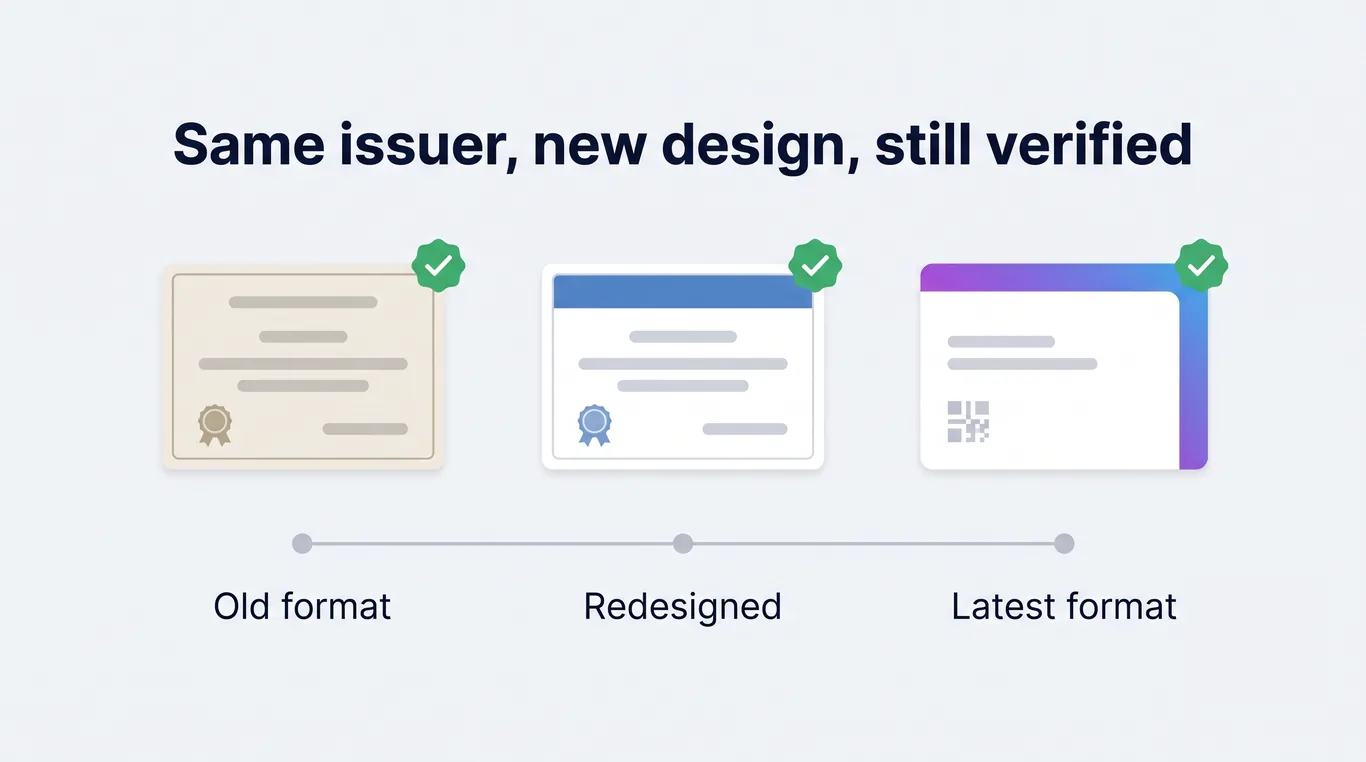
The same university certificate in three different designs across the years, each one screened and cleared
Issuers redesign certificates every few years. Screening should clear every genuine version.

When you evaluate any verification tool, ask one question: what happens the year an issuer changes its format?

Why Forensics Needs the Original File, Not a Photocopy

Forensic screening is built for the original file. A photocopy, a screenshot, a re-scan of a printout or a file re-saved through an editor is flagged "modified", even when nothing was faked.

This is the single most common surprise in a verification pilot. Tell candidates up front to upload the original digital file or a direct scan of the original document.

You can see the difference yourself: run an original PDF and a re-saved copy of it through our free document tampering checker.

Candidate instruction that saves a review queue: "Upload the original PDF you received, or a fresh scan of the original paper document. Do not upload a photocopy, a screenshot or a file you have edited, compressed or converted."

Why Forensics Misses the From-Scratch Fake

Forensics cannot tell you whether an issuer ever issued a document. A certificate typed fresh on a copied letterhead has no edit history to find.

This is not a hypothetical risk. In December 2025, Kerala Police seized more than one lakh fake certificates carrying the names of real universities, traced to a printing house.

Printed and scanned, such a certificate can look cleaner than a genuine one that was stapled, stamped and photocopied for years.

Generative AI adds a second route. A document generated in one pass was never edited after creation, so it may pass forensic screening too.

The honest conclusion: a clean forensic report means "not edited", never "genuine". Fake certificate detection that stops at forensics will miss this whole category.
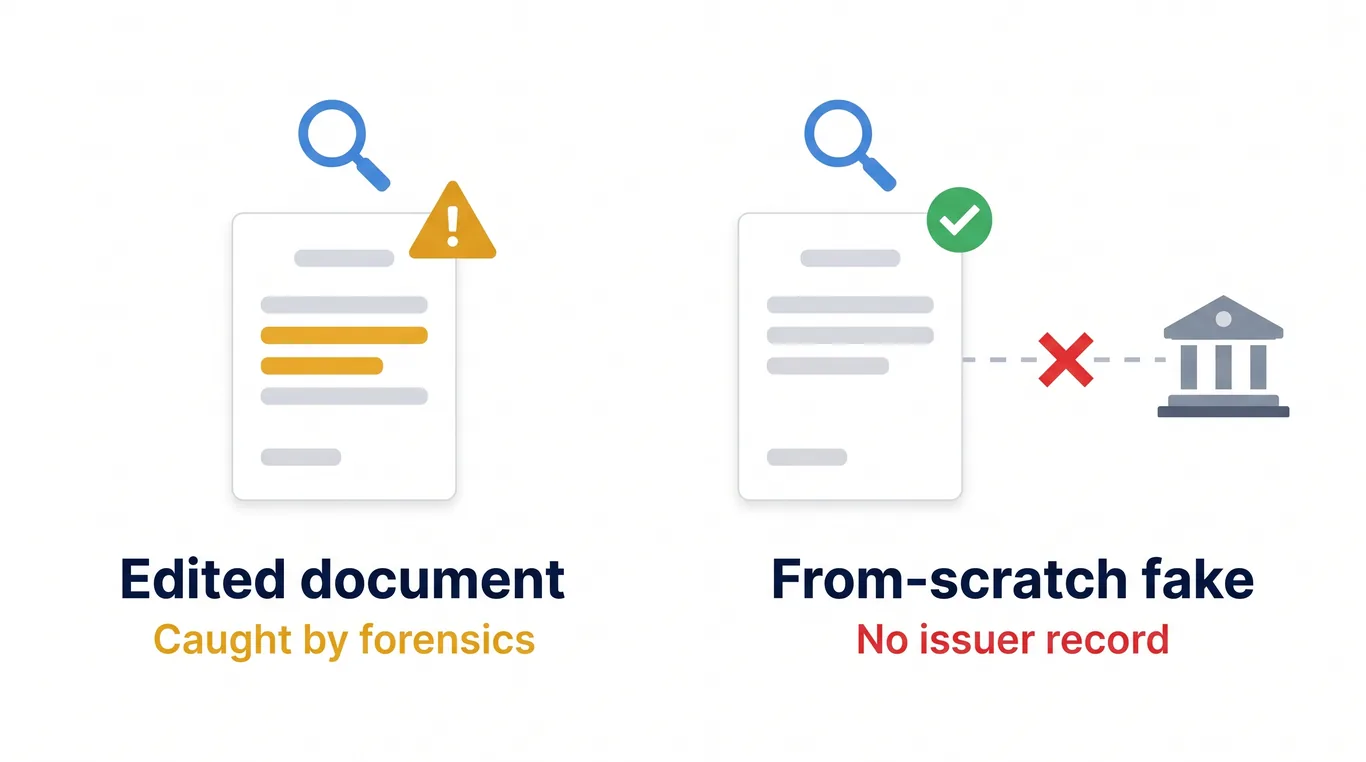
An edited genuine certificate caught by tamper screening, next to a from-scratch fake that passes screening but has no issuer record
Forensics catches the edited document. Only the issuer's record exposes the clean, from-scratch fake.

Forensics, source checks, one flow

Bring a real candidate file. We run all three checks live.

  • Tamper flags on every upload
  • DigiLocker and UAN, with consent
  • Cross-document mismatch checks
  • Pass, refer or fail per file
Book a Free Demo →

Or try a free tool first.

🔒 CERT-IN Certified🛡 ISO 27001🎟 Free trial tokens

What Source Verification Proves: Whether the Issuer Holds the Record

Source verification checks a claim against the issuer's own record, not against the uploaded file. If the record exists and matches, the document is backed by the body that issued it.

That makes it the only check that defeats a clean, from-scratch fake. The fake has no record behind it.

In India the main source channels are:

  • DigiLocker and the National Academic Depository: degrees and marksheets issued directly by participating universities and boards, pulled with the candidate's consent. See our DigiLocker document verification page.
  • UAN and EPFO records: employers, joining and exit dates from PF contributions, covered in our employment history verification API guide.
  • PAN, GSTIN and company registries: identity and business records confirmed against the issuing department.
  • Direct issuer confirmation: a letter or email from the university or employer, still the fallback for everything else.

DocuExprt connects to PAN, Aadhaar, GST and 30+ government database APIs, listed on our government verification API page.

Where Source Verification Runs Out: Coverage, Consent, Cost and Time

Source verification only works where a registry holds the record and the person consents to the check. Outside that, it has nothing to query.

The gaps show up quickly in real files:

  • Older records: many degrees issued before universities began uploading to DigiLocker and NAD are not there, and individuals cannot push their own old records in.
  • Private universities and small issuers: coverage varies widely by institution.
  • No API at all: hospitals, most private employers and local issuing offices publish no verification interface.
  • EPFO blind spots: contract roles, small establishments below the PF threshold and overseas jobs leave no passbook entry.
  • Consent friction: every check needs the person's informed consent, and requests sent by email are often ignored.
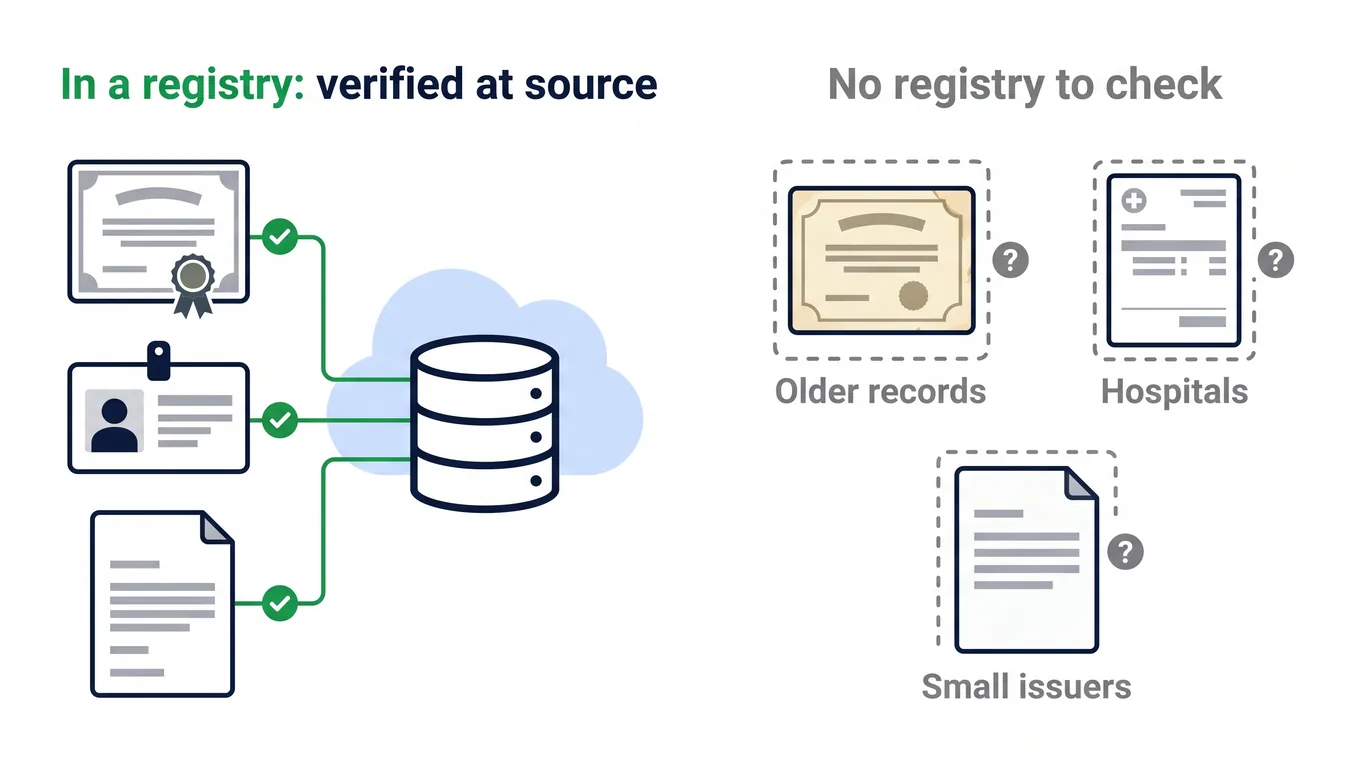
Documents connected to an official registry and verified, while older, hospital and small-issuer documents have no registry to query
Source checks only reach documents a registry holds. The rest need another route.

Where no registry exists, the fallback is the issuer letter. A background-verification firm told us university confirmations take 20 to 45 days, often carry a fee, and vary by institution.

Some of their clients still require that genuineness letter for compliance, whatever the automated result says.

Document Forensics vs Source Verification: Side-by-Side Comparison

The two checks answer different questions, so neither replaces the other. Forensics is fast and universal but cannot prove issuance; source verification proves issuance but only where a registry exists.

🔬 Document forensics

  • Proves: the file was or was not edited
  • Coverage: any document, any issuer
  • Speed: seconds per file
  • Misses: clean, from-scratch fakes
  • Consent: covers the file the person submitted
VS

🏛️ Source verification

  • Proves: the issuer holds a matching record
  • Coverage: only where a registry or API exists
  • Speed: real time by API; weeks by letter
  • Misses: anything outside the registry
  • Consent: explicit consent per check
FactorDocument forensicsSource verification
Question answeredWas this file altered?Did the issuer issue this?
Catches edited genuine documentsYesYes, if a field differs from the record
Catches from-scratch fakesOften notYes, where a record should exist
CoverageEvery document typeRegistries and APIs only
SpeedSecondsSeconds by API; 20-45 days by issuer letter
Cost profileLow, per documentPer API call; issuer fees for letters
Typical failure modeFalse flags on stamps and signatures"No record found" for genuine old documents
Evidence value in an auditShows the file was screenedShows the issuer confirmed it

Cross-Document Mismatch Checks: The Third Layer

Cross-document checks compare what several documents, and the applicant, say about the same fact. They catch lies that are internally clean in every single file.

A fabricated document still has to agree with everything else in the application. That is hard to fake consistently.

  • Declared vs documented marks: an admissions intermediary told us students' stated marks often differ from their marksheets.
  • Salary across three documents: offer letter, payslip and bank credit should reconcile. See our salary slip verification guide.
  • Employment dates: an experience letter's tenure against UAN joining and exit dates.
  • Identity fields: name, date of birth and father's name across ID, marksheet and certificate.
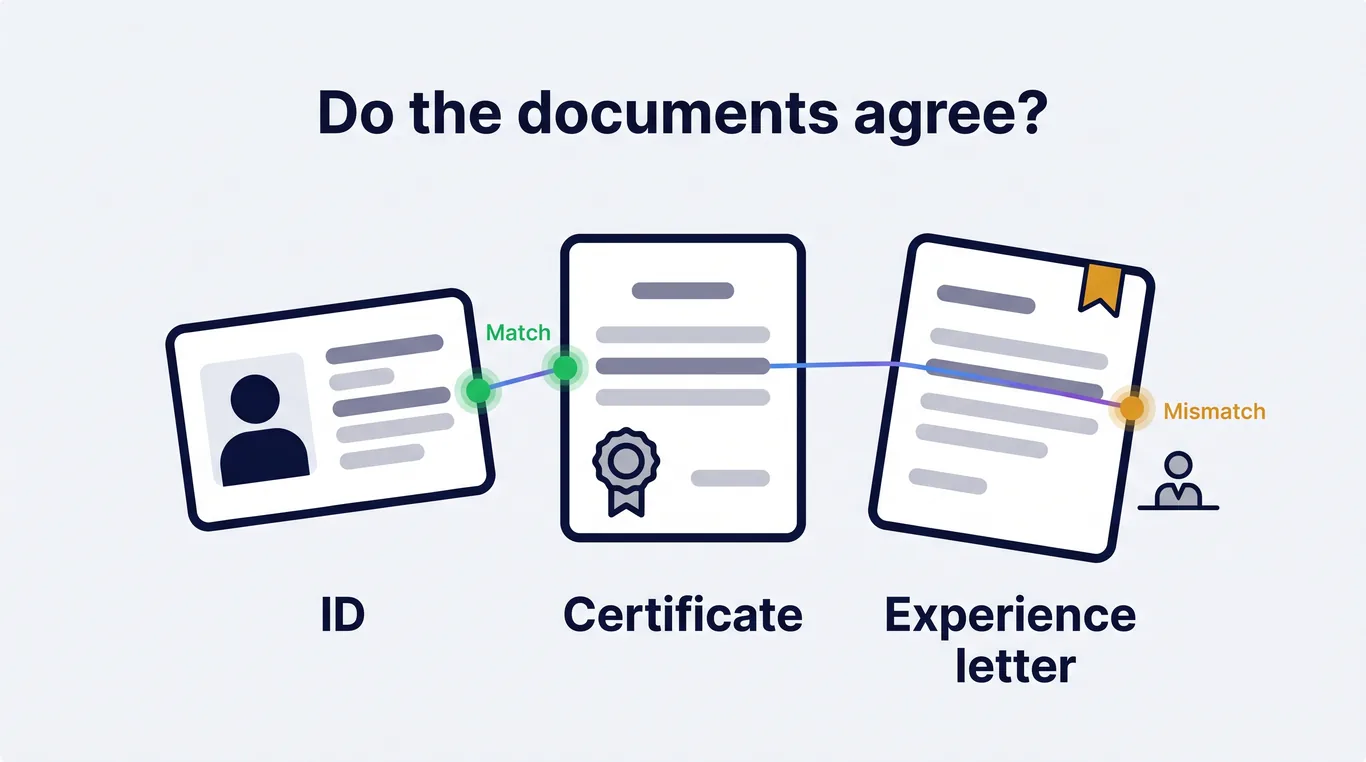
Three documents from one application linked together, with one fact that does not match flagged for review
Each file can look clean alone. Compared side by side, the mismatch shows.

A mismatch does not prove fraud. It tells the reviewer exactly which fact to confirm, which is faster than re-checking the whole file.

Shrink the issuer-letter queue

Tell us your document mix and monthly check volume.

  • Tamper screening on every file
  • PAN, Aadhaar, GST + 30+ govt DBs
  • Your own pass and refer thresholds
  • Audit logs for all actions
Talk to Our Team →

Or book a demo on your own files.

🔒 CERT-IN Certified🛡 ISO 27001🎟 Free trial tokens

Which Verification Check to Use for Each Document Type

Match the check to what exists behind the document. Use source verification wherever a registry covers it, and lean on forensics and cross-checks where none does.

DocumentForensicsSource checkCross-checkEscalate to issuer when
Degree / marksheetYesDigiLocker / NAD where coveredDeclared marks, name, DOBNot on DigiLocker, or flagged
Experience letterYesUAN / EPFO historyTenure vs UAN datesNo PF record, or dates conflict
PayslipYesForm 26AS or UAN, with consentOffer letter and bank creditFigures do not reconcile
PAN / Aadhaar / IDYesGovernment database or secure QRName and DOB across documentsRecord mismatch
Medical billYes, score-basedUsually none: hospitals rarely expose APIsPatient name, dates, amountsHigh risk score or large claim
Domicile / caste certificateYesDigiLocker where the state issues thereAddress across documentsNot on DigiLocker, or flagged

A crowdfunding platform we worked with could only use forensics on hospital bills. With no hospital API to query, a risk score decided which bills a person reviewed.

How a Layered Verification Workflow Shrinks the Issuer-Letter Queue

Run cheap, universal checks on every file first, and save slow issuer confirmation for the cases that fail or fall outside any registry. Automation speeds up first-level screening; it does not replace issuer confirmation where your clients require it.

Step 1Forensics + cross-check at intake
→
Step 2Source check where a registry exists
→
Step 3Pass, refer or fail
→
Step 4Issuer letter for referred files only

In DocuExprt this runs as one workflow that routes each file by its result, against pass and refer thresholds you set.

For a BGV firm, the gain is not skipping the university. It is sending the university only the files that need it, with the reason attached.

Positioning that holds up with compliance teams: automated checks are first-level screening. Where a client contract requires an issuer letter, the workflow still requests one, and the screening result travels with it.

Source checks are only as defensible as the channel they use and the consent behind them. Ask any provider where each record comes from, and keep the consent with the result.

A BGV firm serving multinational clients told us those clients ask one question first: is this UAN and ID data coming from an official channel, and is it legal to use?

It is the right question. Our HR document verification page states that PAN, Aadhaar and UAN checks run through official, authorised channels.

Government registries publish sanctioned integration routes too, such as DigiLocker's APIs on API Setu.

What the DPDP Act Means for Verification Consent

Under the Digital Personal Data Protection Act, 2023, verification data is personal data, so most checks rest on the person's informed consent for a stated purpose.

The DPDP Rules, 2025 were notified in November 2025 with an 18-month phased rollout. Most notice and consent obligations apply at the end of that window.

In practice that means four things for a verification workflow:

  • A notice naming each check you intend to run.
  • Consent tied to that purpose, not a blanket authorisation.
  • A consent channel people actually respond to. Email requests are often ignored; an OTP step is harder to miss.
  • An audit trail showing who verified what, when, and on what consent.

This is general information, not legal advice. Confirm your own obligations with counsel.

How to Tune Forensic Checks Without Flooding Reviewers

Treat a forensic flag as a reason to look, not a verdict. Tune the checks and thresholds to your document mix, and route anything above the threshold to a human reviewer.

Genuine documents trigger flags too. A recruitment client found that rubber stamps and wet signatures, added after printing, often read as "modified".

That is technically true. The stamp was added later. It is just not fraud.

Three settings keep the review queue useful:

  • Checks per document type: choose which checks apply to each document type, rather than reviewing noise.
  • Your own thresholds: a payslip and a medical bill need different pass and refer cut-offs.
  • A review queue with reasons: reviewers see why a file was flagged, then record a decision.

Every reviewer decision is also data. Over a few weeks it shows which flags are noise for your documents and which ones catch real edits.

Key Takeaways

  1. Forensics proves a file was not edited; it never proves a document is genuine.
  2. A from-scratch or AI-generated fake can pass every tamper check.
  3. Source verification proves issuance, but only where a registry holds the record.
  4. Older, private-university and hospital documents often have no registry to query.
  5. Cross-document checks catch lies that each file hides on its own.
  6. Screen every file fast, then send only flagged or uncovered files to the issuer.
  7. Choose screening that keeps working when issuers change their formats.
  8. Ask for the original file: photocopies and re-saved files are flagged as modified.

Frequently Asked Questions

What is the difference between document forensics and source verification?

Document forensics screens the file itself for signs that it was edited after it was issued. Source verification checks the claim against the issuer's own record, such as DigiLocker, UAN or a government database. Forensics shows whether a file was altered; source verification shows whether it was ever issued.

Can document forensics detect a completely fake certificate?

Not reliably. A certificate created from scratch or generated by AI has no edited region to find, so it can pass forensic checks. Catching it needs source verification or issuer confirmation, and cross-document checks often expose inconsistencies with the rest of the application.

What if a degree is not available on DigiLocker?

Many older degrees and some private-university records are not on DigiLocker or NAD. For these, run forensic and cross-document checks first, then request confirmation from the university for files that are flagged or that your client requires an issuer letter for.

Can document forensics verify a photocopy?

No. Forensic screening is designed for the original file. A photocopy, screenshot, re-scan or re-saved file is flagged as modified, even when the underlying document is genuine. Ask candidates to upload the original digital file or a direct scan of the original document.

Does automated verification replace university verification letters?

No. Automated forensics, cross-checks and registry lookups speed up first-level screening and reduce how many files need an issuer letter. Where a client or regulator requires a genuineness letter from the university, the letter is still needed.

Screen Fast, Confirm at Source

Forensics and source verification are not rivals. They answer different questions, and a fake that beats one rarely beats both.

Teams that layer them catch edited documents at intake, confirm what registries can confirm, and send the issuer only the files that truly need it.

Screen first, confirm at source

Bring a sample batch. We run it live on the demo.

  • 99% accuracy
  • CERT-IN certified, ISO 27001
  • Cloud, private cloud or on-premise
  • Role-based access and audit logs

Trusted by enterprises and government boards
Roche Products (India) Pvt. Ltd. logo
Elbrit Life Sciences Pvt. Ltd. logo
Haryana Knowledge Corporation Limited (HKCL) logo
Maharashtra Council of Agricultural Education and Research (MCAER) logo
State Board of Technical Education, Bihar (Patna) logo
SVKM's NMIMS Deemed-to-be University logo
CERT-IN CertifiedISO/IEC 27001:2013Data stays in India

Free trial tokens available for testing.

How to Detect Fake Marksheets and AI-Edited Certificates

How to Detect Fake Marksheets and AI-Edited Certificates

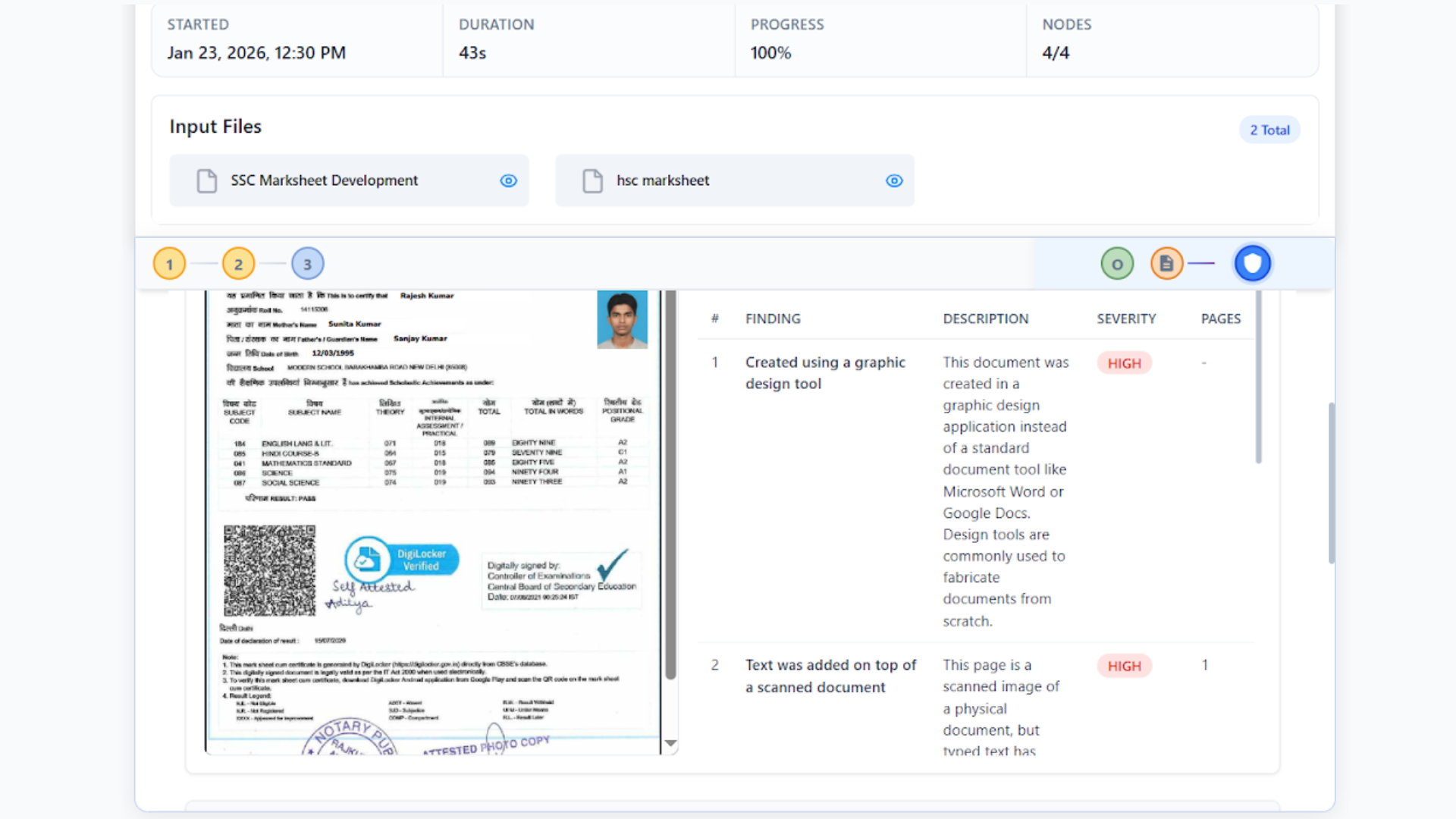
Type "marksheet editor AI" into Google and you will find tools offering to change marks, names and grades on a scanned marksheet.

No printing press. No rubber stamps. A browser tab and two minutes.

Organised forgery has not gone away either. In December 2025, Kerala Police seized more than one lakh fake certificates linked to 22 universities.

For admissions offices, HR teams and lenders, the question has changed. It is no longer "does this look real?" It is "can we prove it is real?"

This guide covers the five checks that catch fake marksheets and AI-edited certificates, and how to run them on every file instead of a sample.

📄
1 lakh+
Fake certificates seized in one Kerala Police case, Dec 2025
🎓
22
Universities whose certificates that one racket copied
🤖
~5x
Rise in AI-generated document fraud, Apr-Dec 2025 (Inscribe data)
✅
50,000+
Documents SBTE Bihar verified in days, not weeks

Screening certificates at volume?

Run your real applicant files through DocuExprt on a call.

  • Tamper flags on every upload
  • QR and digital signature checks
  • DigiLocker source verification
  • Pass, Refer or Fail with audit log
Book a Free Demo →

Or try a free tool first.

🔒 CERT-IN Certified🛡 ISO 27001🎟 Free trial tokens

What Changed: Forgery Moved From the Print Shop to the Browser

A classic fake degree needed a supplier. Someone had to copy the paper, the hologram, the seal and the signature.

The Kerala racket worked this way. Police traced it to printing presses and skilled workers who copied holograms and seals.

AI editing skips all of that. The forger starts with a genuine marksheet and changes only what matters: the marks, the grade, the name or the year.

Everything else stays authentic. The layout, the logo, the paper texture in the scan, even the controller's signature.

Old print-shop certificate forgery compared with a marksheet edited by AI on a laptop
Forgery used to need a print shop. Now it needs a browser tab.

❌ The old fake

  • Source: printed from scratch
  • Cost: paid to a racket
  • Time: days to weeks
  • Tell-tales: wrong paper, blurred seal, odd fonts
  • Caught by: a trained eye, often
VS

⚠️ The AI-edited fake

  • Source: a real marksheet, lightly changed
  • Cost: close to zero
  • Time: minutes
  • Tell-tales: invisible on screen
  • Caught by: file forensics and the issuer's record
Key point: A visual check compares a document with what a genuine one looks like. An AI-edited marksheet is a genuine one, with one number changed. Looking harder will not find it.

How to Check If a Marksheet Is Original or Fake

Check it against the source. Confirm the marks and roll number with the issuing board or university, or in DigiLocker where the institution issues there, and scan the QR code if the marksheet has one.

A marksheet that looks right but does not match the issuer's record is not original. At hiring or admissions volume, run the five checks further down on every file.

The Five Kinds of Fake Certificate You Will Actually See

"Fake certificate" covers very different frauds. Each one fails a different check.

Knowing which kind you face tells you which control to rely on.

Type of fakeHow it is madeWhat catches it
Edited genuine marksheetReal scan, marks or name changed with an editor or AI toolFile forensics + issuer record
Fabricated certificate from a real universityTemplate copied, details inventedIssuer record, QR and signature check
Certificate from an unrecognised institutionIssued by a body that is not a recognised universityRecognition check against the UGC list
Fully AI-generated documentGenerated from a prompt, no original existsTamper screening, issuer record, missing QR
Genuine document, wrong personA real certificate belonging to someone elseName, date of birth and photo cross-match

Notice that no single check catches all five. That is why the checks below work as a stack, not a menu.

5 Checks That Catch Fake Marksheets and AI-Edited Certificates

Each check answers a different question. Together they cover all five fraud types above.

🔍 1. File Forensics: Was This File Edited After It Was Issued?

A marksheet that leaves a university system and is then opened and changed in an editor no longer matches what was issued.

Automated forensic screening flags these files in seconds, even when the change is invisible on screen.

What it catches:

  • Files changed after issue, including ones edited with AI tools
  • Content added on top of an otherwise genuine document
  • Swapped marks, names or dates on a real scan
  • A stripped digital signature, or signature fields that were never filled

You can try a file yourself with our free PDF forensics viewer, which runs in your browser without uploading it.

🧪 2. Tamper Screening: Has Any Part of the Image Been Changed?

When marks, a name or a date are changed on a scan, the change can be detected even when the eye cannot see it.

Tamper screening flags the changed region and returns a risk score, so a reviewer knows exactly where to look.

The free document tampering checker gives any document a 0-100 tamper risk score in seconds.

📱 3. QR Code and Digital Signature: Does the Document Agree With Itself?

Many universities now print a QR code on marksheets and degrees. Documents issued through DigiLocker are digitally signed by the issuer.

These are powerful checks, but only if someone actually runs them. A QR code nobody scans proves nothing.

  • Decode the QR and compare its data field by field with the printed marks
  • Check where the QR points, because a lookalike domain is a common trick
  • Validate the signature, since any change after signing breaks it
Phone scanning a certificate QR code that does not match the printed marks
An edited marksheet with an untouched QR still carries the original marks.

An edited marksheet with an untouched QR code gives itself away. The QR still carries the original marks.

🏛️ 4. Source Verification: What Does the Issuer's Record Say?

This is the strongest check, because it bypasses the document entirely.

Instead of trusting the file an applicant uploads, you fetch the record from the issuer. In India that increasingly means DigiLocker and the National Academic Depository (NAD), where universities and boards issue academic records directly.

With the candidate's consent, a DigiLocker-based verification flow pulls documents straight from the issuing authority. A forger cannot edit a record they never touch.

Degree certificate verified directly from the issuing university with candidate consent
The strongest check skips the uploaded file and asks the issuer.

For older graduates whose records were never digitised, the fallback is a direct confirmation from the university's examination section.

🔗 5. Cross-Document Consistency: Does the Whole File Tell One Story?

A forger can perfect one document. Keeping five documents consistent with each other is much harder.

  • Name, date of birth and parent's name should match across marksheets, ID and degree
  • Passing years should follow a realistic sequence for the candidate's age
  • Totals and CGPA should add up from the subject marks shown
  • Roll and enrolment numbers should follow the issuer's known format
  • The photo should match the applicant's ID and selfie (try the free face match checker)

These rules catch the fifth fraud type: a real certificate carried by the wrong person.

Why a Database Match Alone Is Not Enough

Many verification setups stop at one question: does a record with this roll number exist?

That catches invented certificates. It misses the more common case.

An AI-edited marksheet usually carries a real roll number belonging to a real student. The lookup succeeds. Only the marks, or the name, are wrong.

So a lookup must compare values, not just confirm a record exists. And where no issuer record can be reached, forensics is the only line of defence left.

Key point: A database confirms that a record exists. Forensics confirms that the file in front of you was not changed. You need both, because AI-edited fakes are built to pass the first test.

This is also where document-level tools differ from pure lookup services. A lookup reads a registry. A document AI fraud detection layer also reads the paper, and can tell you when the two disagree.

Catch the edit, not just the typo

Tell us your admissions or hiring volumes.

  • Forensics plus issuer checks
  • PAN, Aadhaar, GST + 30+ govt DBs
  • Batch upload up to 100 files
  • Role-based access and audit logs
Talk to Our Team →

Or book a demo on your own files.

🔒 CERT-IN Certified🛡 ISO 27001🎟 Free trial tokens

Who Is Most Exposed

Any team that takes decisions on self-uploaded certificates carries this risk. Four carry most of it.

University registrar, HR manager, loan officer and recruitment board reviewer checking certificates for fraud
Admissions, HR, lenders and recruitment boards all decide on self-uploaded certificates.

🎓 University Admissions and Registrars

PG admissions, lateral entry and PhD intake all depend on prior marksheets. A changed percentage can move a candidate past a cut-off.

Scholarship desks face the same problem with income and caste certificates. See our guide to scholarship document verification.

💼 HR and Background Verification

Fresher hiring runs on certificates alone, with no employment history to cross-check.

Industry reports put education at roughly 10-13% of all discrepancies found in background checks. Our HR document verification guide covers the full onboarding stack, and automated background verification covers the checks beyond education.

🏦 Lenders

Education loans and study-abroad financing use marksheets and admission letters as core documents. A forged admission record means a loan against a course that does not exist.

🏛️ Recruitment Boards and Regulators

Government recruitment and professional councils verify thousands of certificates per cycle, often under deadline. Volume is exactly where sampling lets fakes through.

Manual vs Automated Certificate Verification

Manual verification is not careless. It is simply built for a world where fakes were visible.

FactorManual reviewAutomated verification
CoverageOften a sample, under deadlineEvery document, every time
Detects AI editsRarely, the edit is invisibleTamper screening and QR checks
Issuer confirmationLetters and emails, slowDigiLocker pull where available
Consistency checksDepends on the reviewerSame rules applied to every file
Audit trailNotes, if anyLogged per action, per user
Staff timeSpent on every fileSpent only on referred files

Scale changes the picture fastest. SBTE Bihar verified 50,000+ documents within a couple of days, a job that previously took weeks.

How to Build a Certificate Verification Workflow

The goal is simple. Clean files pass automatically, and your team looks only at the exceptions.

Step 1Collect
→
Step 2Extract
→
Step 3Run 5 checks
→
Step 4Route & log
  1. Collect. Take consent first. Prefer a DigiLocker pull. Accept uploads as the fallback.
  2. Extract. Marks, names, dates, roll numbers and QR payloads become structured data.
  3. Run the five checks. Forensics, tamper screening, QR and signature, issuer source, consistency.
  4. Route and log. Clear passes go through. Any conflict goes to a reviewer with the evidence attached, and every decision is logged: who verified what, when, and why.

DocuExprt runs this workflow on one platform. It combines tamper screening, QR and digital signature validation, DigiLocker source verification and checks against PAN, Aadhaar, GST and 30+ government databases.

Workflows are built in a no-code builder with Pass, Refer and Fail routing. Teams can batch upload up to 100 files at once, and every action is captured in an audit log.

📄
3.5 lakh+
Academic documents verified
🎯
99%+
Verification accuracy
🏫
180+
Colleges served
⚡
Days
Not weeks, for 50,000+ SBTE Bihar documents
Key point: Automation does not replace your reviewers. It hands them the ten files that need judgement instead of the thousand that do not.
Automated certificate verification dashboard routing only exceptions to a human reviewer
Clean files pass automatically. Reviewers see only the exceptions.

Guardrails: Verify Fairly, Not Just Fast

A fraud check that wrongly rejects genuine students creates its own problem. Build these guardrails in from day one.

  • ✅ Never auto-reject on one forensic flag. Genuine files can raise false alarms too. Refer, don't fail.
  • ✅ Take explicit consent before pulling records, in line with India's DPDP Act.
  • ✅ Mask Aadhaar numbers you do not need. Our Aadhaar masking tool shows how.
  • ✅ Give candidates a route to respond when a document is referred.
  • ✅ Keep the evidence behind every decision, not just the verdict.
  • ✅ Re-check at decision points, such as final admission or offer letter, not only at application.

Key Takeaways

  1. AI tools let anyone edit a genuine marksheet in minutes, and the result passes a visual check.
  2. Organised forgery persists too: one Kerala case seized more than one lakh fake certificates.
  3. There are five kinds of fake certificate, and no single check catches all of them.
  4. Forensics and tamper screening show whether a document was changed after issue.
  5. QR codes and digital signatures only help if someone decodes and validates them.
  6. Issuer verification through DigiLocker and NAD is the strongest check, because it bypasses the uploaded file.
  7. A database lookup must compare values, because AI-edited fakes often carry real roll numbers.
  8. Automate the five checks, route conflicts to reviewers, and log every decision.

Frequently Asked Questions

How can you tell if a marksheet has been edited with AI?

Check the file, not just the image. Automated forensic screening flags documents changed after issue, even when the edit is invisible, and a decoded QR code will still show the original marks. The surest test is to compare the document with the issuer's own record.

Can a fake certificate pass a visual check by HR?

Yes. An AI-edited certificate starts from a genuine document and changes only a few values, so the layout, logo, seal and signature are all real. Visual review was designed to catch badly printed fakes, not surgical digital edits.

What is the most reliable way to verify a degree certificate in India?

Fetch the record from the issuer rather than trusting the uploaded file. Universities and boards issue academic records through DigiLocker and the National Academic Depository, and a consent-based DigiLocker pull returns the issuer's own copy. For older records that were never digitised, ask the university's examination section to confirm directly.

Is a certificate with a QR code always genuine?

No. A QR code can be copied from another certificate or point to a lookalike website. Decode it, confirm the domain belongs to the issuer, and compare every field in the QR payload with the printed document. A mismatch is a strong sign of editing.

Is automated certificate verification practical for large volumes?

Yes, volume is where it helps most. Automated checks run on every document instead of a sample, and reviewers see only the files that raise a conflict. SBTE Bihar used DocuExprt to verify more than 50,000 documents within a couple of days, work that previously took several weeks.

The Edit Is Invisible. The Evidence Is Not.

AI has made forging a marksheet cheap and fast. It has not made it undetectable.

Every edited file leaves evidence: in the file itself, in its QR code and in its disagreement with the issuer's record.

The organisations that stay ahead will be the ones that check those traces on every file, automatically, and keep their people for the judgement calls.

Universities, boards and enterprises already run academic verification on DocuExprt, from SBTE Bihar to VIT Vellore.

Stop AI-edited certificates at intake

Bring a sample batch. We run it live on the demo.

  • 3.5 lakh+ documents verified
  • 99%+ verification accuracy
  • SBTE Bihar: 50,000+ docs in days
  • Only exceptions reach your team

Trusted by enterprises and government boards

Roche Products (India) Pvt. Ltd. logo
Elbrit Life Sciences Pvt. Ltd. logo
Haryana Knowledge Corporation Limited (HKCL) logo
Maharashtra Council of Agricultural Education and Research (MCAER) logo
State Board of Technical Education, Bihar (Patna) logo
SVKM's NMIMS Deemed-to-be University logo
CERT-IN CertifiedISO/IEC 27001:2013Data stays in India

Free trial tokens available for testing.

Document Scrutiny Status Meaning: RTO, Scholarship and Exam Portals

Document Scrutiny Status Meaning: RTO, Scholarship and Exam Portals

You checked your application status and it says "Scrutiny – (Verification of Proof Documents)". Or "Pending for Scrutiny (Level-1)". Or simply "Under Scrutiny". Here is what those messages mean, portal by portal.
Short answer: your documents have been received and an officer has to check them. Scrutiny is a normal processing stage. It is not a rejection, and it does not mean something is wrong with what you submitted.
This page covers the exact status labels used by driving licence, scholarship, exam and insurance portals in India, and what each one means for you.
FREE STATUS DECODER
What does my scrutiny status mean?
Type or paste the exact message from your portal, or tap one below.
Scrutiny – (Verification of Proof Documents)
Parivahan Sarathi · driving licence, learner’s licence
What it meansThe RTO is checking the proof documents you uploaded, such as age, address and ID proof.
What to doCheck your acknowledgement slip for an RTO appointment. Attend it with your original documents.
हिंदी में: आरटीओ आपके अपलोड किए गए प्रमाण दस्तावेज़ों की जाँच कर रहा है।
Full RTO status guide ↓
Pending for Scrutiny (Level-2)
National Scholarship Portal
What it meansYour institution has approved it. It is now with the district or state authority.
What to doWait. No action is needed from you at this stage.
हिंदी में: संस्थान ने मंज़ूरी दे दी है, अब आवेदन ज़िला या राज्य स्तर पर जाँच के लिए लंबित है।
Full scholarship status guide ↓
Pending for Scrutiny (Level-1)
National Scholarship Portal
What it meansYour application is waiting for your own school or college to verify it.
What to doContact your institute’s nodal officer. The application is sitting with them.
हिंदी में: आपका आवेदन आपके स्कूल या कॉलेज द्वारा सत्यापन के लिए लंबित है।
Full scholarship status guide ↓
Under Scrutiny
GATE and other exam portals
What it meansThe details, photograph and signature you entered are being checked.
What to doWatch your email for a correction request and respond before the deadline.
हिंदी में: आपके आवेदन की जानकारी, फ़ोटो और हस्ताक्षर की जाँच चल रही है।
Full exam status guide ↓
No action taken
Various government portals
What it meansThe file is in the queue. No officer has opened it yet.
What to doFollow up with the office if it goes past the published processing time.
हिंदी में: फ़ाइल कतार में है, अभी किसी अधिकारी ने इसे खोला नहीं है।
What to do if it does not move ↓
Subject to claim documents scrutiny
Insurance claims
What it meansThe claim is accepted in principle, pending a check of your documents.
What to doSubmit any documents the insurer has listed as outstanding.
हिंदी में: दावा सैद्धांतिक रूप से स्वीकार है, दस्तावेज़ों की जाँच बाकी है।
Full insurance claim guide ↓
Pending for Scrutiny / Document Scrutiny
Any portal
What it meansAn officer still has to check your uploaded documents against the rules. Nothing is wrong yet.
What to doCheck whether the portal shows a level (Level-1, Level-2) or an appointment. That tells you who holds the file.
हिंदी में: आपके दस्तावेज़ों की जाँच (सत्यापन) अभी बाकी है।
See every status in the table ↓
We could not match that message. Try one of the statuses above, or check the full lookup table below.
Run a verification queue like these? See how DocuExprt clears scrutiny backlogs →

Status message lookup table

Find the message you are seeing in the first column.
Status messageWhere you see itWhat it meansWhat to do
Scrutiny – (Verification of Proof Documents)Parivahan Sarathi – driving licence, learner's licenceThe RTO is checking the proof documents you uploaded.Check your acknowledgement slip for an RTO appointment. Attend it with originals.
Pending for Scrutiny (Level-1)National Scholarship PortalWaiting for your own school or college to verify the application.Contact your institute's nodal officer. It is sitting with them.
Pending for Scrutiny (Level-2)National Scholarship PortalYour institution has approved it. Now with the district or state authority.Wait. No action needed from you.
Under ScrutinyGATE and other exam portalsYour entered details, photograph and signature are being checked.Watch your email for a correction request.
No action takenVarious government portalsThe file is in the queue. No officer has opened it yet.Follow up with the office if it exceeds published processing time.
Subject to claim documents scrutinyInsurance claimsThe claim is accepted in principle, pending a document check.Submit any documents the insurer has listed as outstanding.

Driving licence and RTO status (Parivahan Sarathi)

This is the most common source of the phrase Scrutiny – (Verification of Proof Documents). It appears after you submit a learner's licence or driving licence application on the Parivahan Sarathi portal. It means the RTO is verifying the proofs attached to your application – usually age proof, address proof and your photograph. The part that catches people out: in many states this stage does not complete online. Your application waits until you attend the RTO in person with the original documents for physical verification and biometrics.
If your status has not moved for days: open the acknowledgement slip your application generated. If it names an appointment date and RTO office, the status will not advance until you attend. The portal will keep showing scrutiny indefinitely.

Scholarship status (National Scholarship Portal)

Scholarship applications pass through verification levels, and the level number tells you exactly who is holding your file.

Level-1 – your institution

Level-1 verification is done by the Institute Nodal Officer at your own school or college. "Pending for Scrutiny (Level-1)" means your application has reached your institution and is waiting for that officer to act. The portal cannot move it forward. Only your institution can.

Level-2 – district or state

Once your institution approves, the application moves to the district or state authority for the second check. At this point there is nothing for you to do. The file is out of your institution's hands.
Practical tip: if Level-1 has not moved for several weeks, contact your college's scholarship or nodal officer by name. Applications stall at Level-1 far more often than at any other stage, usually because the officer has a large queue and no reminder system.

Exam application status (GATE and similar)

On exam portals, "Under Scrutiny" refers to a compliance check rather than a document authenticity check. The portal is confirming that your entered details, uploaded photograph and signature meet the specification – correct dimensions, clear image, matching name. This stage is usually quick because much of it is automated. If something fails the check, most exam portals open a correction window and email you. Watch the email address you registered with, including the spam folder.
Run One of These Queues?
Cut scrutiny from days to a same-day decision.
  • Applications triaged in minutes
  • Verified at source, not on screen
  • Only exceptions reach officers
  • Status visible to applicants
Book a Free Demo →
🔒 CERT-IN Certified🛡 ISO 27001🎟 Free trial tokens

Insurance claim document scrutiny

"Subject to claim documents scrutiny" means the insurer has accepted your claim in principle but has not finished checking the supporting documents. The claim amount is not final until that check completes. If the insurer has listed outstanding documents, supplying them is the only thing that moves this forward.

What to do if your status does not change

Work through these in order. Most stalled applications are resolved by the first two.
  • ✅ Re-read your acknowledgement slip. It often names a required appointment or a document you have not supplied.
  • ✅ Identify who holds the file. The status label usually tells you – your institution, the RTO, the district office. Contact them, not the portal helpdesk.
  • ✅ Check your registered email and phone. Correction requests are frequently sent and missed.
  • ✅ Compare against the published processing time. Only escalate once you are past it.
  • ✅ Do not re-apply. A duplicate application usually goes to the back of the same queue and can cause both to be held.
Why Scrutiny Takes So Long
Manual queues. Automation removes the waiting.
  • Thousands of documents per batch
  • 30+ government checks, one flow
  • Audit trail written at each step
  • Free trial tokens to test with
Talk to Our Team →
Or book a demo on your own files.
🔒 CERT-IN Certified🛡 ISO 27001🎟 Free trial tokens

Why scrutiny takes as long as it does

The delay is almost never about your documents. It is about volume. Verification queues at institutions and government offices are still largely manual. An officer opens each application, compares the uploaded document against the entered details, and decides. Checking one applicant's document set by hand takes roughly 30 to 75 minutes. Multiply that by an admissions intake or a post-deadline scholarship rush, and a backlog of weeks builds from a queue that was never designed to absorb it. This is why the same status can clear in two days in one district and take six weeks in another. The process is identical; the queue length is not.

Key Takeaways

  1. Scrutiny is normal. It means your documents are being checked, not that they were rejected.
  2. The label tells you who holds your file. Level-1 is your institution; RTO scrutiny is the transport office; exam scrutiny is the examining body.
  3. Driving licence scrutiny often needs an in-person visit. Check your acknowledgement slip for an appointment before assuming the portal is stuck.
  4. "No action taken" is a queue position, not a fault. Nobody has opened the file yet.
  5. Contact whoever holds the file, not the portal helpdesk. The helpdesk cannot approve a verification step.
  6. Never submit a duplicate application. It rarely speeds anything up and often delays both.
  7. Delays come from queue length, not from your paperwork. Manual checking takes 30 to 75 minutes per applicant.

Frequently Asked Questions

What does document scrutiny status mean?

Document scrutiny status means your application has been received and your uploaded documents are being checked by the issuing authority. It is a normal processing stage, not a rejection and not a problem with your application. The check confirms that the documents are genuine, that the details on them match what you entered in the form, and that nothing required is missing. Your application moves to the next stage once an officer completes that check.

What does “Scrutiny – (Verification of Proof Documents)” mean on Parivahan?

On the Parivahan Sarathi portal it means the RTO is verifying the proof documents you uploaded with your driving licence or learner's licence application — typically your age proof, address proof and photograph. In many states this stage also requires you to attend the RTO in person with the original documents for physical verification and biometrics. Check the acknowledgement slip your application generated: if it lists an RTO appointment, the status will not advance until you attend.

What does “Pending for Scrutiny (Level-1)” mean on the scholarship portal?

On the National Scholarship Portal, Level-1 verification is done by your own school or college, by the Institute Nodal Officer. “Pending for Scrutiny (Level-1)” means your application has reached your institution and is waiting for that officer to verify it. Level-2 is the district or state authority, which reviews it after your institution approves. If Level-1 has not moved for several weeks, the fastest fix is to contact your institution's scholarship or nodal officer directly, because the application is sitting with them and not with the portal.

What does “no action taken” mean on a document scrutiny status?

It means no officer has acted on your application yet. The file has reached the verification queue but nobody has opened, approved or rejected it. It does not indicate a defect in your documents. This status commonly appears during peak application periods when queues are long. If it persists well beyond the published processing time, follow up with the office handling your application, since the delay is on their side and nothing you submit again will clear it.

How long does document scrutiny take?

It depends entirely on the authority and the season, not on your documents. Driving licence scrutiny at an RTO is often resolved within a few working days once you have attended any required appointment. Scholarship verification can take several weeks, because it passes through your institution before it reaches the district or state level, and volumes peak immediately after the application deadline. Exam application scrutiny is usually the fastest, since it is largely an automated compliance check on your photo, signature and entered details.

If you run one of these verification queues

Everything above describes the applicant's side of a manual verification backlog. If you work at an institution or authority processing these queues, the same check that takes 30 to 75 minutes by hand can be automated against government databases and completed in under 30 seconds per document set. How AI automates document scrutiny →
Run It on Your Own Queue
Bring one real batch. We scrutinise it on the call.
  • Your scrutiny workflow mapped
  • 30+ government databases, real time
  • Inspection-ready audit trails
  • Cloud, private cloud or on-premise
Trusted by enterprises and government boards
Roche Products (India) Pvt. Ltd. logo Elbrit Life Sciences Pvt. Ltd. logo Haryana Knowledge Corporation Limited (HKCL) logo Maharashtra Council of Agricultural Education and Research (MCAER) logo State Board of Technical Education, Bihar (Patna) logo SVKM's NMIMS Deemed-to-be University logo
CERT-IN CertifiedISO/IEC 27001:2013Data stays in India

Free trial tokens available for testing.

Document Fraud Detection: How AI Image Forensics Catches Tampered Documents

Document Fraud Detection: How AI Image Forensics Catches Tampered Documents

Global fraud losses reached $442 billion in 2024. In identity verification alone, machine vision technologies caught $3 billion worth of forged documents - and that's only what was detected. By early 2025, deepfakes accounted for 40% of all biometric fraud instances.

The problem is accelerating. After analyzing tens of millions of documents, fraud detection platforms have found that up to 17% of digital bank statements used for loan applications have been tampered with, and 15% of company registration certificates submitted during vendor onboarding are fake.

AI-generated documents - fake PAN cards, fabricated salary slips, synthetic academic certificates - are now sophisticated enough to pass visual inspection by trained professionals. Our guide shows how to detect fake marksheets and AI-edited certificates.

Traditional document verification - human reviewers looking at documents for "obvious" signs of tampering - fails against this reality. You cannot visually detect a well-made digital edit or an AI-generated document. And you certainly cannot verify at the speed and scale that modern enterprises require.

This guide covers what AI-powered document fraud detection catches, from tampered files to the ultimate defense: government database cross-verification that catches what even the best AI-generated forgeries cannot fake.

The Growing Threat of Document Fraud

Document fraud is not a new problem - but the tools available to fraudsters in 2026 have fundamentally changed the threat landscape. What once required physical counterfeiting skills now requires only a laptop, AI tools, and a PDF editor.

Document Fraud by the Numbers

Fraud Metric Scale
Global fraud losses (2024) $442 billion
Consumer-reported fraud losses in US (2024) $12.5 billion (25% YoY increase)
Forged documents caught by machine vision $3 billion worth in identity verification
Synthetic identity document fraud growth (North America) 311% increase
Deepfakes as percentage of biometric fraud (2025) 40%
Tampered bank statements in loan applications Up to 17%
Fake company registration certificates 15% of submissions
AI fraud detection prevention value (2025) $25.5 billion in prevented losses
Organizations victimized by payments fraud (2024) 79%

Four types of document fraud arranged by sophistication: physical tampering, digital manipulation, complete fabrication, and AI-generated documents.

Types of Document Fraud

Sophistication and detection difficulty rise with each tier.

01 · TIER 1
Detectable

Physical tampering

Altering dates, amounts, or names on real documents — erasing, rewriting, swapping pages, or modifying stamps and seals.

Tells: ink shifts, paper texture, alignment
02 · TIER 2
Hard to detect

Digital manipulation

Photoshop and PDF editors used to alter salary slips, bank statements, and certificates — often pixel-perfect to human reviewers.

Caught by: AI tamper screening
03 · TIER 3
Very hard

Complete fabrication

Entirely fake documents built from scratch — government IDs, registration certificates, and academic degrees with realistic logos and seals.

Scale: 1M+ fake certificates uncovered, India 2025
Newest threat
04 · TIER 4

AI-generated documents

Generative AI builds realistic PAN cards, salary slips, bank statements, and IDs with consistent fonts, formatting, and plausible data.

Threat: nothing edited — created clean

1. Physical Tampering:
Altering dates, amounts, names, or other details on genuine documents. This includes erasing and rewriting information, replacing pages in multi-page documents, and altering stamps or seals.

Physical tampering leaves traces - inconsistent ink, paper texture variations, alignment issues - that trained eyes can sometimes catch, but at scale this approach fails.

2. Digital Manipulation:
Using Photoshop, PDF editors, and other tools to modify digital documents. This is far more common than physical tampering and significantly harder to detect visually.

Altered salary slips, modified bank statements, and edited certificates can appear pixel-perfect to human reviewers. AI forensics flags the edits that digital manipulation leaves behind, even when they are invisible on screen.

3. Complete Fabrication:
Creating entirely fake documents from scratch - fake government IDs, fabricated company registration certificates, forged academic degrees with realistic logos, seals, and formatting.

In December 2025, Kerala Police seized more than 1 lakh fake academic certificates linked to 22 universities, and investigators estimate up to 1 million fakes are already in circulation. Many were virtually indistinguishable from legitimate documents.

4. AI-Generated Documents:
The newest and most dangerous category. Generative AI tools can now create realistic-looking PAN cards, salary slips, bank statements, and even identity documents with consistent formatting, appropriate fonts, and plausible data.

AI-generated documents don't have the telltale signs of traditional forgery - they are created clean, without any cutting, pasting or editing.

Industries Most Affected

Industry Fraud Type Financial Impact
BFSI Fake KYC documents, forged income proofs, manipulated bank statements ₹36,014 crore in banking fraud (FY 2024-25)
Insurance Altered medical bills, fake FIRs, inflated repair estimates 5-10% of all claims are fraudulent
HR/Recruitment Fake certificates, forged experience letters, inflated resumes ₹8-12 lakhs per bad hire
Real Estate Altered property documents, fake ownership certificates, forged NOCs Lakhs to crores per fraudulent transaction
Education Fake academic certificates, manipulated marksheets 10-13% of BGV checks reveal discrepancies
Government Fake identity documents for benefits, forged eligibility certificates Billions in welfare scheme leakage

Catch Tampered Documents Fast

Image forensics plus source verification, together.

  • AI tamper screening
  • QR, watermark and signature checks
  • Cross-checked at government source
  • Discrepancy named, not guessed
Book a Free Demo →

Or try a free tool first.

🔒 CERT-IN Certified🛡 ISO 27001🎟 Free trial tokens

How AI Image Forensics Detects Document Tampering

AI forensic screening catches five kinds of tampering that the human eye misses.

95%+
Detection accuracy

Enterprise-grade forensic AI flags tampering that no human reviewer can see, and returns a risk score for every document.

What It Catches

01

Edited names, amounts and grades

The most common fraud is a genuine document with one detail changed.

What it catches
  1. A name changed on an ID card
  2. An amount raised on a bill or payslip
  3. A grade upgraded on a certificate
In practice

A PAN card with the name changed after issue is flagged before it reaches onboarding.

02

Swapped photos and pasted elements

Photos, seals, signatures and line items added after a document was issued.

What it catches
  1. A replaced photograph
  2. A seal or signature added later
  3. Line items duplicated to inflate a claim
In practice

On a medical bill, duplicated line items used to inflate the total are flagged for review.

03

Files changed after issue

Documents that were opened and altered after they left the issuing system.

What it catches
  1. Edits made after the issue date
  2. Content added on top of a genuine file
  3. Records that did not come from the issuer's system
In practice

A salary slip dated January 2026 but altered weeks later is flagged, even though it looks identical on screen.

04

AI-generated and AI-edited documents

Documents produced or retouched by generative AI tools.

What it catches
  1. Certificates generated from a prompt
  2. Synthetic ID cards
  3. Scans retouched with AI editors
In practice

An AI-generated experience letter is flagged and then checked against UAN employment records.

05

Facts that do not agree

Details that conflict across the documents in one application.

What it catches
  1. Name or date of birth mismatches
  2. Tenure that conflicts with PF records
  3. Salary that does not match bank credits
In practice

A degree, an ID and an offer letter that disagree on the date of birth go straight to a reviewer.

Document Tampering & Forensics

Government Database Cross-Verification - The Second Layer

AI image forensics is powerful but it has a fundamental limitation. As AI generation technology improves, forensic detection becomes an arms race. A sufficiently advanced AI-generated document may eventually produce clean forensics.

This is where government database cross-verification becomes the definitive defense layer. AI can generate a perfect-looking PAN card - but it cannot create a valid PAN entry in the NSDL database.

Why Image Forensics Alone Is Not Enough

Scenario Image Forensics Result Government API Result True Status
Genuine document Pass Pass (data matches) Legitimate
Crude forgery Flagged (edit detected) Fail (number doesn't exist) Fraudulent
Expert digital manipulation May pass Fail (data mismatch) Fraudulent - caught by API
AI-generated document May pass (nothing was edited) Fail (number doesn't exist in database) Fraudulent - caught by API

The critical row is the last one. An AI-generated PAN card shows no edits because it was created from scratch - no original document was modified. Image forensics may not flag it.

But when the extracted PAN number is checked against the NSDL database, it either exists with matching details, or it doesn't. This binary verification is immune to AI document generation.

A Perfect Forgery Still Fails

The number exists at source, or it does not.

  • 30+ government databases checked
  • Forgery quality stops mattering
  • Mismatches flagged automatically
  • Every check timestamped
Talk to Our Team →

Or book a demo on your own files.

🔒 CERT-IN Certified🛡 ISO 27001🎟 Free trial tokens

DocuExprt's 30+ Government API Cross-Verification

Document Type Government API Verification Logic
PAN Card PAN Verification (NSDL) Does this PAN exist? Does the name/DOB match the submitted document?
Aadhaar Card Aadhaar eKYC (UIDAI) Is this Aadhaar valid? Does demographic data match?
GSTIN Certificate GSTIN Verification Is this GSTIN active? Does the business name match?
Driving License DL-Advanced (RTO) Is this DL valid? Does it belong to the named person?
Passport Passport Verification Is this passport number valid? Name and DOB match?
Voter ID Voter ID Verification Is this EPIC number valid?
Bank Statement Bank Account Verification Does this account exist? Is the account holder name correct?
Employment Letter UAN-to-Employment-History Does EPFO have records matching this claimed employment?
MSME Certificate Udyam Registration Status Is this Udyam registration valid and active?
FSSAI License FSSAI License Verification Is this food license valid for the claimed category?
Company Registration CIN-to-PAN, Director Lookup Is this company registered with MCA? Are directors valid?

Real-World Fraud Caught by Cross-Verification

Three cases where image forensics passed cleanly but API cross-checks against authoritative sources surfaced the truth.

1stolen identity
Real PAN, fake holder — caught via NSDL
5years fabricated
8 claimed vs 3 actual EPFO years
₹5.5Linflated
₹8L claim on ₹2.5L of real bills
CASE 01 Loan fraud

Sophisticated PAN card forgery

A loan applicant submits a PAN card that passes every image forensics check. The document looks genuine because, in a sense, parts of it are.

Image forensics: passed
  • Image forensics: no tampering flagged
  • Layout looks genuine
  • No sign of editing
NSDL API: caught
  • PAN number is real and active
  • Belongs to a different person entirely
  • Identity stolen from a prior data breach
Verified against NSDL PAN API
CASE 02 HR fraud

Fabricated employment history

An HR candidate submits experience letters from three companies showing 8 years of progressive growth — proper letterheads, signatures, and company stamps. Authoritative-looking on every visual axis.

Letters: looked authentic
  • Three companies, 8 years of experience
  • Proper letterheads and signatures
  • Company stamps present and aligned
UAN/EPFO: caught
  • Actual EPFO record: only 3 years
  • Two of three employers never existed in record
  • Five years of experience entirely fabricated
Verified against UAN to Employment History API
CASE 03 Insurance fraud

Manipulated insurance claim

A claimant submits medical bills totalling ₹8 lakhs from a hospital that genuinely exists. Image forensics flags the amount fields as edited — and cross-verification reveals the rest.

Hospital: verified real
  • GSTIN exists and is active
  • Hospital legitimacy confirmed
  • Claim amount: ₹8 lakhs submitted
Bills: amounts inflated
  • Amount fields flagged as edited
  • Original bills totalled only ₹2.5 lakhs
  • ₹5.5 lakhs of digital inflation
Verified against GSTIN API Image forensics

Detecting AI-Generated Documents - The 2026 Threat

AI-generated document fraud represents the most rapidly growing threat to document verification systems. Generative AI can now produce realistic fake documents - identity cards, financial statements, academic certificates, and official correspondence - that show none of the edits that give manual forgery away.

Why AI-Generated Documents Are Different

Traditional forgery modifies an existing document. This modification leaves traces that forensic screening can flag.

AI-generated documents are created from scratch. There is no "original" that was modified, so screening designed to detect editing may not flag them.

How AI-Generated Documents Differ from Genuine Ones

Despite their sophistication, AI-generated documents have distinguishing characteristics:

Signal What AI Gets Wrong
Writing that reads as generated Trained detection models flag text that was produced by AI rather than written by a person
Images that were generated AI-generated images can be flagged even when they look perfect to a reviewer
Content specificity AI-generated recommendation letters and experience certificates tend to be generic, lacking specific project names, dated events, and verifiable details
Data validity AI can generate a plausible-looking PAN number, but it cannot ensure that number is registered in NSDL's database

DocuExprt's Three-Layer AI Document Detection

Layer 01

AI Forensic Analysis

Detection models flag documents that were created or retouched by AI rather than issued, photographed or scanned from an original.

AI-created images Synthetic IDs AI-edited scans
Layer 02

Content Pattern Analysis

For text-heavy documents — recommendation letters, experience certificates, legal documents — DocuExprt checks whether the content holds up: specific, verifiable details that agree with the rest of the application.

Verifiable details Consistent facts Missing specifics
Layer 03

Government Database Verification The Ultimate Defense

The layer AI cannot defeat. AI can fabricate a perfect-looking document — but it cannot create a real entry inside a government system of record.

PAN
NSDL database
Aadhaar
UIDAI registry
GST
Returns portal
PF
EPFO records
MCA
Company registry

Industry-Specific Fraud Detection Workflows

Insurance - Claims Fraud Detection

Insurance claims fraud costs the industry 5-10% of total claims payouts. Common document fraud in insurance includes altered medical bills, fake First Information Reports (FIRs), manipulated repair estimates, and fabricated receipts.

1
Intake

Documents uploaded

Claimant submits supporting documents through the claim portal. All intake formats are accepted.

Medical bills FIR Repair estimates Identity proof
2
Analysis

AI image forensics

Tamper screening on the fields most often manipulated.

Amount fields Dates Patient details
3
Analysis

Data extraction

Structured fields pulled from each document for downstream verification and matching.

Hospital GSTIN Claimant identity Bill amounts
4
Verification

GSTIN verification

Confirm the hospital, garage, or service provider is a legitimate registered entity in active status.

GSTIN API Active registration
5
Verification

Identity verification

PAN and Aadhaar checks confirm the claimant is who they say they are — and that the names match the documents submitted.

PAN check Aadhaar check Name match
6
Decision

Cross-document analysis

Claimed amounts, dates, and entities are reconciled across every document submitted in this claim — and against historical claims by the same party.

Amount reconciliation Duplicate detection History match
7
Final · Output

Anomaly scoring

Every signal from the previous six steps feeds a probabilistic score. Claims above the fraud threshold are routed to investigators; clean claims continue to settlement.

Fraud probability Investigation queue Auto-clear path

BFSI - KYC Fraud Prevention

Banks process millions of identity documents for customer onboarding. Document fraud in banking directly enables financial crime - money laundering, identity theft, and unauthorized account access.

1
Intake

Identity documents uploaded

Customer submits identity and address documents through the onboarding flow. All standard formats are accepted.

PAN Aadhaar Address proof
2
Analysis

AI forensics

Tamper screening of every identity document — altered names, modified photos, edited dates of birth, or swapped signatures.

Tampering detection Photo integrity Field-level analysis
3
Verification

PAN verification

The PAN number is confirmed against the NSDL database — checking that it exists, is active, and matches the holder name on the submitted card.

NSDL API Active status Name match
4
Verification

Aadhaar eKYC

UIDAI-backed verification with live face match — confirming the person on the call is the same person on the Aadhaar record.

UIDAI API eKYC Face match Liveness check
5
Verification

Bank account verification

Confirms the customer actually owns the bank account being linked — ownership is established directly with the bank, not just inferred from the submitted documents.

Penny drop Account ownership IFSC validation
6
Decision

Cross-verification

The same name and identity must reconcile across PAN, Aadhaar, and bank records. Mismatches — even small ones — are flagged as a fraud signal rather than a typo.

Name consistency PAN ↔ Aadhaar Bank ↔ identity
7
Final · Output

Risk scoring

Every signal from the previous six steps feeds a single risk score. The score routes the customer down the appropriate path — fast onboarding for low-risk profiles, deeper review for high-risk ones.

Low risk
Auto-approve and onboard
High risk
Flag for Enhanced Due Diligence

See AI-Made Documents Caught

The 2026 threat, tested on your own samples.

  • Synthetic document detection
  • Three layers, not one model
  • Only real exceptions reach you
  • Audit trail written at each step
See It on Your Data →

Or try a free tool first.

🔒 CERT-IN Certified🛡 ISO 27001🎟 Free trial tokens

HR - Resume and Certificate Fraud

With 56% of Indian hiring managers detecting at least one case of resume fraud in 2024, and more than 1 lakh fake academic certificates seized in a single December 2025 raid, HR document fraud is a growing enterprise risk.

1
Intake

Candidate documents uploaded

Candidate submits all supporting hiring documents through the recruitment portal. Every standard format is accepted.

Resume Certificates Experience letters ID proof
2
Analysis

AI forensics

Tamper screening of certificates and experience letters — checking for tampered grades, modified dates, and the authenticity of seals and holograms.

Tampering scan Seal analysis Hologram check
3
Analysis

AI extraction

Structured fields are pulled from every document — names, dates, employers, qualifications — so resume claims can be matched against original sources downstream.

Education Employment dates Employer names Identity fields
4
Verification

UAN employment history

Actual employment is verified against EPFO records — every employer, every tenure, every gap. The candidate's claimed history must match the government record.

UAN API EPFO records Tenure match
5
Verification

PAN verification

The candidate's PAN is confirmed against the NSDL database — establishing identity and ensuring the holder name matches the documents and the EPFO record.

NSDL API Identity match Name reconciliation
6
Decision

Cross-document analysis

Resume claims are systematically compared against government records — employer overlap, date alignment, role progression — surfacing anything the candidate could not back up with an authoritative source.

Resume vs records Date overlaps Employer match
7
Final · Output

Discrepancy reporting

A detailed mismatch report is delivered to the hiring manager — every claim labelled verified, partial, or contradicted — so hiring decisions rest on evidence, not assumption.

Clean profile
All claims verified — proceed with hire
Discrepancies found
Mismatch report — manager review required

Real Estate - Property Document Fraud

Forged property documents, fake ownership certificates, and altered sale deeds can lead to losses running into crores. Real estate document fraud is particularly dangerous because it often involves high-value transactions.

1
Intake

Property documents uploaded

The buyer or legal team submits all property documents through the verification portal. Every standard format is accepted.

Sale deed Title documents Seller ID
2
Forensics

AI forensics

Tamper screening across every property document — checking for tampered names, modified survey numbers, altered dates, and forged stamp paper or registration seals.

Tampering scan Stamp authenticity Signature integrity
3
Verification

Seller identity verification

The seller's identity is confirmed against the NSDL and UIDAI databases — establishing that the person selling the property is genuinely who the documents claim them to be.

PAN check Aadhaar check Name match
4
Verification If business entity

GSTIN verification

When the seller is a company, LLP, or other business entity, the GSTIN is verified to confirm the entity exists, is active, and is authorised to transact in real estate.

GSTIN API Active registration Entity status
5
Verification

Director lookup

For corporate sellers, the company's ownership structure is verified — current directors, signing authorities, and any recent changes that might affect the validity of the transaction.

Company directors Signing authority Ownership history
6
Consolidation

Multi-language extraction

Property documents in regional languages are processed with language-aware extraction — so registration details and title chains in any state's official language are read accurately into the report.

हिन्दी मराठी தமிழ் తెలుగు ಕನ್ನಡ ગુજરાતી বাংলা + more
7
Final · Output

Cross-verification report

All findings — forensics, identity, entity, ownership, and extracted document data — are consolidated into a single legal-review report, with every claim labelled verified, partial, or flagged.

Clear title
All checks aligned — proceed with closing
Title issues
Anomalies flagged — legal team review

Building a Fraud Detection Workflow in DocuExprt

DocuExprt's visual no-code workflow builder enables enterprises to create multi-step fraud detection pipelines using 5 node types: Input, Processing, Conditional, Output, and Evaluation.

DocuExprt - Document Tampering & Forensics

How Each Step Works

Step 1: Document Upload
The input node accepts documents in any format - PDF, scanned image, photograph, multi-page documents. Email triggers can automatically process documents received via designated fraud review inboxes.

Step 2: AI Image Forensics
The processing node runs forensic screening on every document and returns a modified or not-modified verdict with a risk score.

Step 3: AI Data Extraction
Simultaneously, the extraction engine pulls structured data from the document - names, numbers, dates, amounts, registration numbers. This data feeds the verification step.

Step 4: Government API Verification
Each extracted data point is verified against the relevant government database. API calls run in parallel for speed. Results are returned as match/mismatch/not-found with specific field-level details.

Step 5: Anomaly Scoring
The evaluation node combines all signals:
- Image forensics score (0-100)
- Government API match rate (percentage of fields verified)
- Cross-document consistency (data consistency across multiple submitted documents)
- Historical patterns (comparison against known fraud patterns)

Step 6: Conditional Decision
Based on the combined score, documents are automatically routed to approval, investigation, or rejection. Every decision includes a detailed report with specific findings for audit purposes.

Trigger System for Ongoing Monitoring

Fraud detection doesn't end at initial verification. DocuExprt's trigger system enables:
- Re-verification schedules: Automatically re-verify vendor and partner documents periodically
- Expiry monitoring: Alert when verified documents (licenses, certifications) approach expiry
- Pattern alerts: Notify when submission patterns match known fraud indicators
- Batch screening: Periodic re-screening of historical document archives against updated fraud models

Send Us Your Hardest Forgeries

Bring real tampered files. We run them on the call.

  • Fraud workflows mapped live
  • 30+ government databases, real time
  • Inspection-ready audit trails
  • Cloud, private cloud or on-premise

Trusted by enterprises and government boards

Roche Products (India) Pvt. Ltd. logo Elbrit Life Sciences Pvt. Ltd. logo Haryana Knowledge Corporation Limited (HKCL) logo Maharashtra Council of Agricultural Education and Research (MCAER) logo State Board of Technical Education, Bihar (Patna) logo SVKM's NMIMS Deemed-to-be University logo
CERT-IN CertifiedISO/IEC 27001:2013Data stays in India

Free trial tokens available for testing.

Key Takeaways

  1. Global fraud losses reached $442 billion in 2024 - with machine vision catching $3 billion in forged identity documents and synthetic identity fraud growing 311% in North America.
  2. Up to 17% of digital bank statements in loan applications are tampered with, and 15% of company registration certificates are fake - manual visual inspection cannot detect sophisticated digital manipulation at this scale.
  3. AI image forensics achieves 95%+ accuracy, flagging manipulation invisible to human reviewers.
  4. Government database cross-verification is the definitive fraud defense - AI can generate a perfect-looking PAN card, but it cannot create a valid PAN entry in the NSDL database. DocuExprt's 30+ government APIs provide this verification layer.
  5. AI-generated document fraud is the fastest-growing threat in 2026 - deepfakes account for 40% of biometric fraud, and generative AI creates documents without the edits that give manual forgery away.
  6. DocuExprt's three-layer detection combines AI forensics, content pattern analysis, and government database verification - each layer catches fraud that the others might miss, providing defence in depth.
  7. Industry-specific fraud workflows automate detection for BFSI, insurance, HR, and real estate - from insurance claims with inflated bills to KYC fraud with forged identity documents.
  8. The no-code workflow builder creates complete fraud detection pipelines - from document upload through forensic analysis, government API verification, anomaly scoring, and conditional routing, with full audit trails.

Frequently Asked Questions

How does AI detect document tampering?

AI document forensics screens each file for signs that it was changed after it was issued, such as altered names, amounts, grades or dates, swapped photos, or added seals and signatures.

DocuExprt runs this screening in seconds and returns a modified or not-modified verdict with a risk score for each document, so only flagged files reach a reviewer.

DocuExprt combines all five techniques into a single forensic analysis that runs in seconds, producing a tampering confidence score for each submitted document.

Can AI detect fake PDF documents?

Yes. AI-powered systems detect fake PDF documents through multiple layers of analysis. Forensic screening flags PDFs that were changed after they were issued, even when the edit is invisible on screen. At the content level, AI analyzes extracted data for plausibility and consistency.

Most importantly, DocuExprt cross-verifies extracted data (PAN numbers, GSTIN, Aadhaar numbers) against government databases - providing definitive verification that no amount of PDF manipulation can defeat. Enterprise-grade systems achieve over 95% accuracy in detecting forged PDFs including bank statements, salary slips, and registration certificates.

How do you verify if a document is AI-generated?

Verifying AI-generated documents requires techniques beyond traditional forgery detection, because AI-generated documents are created from scratch, with nothing edited. DocuExprt uses three approaches:
First, AI detection models that flag documents created or retouched by generative AI.
Second, content checks that test whether a document's details are specific, verifiable and consistent with the rest of the application.
Third and most critically, government database cross-verification. AI can generate a document that looks perfect, but it cannot create corresponding records in government databases. When the extracted data is checked against NSDL (PAN), UIDAI (Aadhaar), GST portal (GSTIN), or EPFO (employment), fabricated data fails verification immediately.

What is the accuracy of AI-based document fraud detection?

Enterprise-grade AI document fraud detection systems achieve over 95% accuracy in detecting forged documents across categories including bank statements, identity cards, certificates, and registration documents. However, accuracy varies by fraud type: traditional digital manipulation (Photoshop edits, PDF modifications) is detected with 95-98% accuracy.

AI-generated documents present a greater challenge for forensic analysis alone, which is why DocuExprt combines AI forensics with government database cross-verification. The cross-verification layer provides near-100% accuracy for documents with verifiable data points (PAN, Aadhaar, GSTIN, UAN) - because the government database is the authoritative source regardless of how convincing the document appears visually.

How does government database cross-verification improve fraud detection?

Government database cross-verification transforms fraud detection from subjective visual assessment to objective data verification. When a document is submitted, DocuExprt extracts key data points (PAN number, Aadhaar number, GSTIN, bank account details) and verifies each against the issuing government database.

This approach catches fraud that image forensics cannot: perfectly forged documents with fake registration numbers (the number doesn't exist in the database), AI-generated documents with plausible but fabricated data, and identity theft cases where real registration numbers are used with the wrong person's details.

DocuExprt integrates 30+ government APIs covering identity (PAN, Aadhaar, passport, DL, Voter ID), business (GSTIN, CIN, Director Lookup, FSSAI, Udyam), banking (bank account, IFSC, UPI), and employment (UAN, EPFO records) - enabling comprehensive cross-verification across all major document types.


Legal Document Scrutiny: AI-Powered Compliance Verification

Legal Document Scrutiny: AI-Powered Compliance Verification

In the fast-paced legal and compliance sector, the sheer volume of documents that need to be scrutinized, verified, and managed can be overwhelming. Traditional methods of handling these tasks are not only time-consuming but also prone to errors.

Enter DocuExprt, an AI-driven platform designed to simplify and enhance the entire process of document scrutiny. This article explores how legal and compliance professionals can leverage Docuexprt to streamline their workflows, ensure accuracy, and save valuable time.

The Challenges in Legal and Compliance Document Management

Legal and compliance professionals often deal with a vast array of documents, including contracts, regulatory compliance documents, and financial statements. The process of manually verifying these documents is labour-intensive and susceptible to human error. Key challenges include:

  • Volume: The sheer number of documents can be daunting.
  • Complexity: Legal documents are often complex and require scrutiny.
  • Accuracy: Ensuring every detail is correct is critical but challenging.
  • Time: Manual verification is time-consuming and can delay decision-making processes.

Introducing Docuexprt: An AI-Driven Solution

AI Document Verification for Legal & Compliance

Docuexprt is an advanced AI platform that addresses these challenges by automating the extraction, comparison, and analysis of content from digital documents. Here’s how it can revolutionize the legal and compliance sector:

1. Automated Information Extraction

Docuexprt excels at extracting information from unstructured documents and converting it into a structured format. This is particularly useful for legal contracts, where key information such as parties involved, terms, dates, and clauses can be automatically extracted and organized.

2. Tagging and Organizing Data

With Docuexprt, users can tag important information within documents, making it easier to locate and reference critical data. This tagging capability ensures that nothing is overlooked and enhances the organization of document contents.

3. Streamlining Verification Processes

Automating the verification of compliance documents with Docuexprt significantly reduces the time and effort required. The platform’s AI capabilities ensure that all necessary documents are verified quickly and accurately, adhering to regulatory requirements.

4. Enhanced Accuracy

AI-driven verification minimizes human errors, ensuring higher accuracy in document scrutiny. This is crucial in the legal sector, where even minor mistakes can have significant consequences.

5. Efficient Due Diligence

During due diligence activities, Docuexprt can quickly verify financial statements and legal documents, providing structured information that is easy to analyze. This accelerates the due diligence process and enhances the reliability of the outcomes.

Power of AI-Driven DocuExprt in Legal and Compliance Sector
  • Reduce the time required to review and manage contracts.
  • Streamlines contract lifecycle management.
  • Enhances accuracy and ensures all legal requirements are met.

Book a Free Demo

Practical Applications in Legal and Compliance

Here are some practical examples of how Docuexprt can benefit legal and compliance professionals:

Contract Management

Legal teams can use Docuexprt to automate the extraction and verification of contract details. By comparing clauses, dates, and terms across multiple contracts, the platform ensures consistency and compliance with legal standards.

Regulatory Compliance

Compliance officers can streamline the verification of regulatory documents. Docuexprt’s ability to tag and extract key information ensures that all required documents are in place and adhere to regulatory guidelines.

Document Verification

The platform simplifies the verification process of various legal documents, such as financial statements and legal filings. By automating these tasks, Docuexprt frees up valuable time for legal professionals to focus on more strategic activities.

API-Driven Integration for Seamless Workflow

Docuexprt offers a robust API that allows users to integrate the platform seamlessly into their existing workflows. By pushing documents via API, the system can automatically process and extract structured information, making it easily accessible for further analysis and decision-making.

Templatization for Consistent Results

The platform supports document templatization, allowing users to create templates for different types of documents. This ensures that information is extracted consistently and accurately across various document formats.

Book a Free Demo

Conclusion: Embracing the Future of Document Scrutiny

Docuexprt represents the next generation of AI-driven solutions for the legal and compliance sector. By automating the extraction, verification, and analysis of document content, not only enhances accuracy but also saves significant time and resources.

Legal and compliance professionals can now focus on more strategic tasks, confident that their document management processes are efficient, reliable, and error-free.

In an era where efficiency and accuracy are paramount, Docuexprt offers a compelling solution that transforms the way legal and compliance documents are managed. Embrace this cutting-edge technology to stay ahead in the ever-evolving landscape of legal and compliance scrutiny.