Document scrutiny is a critical task, especially for authorities handling millions of applications for entrance exams, admission processes, and government or private job recruitment. Every certificate, marksheet, and income proof has to be read, validated, and cross-checked before a single merit list can be drawn.
Get it wrong and the cost is steep: a misread mark or a missed forged certificate can move a candidate up or down a merit list, trigger grievances and RTI requests, and damage the institution’s credibility. Get it slow and the entire admission calendar slips.
A Fast-Growing Verification Market
The global document verification market is projected to grow from $8.97 billion in 2026 to $35.68 billion by 2035, a 16.58% CAGR, driven by rising fraud, regulatory pressure, and digital transformation across education, BFSI, and government. The organizations that automate scrutiny now will set the standard everyone else is measured against.
Manual Verification Is Slow and Error-Prone
Manual verification of admission documents is not only time-consuming but also prone to errors, leading to delays in processing applications and admissions. A trained reviewer needs 5 to 10 minutes per document just to read it, check it, and key the data into a spreadsheet.
Multiply that across 50,000+ students submitting 5 to 10 documents each, and the math becomes impossible. The workload does not scale with headcount either – every new reviewer brings new variation in interpretation, and that inconsistency is itself a fairness risk.
Time-Consuming
5 to 10 minutes per document, hundreds of thousands of documents per cycle. Verification becomes the single biggest bottleneck in the admission calendar.
Error-Prone
Manual scrutiny lands at just 85-92% accuracy. Keystroke errors and missed forgeries slip through and surface later as grievances and disputes.
Impossible to Scale
Adding more reviewers adds more inconsistency, not more throughput. Manual teams cannot keep pace with peak-window application volume.
Automated Document Verification with AI
AI-powered document verification removes the manual bottleneck entirely. Instead of reading each document by hand, an AI engine reads, classifies, extracts, and validates every document automatically – in seconds, at consistent accuracy, across any language or layout.
This is the shift the MCAER agri admission process needed: from a human-paced workflow to a machine-paced one that gets faster and more accurate as volume grows, not slower.
Manual Verification
DocuExprt AI Verification
5 to 10 minutes to read and key each document
Documents read, extracted, and validated in seconds
85-92% accuracy, varies by reviewer
99%+ accuracy, consistent across every document
Limited to languages the reviewer can read
20+ languages with auto-translation
Forgeries and tampering frequently missed
Automated tamper, font-change, and signature checks
No cross-check against issuing authority
Validated against 30+ government APIs and DigiLocker
Throughput capped by team size
Thousands of documents processed in parallel
Why Use DocuExprt
DocuExprt is an AI-powered enterprise document verification, extraction, and fraud detection platform that verifies any document instantly. For a government admission body, six capabilities mattered most.
✅
99%+ Accuracy
Consistently high accuracy across marksheets, certificates, and ID documents – far above manual scrutiny, with no reviewer-to-reviewer variation.
20+ Languages
Reads marksheets and certificates in Hindi, Marathi, Tamil, Telugu and 17+ more languages, with instant auto-translation for national applicant pools.
DigiLocker + NAD
Pull government-issued documents and academic credentials directly from DigiLocker and the National Academic Depository with OTP consent – no uploads, no tampering risk.
30+ Government APIs
Direct, real-time verification against PAN, Aadhaar, Passport, Driving License, GSTIN, and Voter ID databases – authenticity checked at source.
Forensic Fraud Detection
Automatically detects tampering, font changes, overlapping text, and signature anomalies on every document, including those pulled from source.
⚙
No-Code & On-Premise
Build custom verification pipelines with a drag-and-drop workflow builder, and deploy on-premise for full control over sensitive admission data.
The Maharashtra Council of Agricultural Education and Research (MCAER) runs the state’s centralized admission process for agricultural colleges.
In a single cycle, 180+ colleges participate and 50,000+ students apply, each submitting 5 to 10 digital admission documents.
That adds up to 3,50,000+ documents that had to be scrutinized, validated, and reduced to merit-ready data before seats could be allotted. Done manually, this was a multi-week bottleneck riddled with the accuracy and fairness risks described above.
The Mandate
Verify every admission document for the agri admission cycle – marksheets, category certificates, leaving certificates, and income proofs – at high accuracy, fast enough to keep the admission calendar on track, and without scaling up a manual scrutiny team.
What Documents Do Students Submit?
Each applicant submits 5 to 10 digital copies of admission documents. DocuExprt is configured to read, classify, and validate each type automatically.
Identity documents – PAN, Aadhaar, and other IDs cross-checked against 30+ government APIs.
10th and 12th marksheets – subject-wise marks extracted and validated against board formats in 20+ languages.
Category certificates – SC / ST / OBC / EWS status verified for reservation eligibility.
Caste and agri certificates – validated for category-specific admission criteria.
Leaving certificates – school / college transfer documents checked for authenticity.
Income proofs – validated for fee concession and scholarship eligibility.
How Document Scrutiny Is Done with DocuExprt
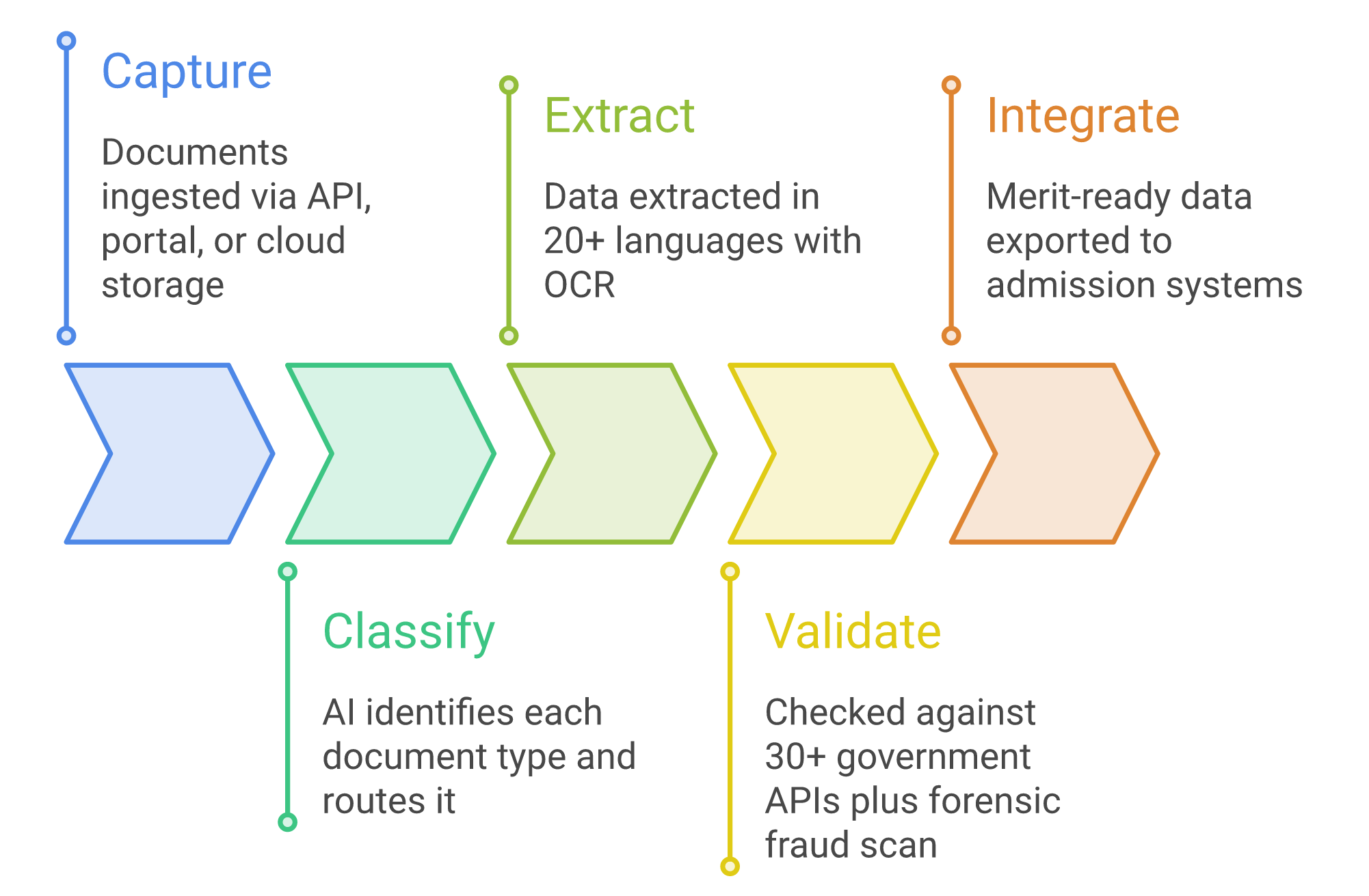
DocuExprt runs every document through its 5-step Intelligent Document Processing (IDP) pipeline. The applicant experience does not change – students upload documents as before. What changes is everything that happens after the upload.
Capture: Thousands of admission documents are passed to DocuExprt via API directly from the admission portal – no separate applicant-facing step.
Classify: The AI identifies whether each file is a marksheet, category certificate, leaving certificate, or income proof, and routes it to the right verification rule.
Extract: Marks, names, categories, and identifiers are extracted from any board, layout, or language – the AI understands the document instead of matching a fixed template.
Validate: Extracted data is cross-checked against 30+ government APIs and DigiLocker, while a forensic layer flags tampering, font changes, and signature anomalies.
Integrate: Clean, structured, merit-ready output is exported to the admission system – ready for merit list generation and seat allotment.
The Impact: Results MCAER Achieved
DocuExprt converted a multi-week manual scrutiny bottleneck into an automated, repeatable step – delivering impact across efficiency, accuracy, and productivity.
Operational Efficiency
3,50,000+ documents verified without human intervention
Scrutiny cycle compressed from weeks to days – 80% faster
180+ colleges served from a single automated pipeline
Accuracy & Trust
99%+ accuracy across every document type
Forgeries and tampering flagged automatically
Standardized, auditable output for every applicant
Productivity Boost
Admission staff freed from manual data entry
No need to scale headcount with application volume
Merit list generation became an automated step
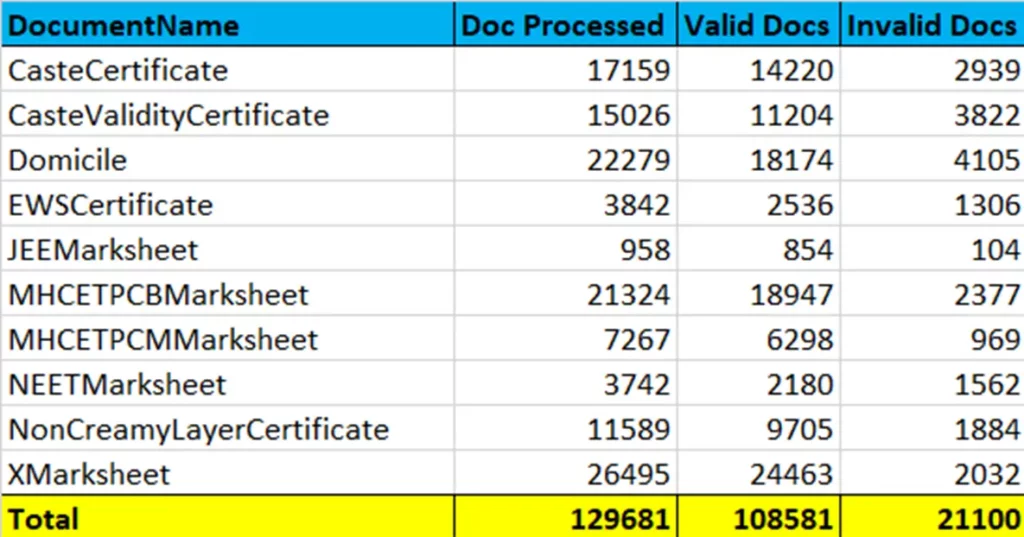
Here is the list of the documents which are auto-verified by DocuExprt-
DocuExprt has helped us simplify the scrutiny of admission documents with high accuracy. Now we are able to verify thousands of educational documents without any human intervention.
– Centralized Admission Committee, Maharashtra Council of Agricultural Education and Research
Beyond Agri Admissions: Proven at Scale
The MCAER agri admission deployment is one of several large-scale document verification programs running on DocuExprt across government, education, and enterprise.
The Takeaway for Admission Bodies
The agri admission pattern is replicable. Any exam board or university running high-volume document scrutiny can deploy the same pipeline, configured to its own eligibility rules.
It scales without headcount. From 50,000 to 8 lakh documents, the workflow stays the same – only the volume changes.
It is built for compliance. CERT-IN, RBI, DPDP, and IT Act 2000 coverage make it defensible in high-stakes, audited admission processes.
How accurate is DocuExprt AI document verification?
DocuExprt delivers 99%+ accuracy across all document types, compared with 85-92% for manual verification. Accuracy reaches 99.7% for insurance claims and 99.2% for government citizen-document verification.
The platform reads scanned, handwritten, and digital documents in 20+ languages and validates extracted data against 30+ government APIs.
Is DocuExprt secure and compliant for government and education use?
Yes. DocuExprt is CERT-IN certified for software security, RBI compliant, and DPDP compliant. Its DigiLocker integration is MeitY-certified and legally valid under the IT Act 2000, making it suitable for high-stakes government, education, and BFSI verification workflows.
What types of documents can DocuExprt verify?
DocuExprt verifies 10th and 12th marksheets, category and caste certificates, leaving certificates, income proofs, domicile certificates, and identity documents such as PAN, Aadhaar, Passport, Driving License, and Voter ID. It supports 50+ document types for education and cross-checks data against 30+ government databases.
How does DocuExprt verify documents directly from the source?
DocuExprt integrates with DigiLocker and the National Academic Depository (NAD). Candidates authenticate with a DigiLocker OTP, and government-issued documents are pulled directly to DocuExprt’s encrypted session – no uploads or copies. Even source-pulled documents pass through a forensic layer that detects tampering, font changes, and signature anomalies.
How much faster is AI document verification compared with manual scrutiny?
Manual verification takes 5 to 10 minutes per document and is prone to errors. DocuExprt processes documents 80% faster, cutting verification cycles from weeks to days while maintaining 99%+ accuracy. For one deployment, it scaled from 5,000 to 8 lakh documents without adding headcount.
Thousands of UG applications processed through DocuExprt APIs each admission cycle, with zero manual marksheet data entry.
Subject-wise extraction of Physics, Chemistry, and Maths or Biology scores - the exact fields VIT uses for eligibility - auto-tagged to admission criteria.
Multilingual marksheet reading across all major Indian languages, with instant translation into the required working language.
Standardized, merit-ready Excel output replaced weeks of manual compilation across four campuses.
Staff redeployed from data entry to core academic and operational work, reducing dependency on manual verification teams.
Consistent processing with fewer errors, even at peak admission volume.
Vellore Institute of Technology (VIT) is one of India's leading private universities, consistently ranked among the country's top engineering and research institutions.
VIT runs four campuses - Vellore, Chennai, Bhopal, and Amaravati each offering undergraduate programs that attract applications from every Indian state board, international boards, and regional language boards.
At this scale, undergraduate admissions are not a form-filling exercise. Every applicant uploads academic marksheets, and every marksheet has to be read, validated, and reduced to a small set of subject-wise marks that decide eligibility.
When applications run into the tens of thousands across four campuses, document processing becomes the single biggest bottleneck in the admissions calendar.
VIT needed an approach that could keep pace with application volume without adding more admissions staff every year - and without sacrificing accuracy at a stage where a single wrong mark can change a merit list position.
Why Admissions Document Processing Is Hard
Indian UG admissions involve marksheets from 50+ boards, multiple languages and scripts, inconsistent layouts, and a mix of handwritten, scanned, and digital documents. Every one of them has to be read correctly and reduced to the same structured format before merit lists can be drawn.
The Challenge: Manual Marksheet Processing at Scale
VIT's UG admission process required candidates to upload their academic documents via the application portal. Eligibility depended on subject-wise marks in science disciplines - specifically Physics, Chemistry, and Mathematics or Biology.
On paper, this is a simple eligibility rule. In practice, it meant converting every uploaded marksheet into structured subject-wise data before merit lists could be generated.
Before DocuExprt, that conversion was entirely manual. Admission staff across campuses would open each marksheet, read the subject names and marks, and type them into internal spreadsheets that fed into merit list preparation. That workflow created three compounding problems.
Manual Data Extraction
Staff manually extracted subject-wise marks from every uploaded marksheet. At the scale of UG admissions, this was slow, tedious, and highly repetitive work that consumed the bulk of the admissions team's capacity during peak windows.
Repetitive Data Entry
Once extracted, the same data had to be re-entered into predefined formats used for eligibility and merit calculation. This duplication ran across thousands of applications and introduced keystroke errors that had to be caught and corrected downstream.
Processing Delays
Large application volumes created significant delays in admission processing timelines. Weeks of effort went into reaching a merit-ready dataset - time that could not easily be shortened by adding more people, because each new reviewer brought new variation in interpretation.
The Hidden Cost of Manual Processing
Manual data entry is not just slow - it is a compliance and fairness risk. A single mis-typed subject mark can move a candidate up or down a merit list, and in high-stakes admissions that translates directly into grievances, RTI requests, and reputational damage. Standardized, machine-driven extraction is the only sustainable answer at national university scale.
Running Admissions at University Scale?
See how DocuExprt's agentic AI can automate marksheet extraction, subject-wise tagging, and merit list preparation for your admission cycle.
VIT selected DocuExprt, an agentic AI platform for high-volume document processing, to replace manual marksheet handling.
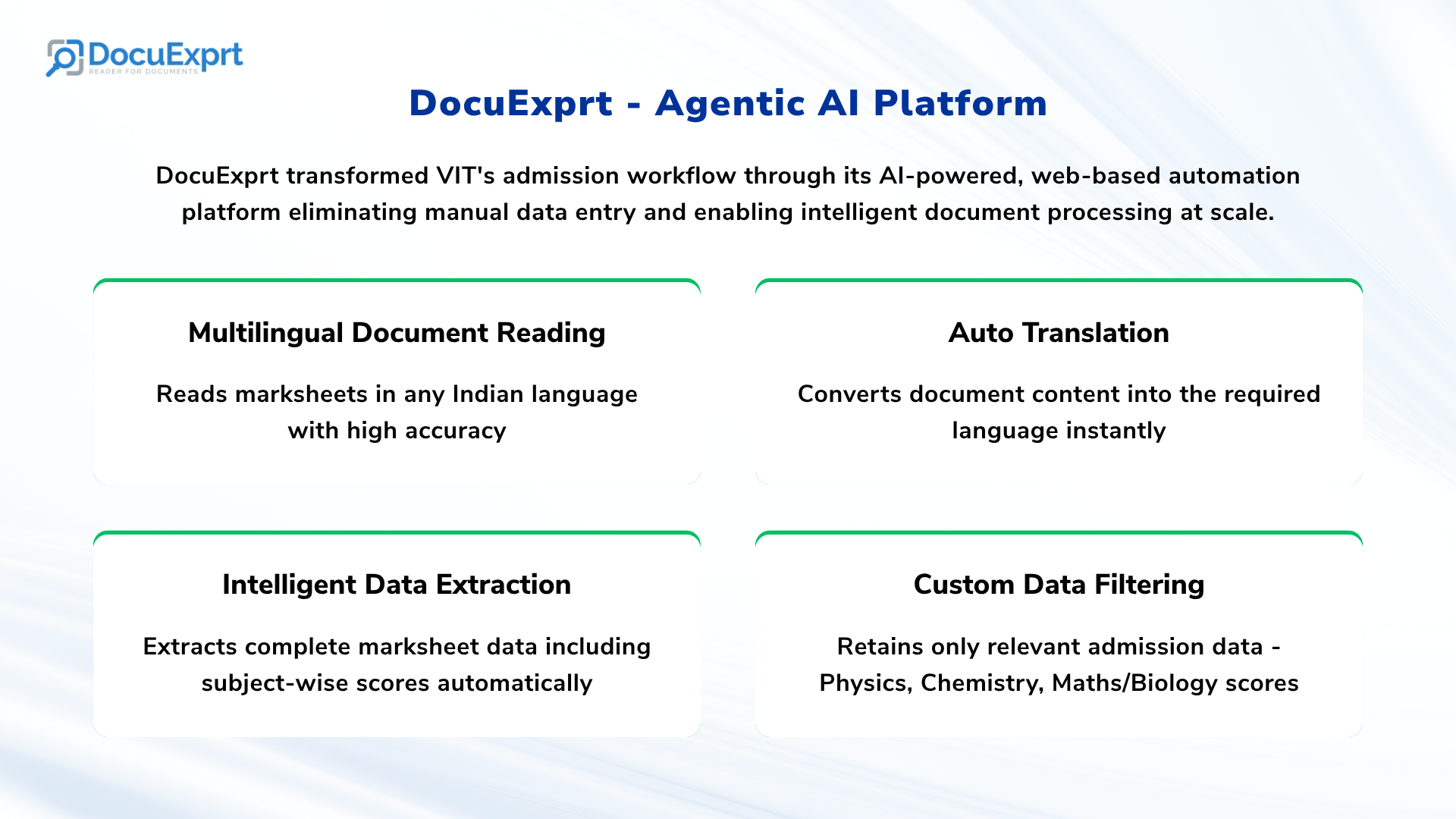
DocuExprt transformed VIT's admission workflow through an AI-powered, web-based automation platform that eliminated manual data entry and enabled intelligent document processing at scale.
Four DocuExprt capabilities were directly relevant to VIT's UG admissions use case:
How DocuExprt Processes VIT Admissions
The DocuExprt workflow for VIT UG admissions was designed to slot into the university's existing application portal without disrupting the applicant experience. Applicants continue to upload marksheets as before. What changes is what happens after the upload.
API Integration: Thousands of marksheets uploaded through VIT's application portal are passed to DocuExprt via APIs. There is no separate applicant-facing step. The portal remains the single point of truth for submissions.
Data Extraction: DocuExprt's agentic AI reads each marksheet regardless of board, language, layout, or image quality and extracts all subject-wise marks along with the candidate identifiers. The system understands the document, rather than matching it to a rigid template.
Filtering & Tagging: Only admission-relevant fields are retained. For VIT's UG eligibility, that means Physics, Chemistry, and Maths or Biology scores. Each value is auto-tagged to the correct admission field in the downstream dataset.
Export & Merit List: The output is a structured Excel file, ready to feed into merit list generation. What previously took weeks of manual compilation now arrives as a clean, standardized dataset.
Why This Matters Operationally
Each step in this pipeline is deterministic and auditable. The same applicant, uploading the same marksheet, produces the same structured output every time. That is what makes the workflow defensible in a high-stakes admissions process - not just faster, but more consistent than a team of human reviewers could ever be.
Automate Document Verification with AI
Extract & verify data from any document in seconds
The contrast between VIT's pre-DocuExprt and post-DocuExprt admissions workflow is best seen step by step. The table below maps each stage of the manual process to its automated counterpart.
Before - Manual Process
After - DocuExprt AI
Staff manually read each uploaded marksheet, line by line
AI reads marksheets in any Indian language with high accuracy
Subject marks typed into spreadsheets, one applicant at a time
Subject-wise data extracted and structured automatically
Weeks of processing time required for each admission cycle
Thousands of applications processed through APIs at scale
Frequent data entry errors, especially at peak volume
Staff redirected from data entry to core admission operations
Merit lists compiled manually from hand-keyed data
Standardized extraction with fewer errors and consistent output
The most important shift is not any single line in the table - it is that the admissions team stops being a data entry team. Once DocuExprt is in place, the cycle bottleneck moves from typing speed to decision-making, which is what admissions staff should be spending their time on in the first place.
Impact Across Three Dimensions
VIT's deployment of DocuExprt delivered impact across three clear dimensions - efficiency, productivity, and accuracy. Each dimension reinforces the others, and together they change what a UG admission cycle looks like on the ground.
Operational Efficiency
Eliminated manual data entry entirely from the admissions pipeline
Reduced processing time significantly per admission cycle
Enabled bulk handling of applications across all four campuses from a single pipeline
Productivity Boost
Administrative staff redirected to core academic and operational tasks
Reduced dependency on manual verification teams during peak windows
No need to scale headcount linearly with application volume
Accurate & Consistent
Minimized human errors in subject-wise data extraction
Standardized processing across all applications and campuses
Automated, merit-ready output feeding directly into downstream systems
Why Agentic AI Matters for Higher Education Admissions
Traditional OCR and template-based extraction tools fall apart in Indian higher education admissions. Every board has its own layout. Every language brings its own script. Scans are uneven. Handwritten entries creep in. That is exactly where agentic AI changes the equation.
Rather than trying to match each marksheet to a fixed template, DocuExprt's agentic AI understands the document. It identifies the structure, finds the subjects, locates the corresponding marks, and applies the university's eligibility rules - even on boards and formats it has not been explicitly trained on. That is what allows a single pipeline to serve Vellore, Chennai, Bhopal, and Amaravati through one admission cycle.
Step 1 - Understand, Don't Template
Agentic AI reasons about document structure instead of relying on fixed field positions. New boards and layouts no longer require manual template engineering.
Step 2 - Extract With Context
Subject names, marks, and identifiers are extracted together, so every value is attached to the right field. Ambiguities are resolved using surrounding context on the marksheet.
Step 3 - Apply Admission Rules
Custom filtering retains only the subjects used for eligibility and discards the rest. The output is narrow by design, which is exactly what merit list systems need.
Step 4 - Hand Off, Audit Later
Structured Excel output flows straight into merit list generation, while extracted fields remain auditable for any future review or grievance resolution.
This is the shift from "document OCR" to agentic document processing - and it is the reason the same DocuExprt workflow used at VIT can be deployed for PG admissions, scholarship disbursement, foreign credential evaluation, or any other high-volume document-driven workflow inside a university.
Replicating This Across Other Universities
The VIT deployment is a reference architecture, not a one-off project. Any university or exam body running document-driven admissions can run the same pattern, configured to its own eligibility rules and board coverage.
UG and PG Admissions
Swap Physics / Chemistry / Maths eligibility for any other subject combination, GPA conversion rule, or weightage formula. The pipeline stays the same; the filtering layer changes.
Scholarship Verification
Extract income certificates, caste certificates, and merit documents with the same agentic AI approach, and feed them into rule-based eligibility engines for scholarship disbursement.
Foreign Credential Evaluation
Multilingual reading and auto-translation make it straightforward to process transcripts from international boards as part of global student admissions, without adding manual translation staff.
The deployment path for a new university is standard: integrate DocuExprt with the application portal via API, configure the eligibility rule, validate on a sample batch, and go live. The platform handles the rest of the document complexity behind the scenes.
How did DocuExprt automate VIT UG admissions document processing?
DocuExprt ingested marksheets uploaded through VIT's application portal via API, automatically extracted subject-wise scores using agentic AI, retained only admission-relevant data (Physics, Chemistry, Maths or Biology), and produced structured Excel output ready for merit list generation across all four campuses.
Which Indian languages can DocuExprt read on academic marksheets?
DocuExprt reads marksheets in any major Indian language including Hindi, Tamil, Telugu, Marathi, Bengali, Kannada, Malayalam, Gujarati, Punjabi, and Odia. Its auto-translation layer converts content into the required language instantly, making it ideal for national universities that receive applications from every Indian state board.
How does DocuExprt filter subject-wise marks for admission eligibility?
After extracting the complete marksheet, DocuExprt's custom data filtering retains only subjects relevant to the admission criteria. For VIT UG admissions, the system kept Physics, Chemistry, and Maths or Biology scores and auto-tagged them to admission fields, discarding irrelevant data to keep the dataset clean and merit-ready.
What was the main operational challenge VIT faced before DocuExprt?
VIT's staff manually read each uploaded marksheet, extracted subject-wise marks, and re-typed the data into internal spreadsheets for merit list preparation. At the scale of a national UG admissions cycle across four campuses, this created weeks-long processing delays, repetitive effort, and frequent data entry errors that compromised admission timelines.
How does DocuExprt integrate with a university's existing admission portal?
DocuExprt connects via APIs, which means thousands of marksheets uploaded through the university's own application portal can be passed to DocuExprt for processing without changing the applicant experience. Extracted and filtered data is returned in structured formats like Excel, which can then be imported into the merit list and student information systems.
What measurable impact did VIT see after deploying DocuExprt?
VIT eliminated manual data entry entirely, enabled bulk handling of applications across all four campuses, minimized human errors in subject-wise extraction, standardized processing of every application, and redirected administrative staff from data entry to core academic and operational tasks. Merit list generation shifted from a weeks-long manual compilation to an automated, repeatable step.
Is DocuExprt suitable for universities beyond VIT?
Yes. Any university or exam body running high-volume document-driven admissions, scholarship verification, or eligibility checks can deploy DocuExprt. The same agentic AI workflow used for VIT's UG admissions applies to PG admissions, foreign credential evaluation, scholarship disbursement, and on-boarding verification for large cohorts.
How quickly can a university go live with DocuExprt?
Because DocuExprt is API-based and cloud-deployed, a typical admissions use case can go live within a few weeks. The timeline depends on portal integration, admission rule configuration, and UAT with sample marksheet batches. The DocuExprt team handles template learning, language coverage validation, and merit output formatting during onboarding.
Ready to Run Your Next Admission Cycle on Agentic AI?
Join universities like VIT that have replaced manual marksheet processing with DocuExprt. Automate extraction, eligibility filtering and merit list generation end to end.
Haryana Knowledge Corporation Ltd. (HKCL) is a government-supported entity that plays a pivotal role in implementing IT-driven solutions across education, skill development, and public administration in Haryana.
It operates as a technology partner for several government initiatives and is known for driving digital transformation at scale.
One of its major collaborations is with the Haryana Kaushal Rozgar Nigam Limited (HKRNL), a government body responsible for facilitating temporary employment opportunities across various departments.
HKCL was entrusted with managing the end-to-end document verification process for all HKRNL applicants, ensuring the process was not only efficient but also transparent and bias-free.
This partnership placed HKCL at the center of a monumental verification task, prompting the need for an AI-powered solution to streamline operations at scale.
The Challenge
Imagine being tasked with verifying over 7 million documents, each critical to someone’s future. This was the reality for Haryana Knowledge Corporation Ltd. (HKCL) as they managed the recruitment process for Haryana Kaushal Rozgar Nigam Limited (HKRNL).
With approximately 8,00,000 candidates submitting 7–8 documents each, the manual verification process was not only time-consuming but also prone to human error. The sheer volume led to delays, inconsistencies, and a significant drain on resources.
But what if a solution existed that could analyze, verify, and filter thousands of documents in minutes, not months?
What follows is not just a case study, it’s a glimpse into the future of document intelligence powered by artificial intelligence.
Embracing AI with DocuExprt
To tackle this monumental task, HKCL turned to DocuExprt, an AI-powered document verification platform. DocuExprt’s technology automates the extraction and comparison of data from various documents, ensuring accuracy and efficiency.
By leveraging machine learning algorithms, the platform can identify discrepancies between submitted documents and application data, flagging inconsistencies for review.
Key Features of DocuExprt’s AI Verification
Automated Data Extraction:
DocuExprt uses advanced OCR and ML models to extract data from structured (like PDFs) and semi-structured (like scanned images) documents even if quality varies.
Error Detection & Mismatch Alerts:
It automatically compares the extracted document data with the information provided in application forms, flagging mismatches or missing fields.
AI-Generated Remarks:
When discrepancies are found, the system generates remarks for review, helping operators take quicker decisions without scanning every line manually.
Filtered Merit List Generation:
The system can instantly filter candidate lists based on predefined criteria such as category, gender, age, or academic percentage—automating shortlist creation.
The Impact: Efficiency and Accuracy at Scale
HKCL witnessed a significant transformation. The AI-driven approach not only expedited the verification process but also enhanced accuracy, reducing the likelihood of errors that could affect candidate outcomes.
The success has paved the way for scaling the solution to process all 800,000 candidate applications, totaling over 7 million documents.
What HKCL Had to Say About Us?
The HKCL official teams appreciated the platform’s capabilities and acknowledged its potential to eliminate manual intervention, thereby significantly reducing time, errors, and human effort in handling such a massive scale of document verification.
AI in Document Verification
The challenges faced by HKCL are not unique. Organizations worldwide struggle with the complexities of document verification. DocuExprt is tackling these challenges by offering:
Accuracy: Machine learning algorithms minimize human error.
Scalability: AI systems can handle vast volumes of data without compromising performance.
According to a report by Fortune Business Insights, the global identity verification market size was valued at $11.97 billion in 2024 and is projected to grow to $39.82 billion by 2032, exhibiting a CAGR of 16.4% during the forecast period.
HKCL’s collaboration with DocuExprt proves that even the most complex verification workflows can be streamlined, secured, and scaled using intelligent automation.
By embracing technologies like DocuExprt, they not only enhance operational efficiency but also ensure greater accuracy and fairness in recruitment processes.
As AI continues to evolve, so too will the possibilities for faster, fairer, and more efficient verification across industries, from education to recruitment and beyond.
Issue of Manual Verification of Academic Documents
Have you ever wondered about the intricacies and challenges that educational boards face during the admission process, especially when it comes to verifying thousands of academic documents?
The State Board of Technical Education (SBTE) in Bihar found itself entwined in a similar situation, grappling with the manual, error-prone scrutiny of academic documents during the admission process.
During the admission process, typically thousands of students submit multiple documents like SSC, HSC mark sheets, certificates, category certificates, academic credentials, etc. It is the responsibility of the admission authority to validate the documents and allot admission to candidates based on merit.
Verification of such documents is a time-consuming task, and a large number of human resources might be required to validate all documents. Manual checks also miss digitally altered records. Here is how to detect fake marksheets.
The admission process typically gets delayed due to manual document validation. Let’s explore how the State Board of Technical Education has solved this problem with the help of technology.
About State Board of Technical Education, Bihar
The SBTE, Bihar, a pivotal entity, manages centralized admission processes across the state, ensuring that technical education is not only of superior quality but also accessible to all.
With a mission to foster technical education by providing robust study materials, initiating new technical schools, and ensuring quality through specialized committees, the board found itself submerged in thousands of admission applications each year for Diploma College admissions.
The Challenge: Unraveling the Process of Manual Verification
Time-consuming: Manual verification of documents was not only tedious but also a time-consuming affair.
Error-Prone: The susceptibility to human errors was significantly high, jeopardizing the integrity of the admission process.
Resource-Intensive: The manual scrutiny demanded substantial human resources, diverting them from other crucial tasks.
How could technology pave the way to a more efficient, accurate, and swift verification process?
The Solution: Embracing Technological Advancement with Docuexprt
In a bid to eradicate the challenges posed by manual verification, SBTE, Bihar, turned to technology, specifically targeting Docuexprt, to automate and streamline the document scrutiny process.
Automate Document Verification with AI
Extract & verify data from any document in seconds
Automated Verification: Enabled the automation of the document verification process, significantly reducing manual intervention.
Efficient Credential Checking: Facilitated the effortless and automated checking of academic credentials like mark sheets and passing certificates.
Swift and Accurate: Successfully verified 50,000+ documents within a couple of days, a task that previously spanned multiple weeks.
Enhanced Accuracy: The accuracy associated with document verification witnessed a substantial enhancement.
Feedback from the Secretary, SBTE, Bihar
“We utilized the Docuexprt platform during the admission process of Diploma Courses.
This software has been instrumental in verifying and extracting data from PDF and JPEG files, meeting the requirements of our admission department for data validation.
We endorse the use of Docuexprt for data validation and document scrutiny to streamline the validation process of academic credentials. Looking forward to working with Docuexprt in the future as well.”
– Dr. Chandra Shekhar Singh (Secratary), State Board of Technical Education, Bihar
Crafting a Future with Automated Verification
The collaboration between SBTE, Bihar, and Docuexprt not only alleviated the challenges of manual verification but also paved the way for a future where technology and education go hand in hand, ensuring accuracy, efficiency, and reliability in the academic admission process.
If you want to simplify data validation, and document scrutiny during the admission process then subscribe to the document verification platform docuexprt.com.
Automate Document Verification with AI
Extract & verify data from any document in seconds
Run It on Your Own Queue Bring one real batch. We scrutinise it on the call. Your scrutiny workflow mapped 30+ government databases, real time Inspection-ready audit trails Cloud, private cloud or on-premise Trusted by enterprises and government boards CERT-IN...