In the healthcare sector, the accuracy and efficiency of document processing are critical. Medical records, insurance claims, patient histories, and research documents require meticulous scrutiny. Integrating AI into document verification processes offers transformative benefits, enhancing accuracy, efficiency, and security. Here’s how AI document scrutiny can revolutionize healthcare.
AI Document Verification in Healthcare
1. Automated Data Extraction and Verification
Optical Character Recognition (OCR): AI-powered OCR technology can convert handwritten or scanned medical records into machine-readable text. This technology is essential for digitizing patient records, prescriptions, and diagnostic reports, enabling quick and accurate data retrieval.
Cross-Referencing Data: AI systems can automatically cross-reference extracted data with existing databases, such as electronic health records (EHRs), insurance databases, and clinical trial registries. This ensures the accuracy of patient information, streamlines billing processes, and enhances the integrity of medical records.
2. Enhanced Accuracy and Fraud Detection
Pattern Recognition: AI can identify patterns and anomalies in medical documents, detecting potential fraud or errors. For example, it can flag unusual billing patterns or discrepancies in patient records that might indicate fraud or clerical mistakes.
Machine Learning Models: Advanced machine learning models improve over time by learning from vast datasets. These models can identify common types of errors or fraudulent activities, significantly enhancing the reliability of document verification processes.
3. Time Efficiency and Cost Reduction
Batch Processing: AI systems can process large volumes of medical documents simultaneously, drastically reducing the time required for verification. This capability is particularly beneficial for hospitals and insurance companies that handle substantial paperwork.
Resource Allocation: By automating routine verification tasks, AI frees healthcare professionals to focus on patient care and more complex issues that require human judgment. This not only optimizes labour utilization but also reduces operational costs.
AI-Powered Document Verification in Healthcare Sector
Reduces the time required for patient admissions.
Manage medical records and lab reports efficiently.
Accelerates the claims processing and reimbursement cycle.
Streamlined Workflows: AI can integrate with existing healthcare IT systems to create seamless workflows, ensuring verified documents are quickly and efficiently routed to the appropriate departments or officials.
Real-Time Updates: AI systems provide real-time updates on the status of document verification, enabling faster responses to issues and improving overall operational efficiency.
5. Reducing Human Intervention
Minimizing Manual Input: Automating the majority of the verification process reduces the need for manual data entry and checks, which are prone to errors. This not only speeds up the process but also enhances accuracy.
Decision Support: AI can support healthcare professionals by providing decision-making tools that highlight potential issues or areas needing further investigation, ensuring that human intervention is only required for complex cases.
Real-World Applications
Electronic Health Records (EHRs): AI can automate the updating and verification of EHRs, ensuring that patient records are accurate and up-to-date. This helps in providing better patient care and reducing administrative burdens.
Insurance Claims Processing: AI can streamline the processing of insurance claims by automatically verifying patient information, treatment codes, and billing details. This reduces the time and effort required for claims processing and helps in quickly identifying fraudulent claims.
Clinical Trials: AI can assist in managing clinical trial documentation by ensuring that all records are accurate and compliant with regulatory requirements. This improves the efficiency of trial management and accelerates the approval process for new treatments.
Conclusion
Implementing AI for document verification in the healthcare sector offers significant benefits, including enhanced efficiency, accuracy, and security. By automating routine tasks, detecting fraud, and improving workflows, AI can transform how healthcare providers manage and verify documents, leading to better patient outcomes and more efficient operations.
Government departments handle an immense volume of documents daily, ranging from legal contracts and financial records to correspondence and reports. Maintaining these physical copies for compliance, information extraction, and comparison is both challenging and costly.
However, platforms like DocuExprt offer a cost-effective solution by digitizing document management and streamlining information extraction. This blog explores the common problems faced in maintaining physical documents and how DocuExprt can revolutionize the process.
Automate Document Verification with AI
Extract & verify data from any document in seconds
DocuExprt offers a comprehensive digital platform designed to address the challenges of physical document management. Here’s how it can help government departments transition to a more efficient digital system:
1. Efficient Document Digitization
Digital Conversion: DocuExpert allows for easy digitization of physical documents, converting them into searchable digital formats.
Tagging and Categorization: The platform provides tools for tagging and categorizing documents, making them easier to organize and retrieve.
2. Advanced Information Extraction and Search
Automated Extraction: DocuExpert uses advanced algorithms to extract relevant information from uploaded documents automatically.
Search Functionality: Users can search for specific documents or information using customized criteria, greatly reducing retrieval times.
Comparison Tools: The platform facilitates easy comparison of documents, highlighting differences and similarities for better analysis.
3. Cost-Effective Management
Reduced Storage Costs: Digital documents eliminate the need for physical storage space.
Lower Labor Costs: Automated processes reduce the manual labor required for document management.
Efficiency Gains: Faster retrieval and processing of documents lead to significant productivity improvements.
4. Enhanced Security and Compliance
Secure Storage: Digital documents are stored securely with encryption and access controls, reducing the risk of data breaches.
Regulatory Compliance: DocuExpert helps ensure compliance with document retention and privacy regulations by maintaining accurate digital records.
Automate Document Verification with AI
Extract & verify data from any document in seconds
The transition from physical to digital document management is not just a modernization step but a necessity for efficiency, cost-saving, and compliance.
Government departments can benefit immensely from adopting platforms like DocuExprt, which streamline document management, enhance information extraction, and offer robust security features.
By leveraging DocuExprt, government organizations can overcome the traditional challenges of physical document maintenance and move towards a more efficient, cost-effective, and secure future.
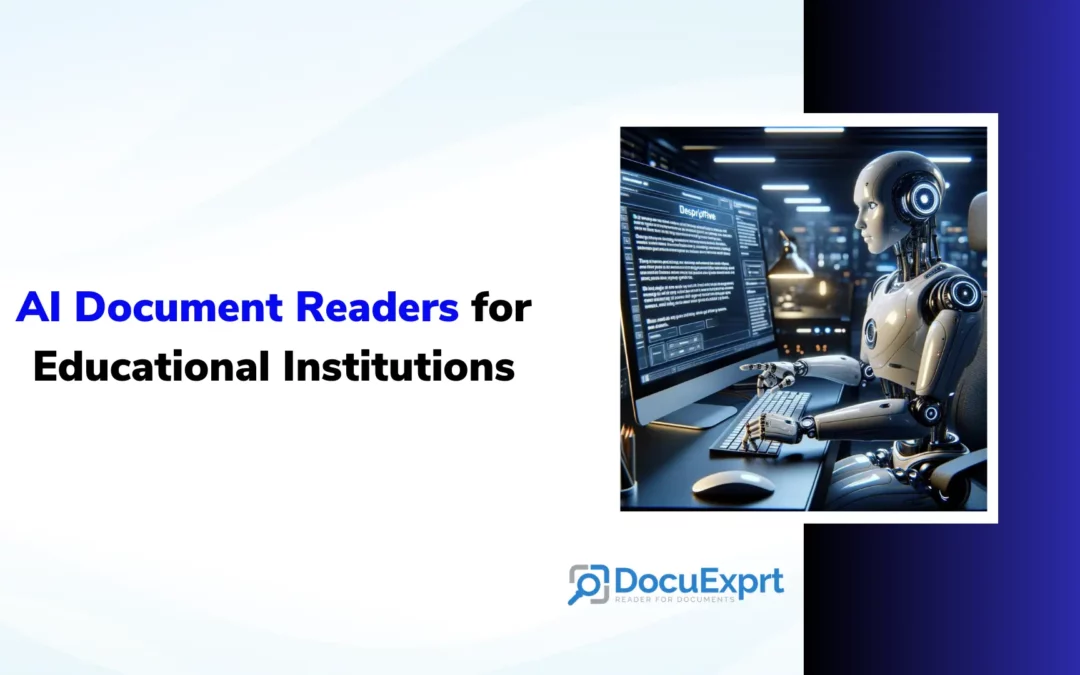
In the rapidly evolving educational sector, leveraging technology to enhance efficiency and productivity is more crucial than ever. As an educational institute, managing thousands of documents is par of the course, particularly during admissions season.
It is crucial to meticulously examine every admission document—category certificates, caste certificates, and mark sheets—to confirm students’ eligibility. Additionally, institutes must handle other documentation such as academic certificates, validation processes, and compliance documents.
This extensive document scrutiny often involves manual verification, consuming multiple man-hours. However, by integrating AI document readers into your workflow, you can save a significant amount of time and enhance overall productivity throughout the admission cycle and document review process.
Artificial intelligence (AI) document readers have emerged as a crucial tool for administrative and academic processes. This guide delves into the practicalities of integrating AI document readers into the workflows of schools, colleges, and universities, focusing on admission documents, academic certificates, and educational compliance, enriched with relevant statistics and case studies.
AI document readers utilize Optical Character Recognition (OCR), Natural Language Processing (NLP), and machine learning to interpret and manage documents digitally.
By automating the extraction of information from various document formats, these tools drastically reduce manual workload, enhance accuracy, and increase overall administrative efficiency.
Utilizing the Advanced AI Document Scrutiny Mechanism, one can effortlessly review documents such as HSC mark sheets, SSC mark sheets, or a student’s overall academic credentials. This allows for a seamless comparison between the information provided by the student in their admission form and their actual academic achievements.
The manual compilation of submitted data and the factual marks obtained by the student are significantly easier with the aid of Advanced AI Document Readers. Indeed, this technology proves invaluable in cross-referencing admission form details against the authentic information supplied by students.
Application Areas in Education
Admission Documents Processing
Admission periods are notoriously busy, with institutions sifting through thousands of applications, each accompanied by numerous documents. Education institutions need to deal with thousands of documents during admissions season. Manual verification is an error-prone and time-consuming activity.
The admission process often gets delayed due to this task of verification. The use of viable technology to improve this process is essential. The average time spent on manual document scrutiny ranges from 5 to 10 minutes per document. For an institution processing 10,000 applications annually, this equates to 1,666 to 3,333 hours spent on document processing alone.
AI document readers can significantly streamline this process by:
Automating Data Extraction: Reducing processing time by extracting data instantly, thus improving the applicant experience.
Enhancing Accuracy: With a manual error rate ranging between 2% and 5%, AI document readers can minimize these errors, improving operational integrity.
Speeding up Admission Processes: Facilitating quicker processing of applications.
Academic Certificates Verification
Verifying the authenticity of academic certificates is vital for upholding academic standards. AI document readers aid by automating the verification process, reducing the manual workload by 60%, and improving the detection rate of fraudulent documents.
Managing Educational Compliance Documents
Compliance management requires meticulous documentation. AI document readers streamline regulatory document management and automate compliance checks, ensuring operations align with regulatory requirements.
Implementation Strategy
Assess Your Needs
Identify areas within your institution that would most benefit from AI document reader integration. Consider factors like paperwork volume, accuracy importance, and potential efficiency gains.
Choose the Right Tool
Select an AI document reader that fits your institution’s needs, considering compatibility with existing systems, ease of use, and customer support.
You can also analyze the feasibility of integrating this tool with your existing workflow or system to streamline the entire activity. You can go ahead with the pilot implementation to assess the cost and benefits of document verification tools.
Monitor and Optimize
Regularly review the system’s performance, gathering user feedback for ongoing optimization.
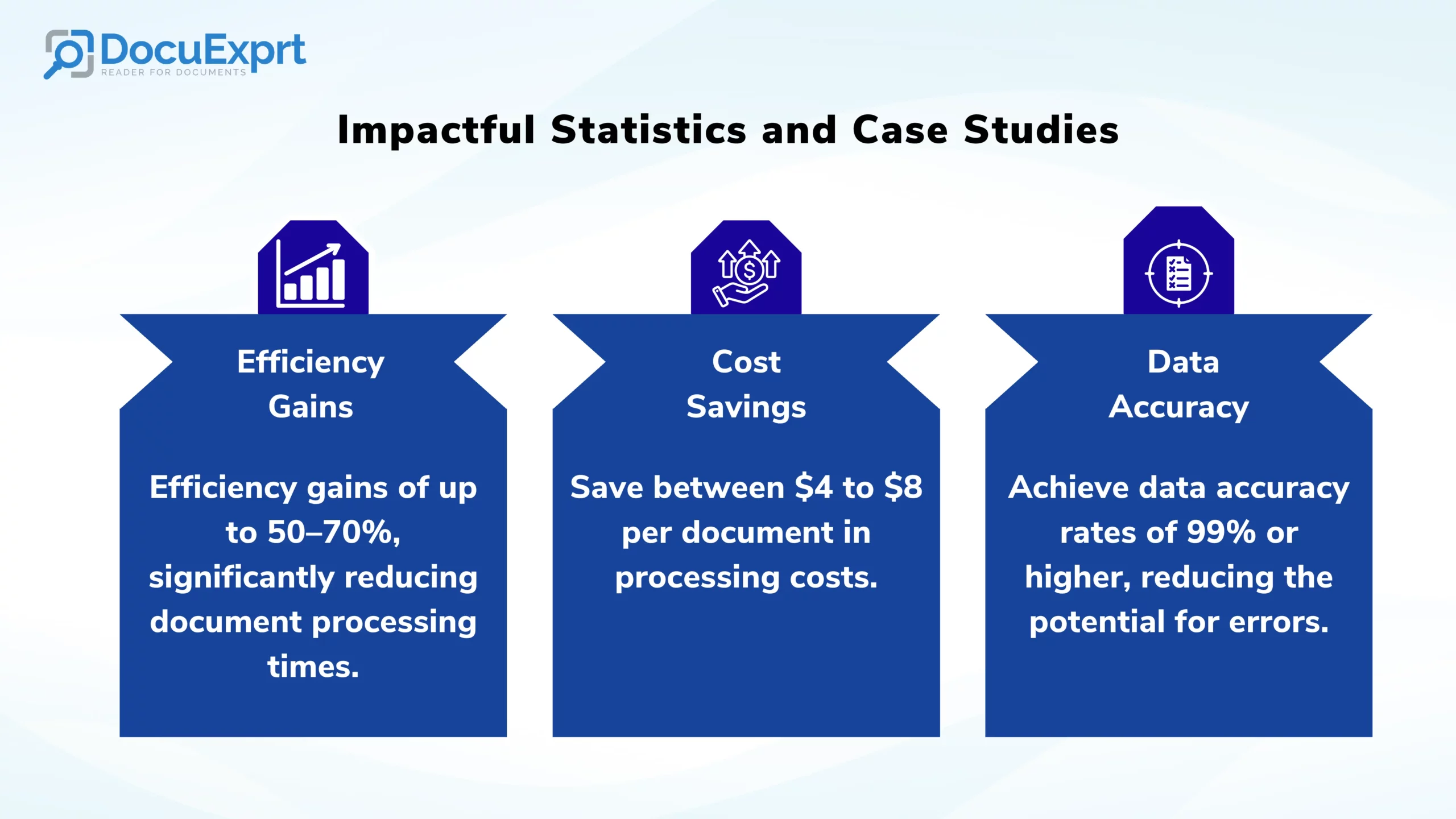
Efficiency Gains: Implementing AI document readers can lead to efficiency gains of up to 50–70%, significantly reducing document processing times.
Cost Savings: Automation can save between $4 to $8 per document in processing costs, translating to substantial annual savings.
Improvement in Data Accuracy: AI document readers can achieve data accuracy rates of 99% or higher, drastically reducing the potential for errors.
Integrating AI document readers into educational institutions’ workflows can significantly enhance efficiency, accuracy, and cost-effectiveness.
By carefully selecting and implementing the right tools, and preparing staff for this digital transformation, institutions can unlock the full potential of AI technologies, ultimately enriching both administrative operations and the educational experience.
Frequently Asked Questions
What are AI document readers?
AI document readers are tools that use Optical Character Recognition (OCR), Natural Language Processing (NLP), and machine learning to digitally interpret and manage documents. They automate the extraction of information, enhancing accuracy and administrative efficiency.
How can AI document readers benefit educational institutions?
They streamline document processing by automating data extraction, reducing manual errors, and speeding up admission and document verification processes. This results in significant time savings, cost reductions, and improved operational integrity.
Which areas in education can benefit from AI document readers?
Key areas include admission document processing, academic certificate verification, and managing educational compliance documents. These tools can drastically reduce the manual workload and enhance the efficiency of these administrative tasks.
What should institutions consider before integrating AI document readers?
Institutions should assess their needs, considering factors like the volume of paperwork, the importance of accuracy, and potential efficiency gains. Choosing the right tool that fits the institution’s needs, compatibility with existing systems, and ease of use is crucial.
How do AI document readers improve the admission process?
By automating data extraction, AI document readers reduce processing time, enhance accuracy, and facilitate quicker processing of applications, improving the overall applicant experience.
How do AI document readers verify academic certificates?
These tools automate the verification process, reducing manual workload by 60%, improving the detection rate of fraudulent documents, and thus upholding academic standards.
Can AI document readers help with educational compliance?
Yes, they streamline regulatory document management and automate compliance checks, ensuring that operations align with regulatory requirements.
What are the steps to implement AI document readers in an educational institution?
Start by assessing your institution’s specific needs. Select an AI document reader that aligns with these needs and is compatible with existing systems. Consider a pilot implementation to assess benefits and costs, then regularly monitor and optimize the system based on feedback.
What are the efficiency gains from implementing AI document readers?
Implementing AI document readers can lead to efficiency gains of up to 50-70%, significantly reducing document processing times.
What cost savings can institutions expect from using AI document readers?
Automation with AI document readers can save between $4 to $8 per document in processing costs, leading to substantial annual savings.
Bring One Admission Batch
We run it on the call and show you the output.
Admission workflows mapped live
30+ government databases, real time
Audit trail for every applicant
Cloud, private cloud or on-premise
Trusted by enterprises and government boards
CERT-IN CertifiedISO/IEC 27001:2013Data stays in India
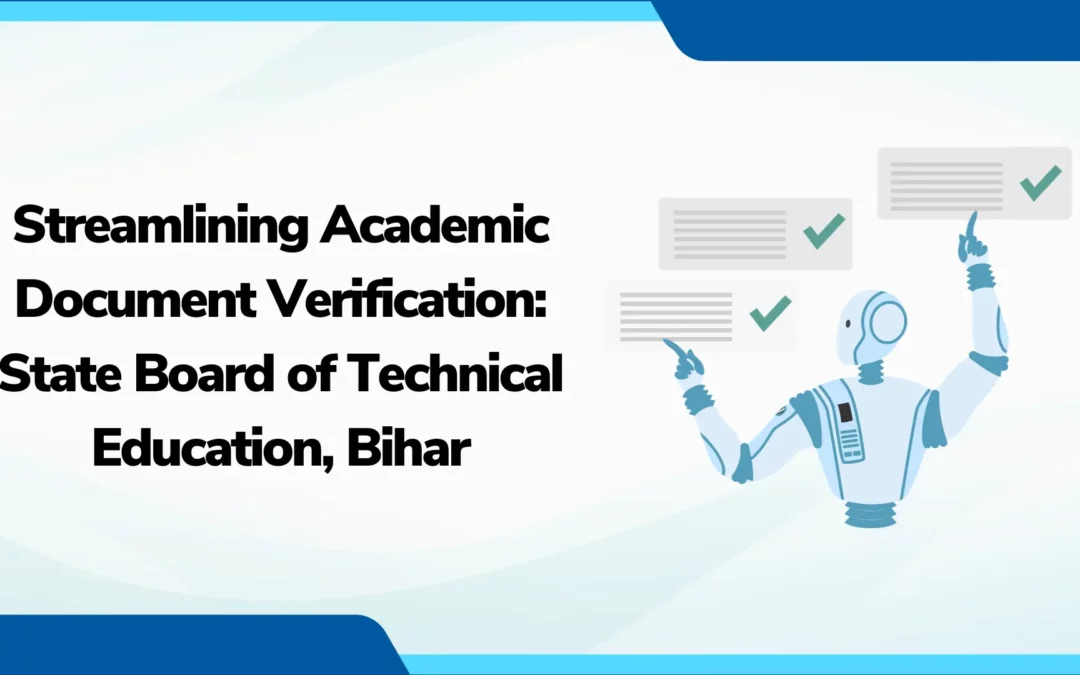
Issue of Manual Verification of Academic Documents
Have you ever wondered about the intricacies and challenges that educational boards face during the admission process, especially when it comes to verifying thousands of academic documents?
The State Board of Technical Education (SBTE) in Bihar found itself entwined in a similar situation, grappling with the manual, error-prone scrutiny of academic documents during the admission process.
During the admission process, typically thousands of students submit multiple documents like SSC, HSC mark sheets, certificates, category certificates, academic credentials, etc. It is the responsibility of the admission authority to validate the documents and allot admission to candidates based on merit.
Verification of such documents is a time-consuming task, and a large number of human resources might be required to validate all documents. Manual checks also miss digitally altered records. Here is how to detect fake marksheets.
The admission process typically gets delayed due to manual document validation. Let’s explore how the State Board of Technical Education has solved this problem with the help of technology.
About State Board of Technical Education, Bihar
The SBTE, Bihar, a pivotal entity, manages centralized admission processes across the state, ensuring that technical education is not only of superior quality but also accessible to all.
With a mission to foster technical education by providing robust study materials, initiating new technical schools, and ensuring quality through specialized committees, the board found itself submerged in thousands of admission applications each year for Diploma College admissions.
The Challenge: Unraveling the Process of Manual Verification
Time-consuming: Manual verification of documents was not only tedious but also a time-consuming affair.
Error-Prone: The susceptibility to human errors was significantly high, jeopardizing the integrity of the admission process.
Resource-Intensive: The manual scrutiny demanded substantial human resources, diverting them from other crucial tasks.
How could technology pave the way to a more efficient, accurate, and swift verification process?
The Solution: Embracing Technological Advancement with Docuexprt
In a bid to eradicate the challenges posed by manual verification, SBTE, Bihar, turned to technology, specifically targeting Docuexprt, to automate and streamline the document scrutiny process.
Automate Document Verification with AI
Extract & verify data from any document in seconds
Automated Verification: Enabled the automation of the document verification process, significantly reducing manual intervention.
Efficient Credential Checking: Facilitated the effortless and automated checking of academic credentials like mark sheets and passing certificates.
Swift and Accurate: Successfully verified 50,000+ documents within a couple of days, a task that previously spanned multiple weeks.
Enhanced Accuracy: The accuracy associated with document verification witnessed a substantial enhancement.
Feedback from the Secretary, SBTE, Bihar
“We utilized the Docuexprt platform during the admission process of Diploma Courses.
This software has been instrumental in verifying and extracting data from PDF and JPEG files, meeting the requirements of our admission department for data validation.
We endorse the use of Docuexprt for data validation and document scrutiny to streamline the validation process of academic credentials. Looking forward to working with Docuexprt in the future as well.”
– Dr. Chandra Shekhar Singh (Secratary), State Board of Technical Education, Bihar
Crafting a Future with Automated Verification
The collaboration between SBTE, Bihar, and Docuexprt not only alleviated the challenges of manual verification but also paved the way for a future where technology and education go hand in hand, ensuring accuracy, efficiency, and reliability in the academic admission process.
If you want to simplify data validation, and document scrutiny during the admission process then subscribe to the document verification platform docuexprt.com.
Automate Document Verification with AI
Extract & verify data from any document in seconds
Education counselling decides where a student spends the next three to five years of their life. It should be a conversation about aptitude and ambition.
In practice, most of it is spent checking paper.
Every applicant arrives with marksheets, board certificates, category and income certificates, and identity proofs. Each one has to be read, cross-checked and validated before an eligibility decision can be made.
At a few hundred applicants, that is tedious. At tens of thousands, inside a compressed admission window, it becomes the single thing that decides whether your round closes on time.
This is the problem DocuExprt was built for: AI-powered document verification that clears the clean files automatically and puts a counsellor in front of only the ones that need judgement.
Advising on the choice — course, institute and career path
Only the first and the last are counselling. The two in the middle are document work, and they are where the hours go.
Key point: The bottleneck is not advice. It is establishing, applicant by applicant, that the paperwork is genuine and complete.
⏱ Where Counselling Stalls: The Document Bottleneck
Counsellors analyse every academic document to understand a student’s educational background and performance.
That means cross-referencing marksheets against board records, category certificates against issuing authorities, and identity proofs against government databases.
It is slow, and the volume is unforgiving.
Admissions officers spend an average of 20 minutes reviewing each application.
Twenty applicants at the cited 20-minute manual average consumes 6 h 40 m. When AI clears the clean files and surfaces only exceptions, roughly three flagged cases at five minutes each leaves the rest of the day for guidance.
The cost is not only time. It is also risk.
Over 40% of college admissions officers have reported encountering fraudulent applications.
A counsellor working through the two-hundredth marksheet of the day is not in the best position to spot an edited grade or a forged category certificate.
Addressing these with an AI-driven verification solution lets institutions streamline counselling, improve accuracy and give both counsellors and students a cleaner experience.
⚙ How AI Automates Document Scrutiny
DocuExprt is a SaaS platform that automates verification across a wide range of document types.
Counsellors upload documents in bulk. The platform extracts the data, compares it against predefined patterns, and flags discrepancies.
How a Batch of Admission Documents Is Cleared
Clean files pass straight through with a timestamped audit trail. Counsellors spend their time on the small exception queue at step six instead of on every applicant.
Three things change once that pipeline is in place:
Extraction replaces data entry — fields are read off the scan, not retyped
Rules replace recall — the same validation runs on applicant 1 and applicant 10,000
Exceptions replace queues — humans see the flagged files, not all of them
Verified documents are stored securely and retrieved on demand, which removes the physical-copy filing problem entirely.
Key point: The goal is not to remove the counsellor. It is to make sure the counsellor only opens the files where a human decision is genuinely required.
⚖ Manual Scrutiny vs AI-Driven Scrutiny
❌ Manual Scrutiny
Speed: about 20 minutes per application
Scale: more applicants means more people
Consistency: varies by counsellor and by hour
Fraud checks: the naked eye, under deadline
Source checks: phone calls and emails to boards
Visibility: spreadsheets, updated when someone remembers
Audit trail: a signature on a checklist
VS
✅ AI-Driven Scrutiny
Speed: bulk batches cleared automatically
Scale: volume changes the compute, not the headcount
Consistency: the same rules on every file
Fraud checks: tamper and mismatch detection built in
Source checks: 30+ government databases, in the flow
Visibility: live status for every applicant
Audit trail: timestamped, per decision
What the committee asks
Manual process
DocuExprt
How long to clear one applicant?
About 20 minutes of officer time
Seconds for a clean file; humans see only exceptions
CERT-IN CertifiedISO/IEC 27001:2013Data stays in India
✅ Benefits of AI-Driven Document Scrutiny
The platform verifies documents in bulk, from Aadhaar and PAN cards to graduation and course certificates.
Uploaded documents are analysed, extracted data is compared against pre-stored records where required, and the result is a decision a committee can stand behind.
⚡
Hours back per round
Clean files clear without a counsellor opening them.
✅
Consistent decisions
The same validation rules apply to every applicant, all round.
🚩
Fraud caught early
Edits, mismatches and forged certificates are flagged, not missed.
📊
Live round visibility
Cleared, pending and flagged counts, per day and per centre.
Counsellor Hours for a 10,000-Applicant Round
Arithmetic on the cited figures: 10,000 applications at the 20-minute manual average is 3,333 hours. At an illustrative 10% exception rate and five minutes per flagged file, human review falls to roughly 83 hours. Your own exception rate decides the exact number.
Time saved on verification goes straight back into guidance and support, which is the part of counselling a student actually remembers.
In 2020, the global market size of AI in education was valued at $1.47 billion and is expected to reach $25.7 billion by 2030.
AI is letting the education sector rebuild processes that were designed around paper.
DocuExprt handles the full admission document set, and adapts to the ones specific to your state or board:
Document
What DocuExprt reads
How it is verified
Board marksheets and transcripts
Roll number, board, year, subject-wise marks, totals
Pattern rules plus tamper detection on the scan
Degree and course certificates
Institute, programme, year, result
Format validation and issuing-authority checks
Aadhaar
Name, date of birth, address, number
Government database verification
PAN card
Name, date of birth, PAN
Government database verification
Category and caste certificates
Category, issuing authority, certificate number, date
Predefined pattern checks against issuing formats
Income and domicile certificates
Income band, district, validity period
Field extraction plus eligibility-rule matching
Driving licence, ration card, election card
Identity fields and numbers
Government-issued document verification
Because the checks are configured rather than coded, a committee can add its own document types before a round without waiting on a release.
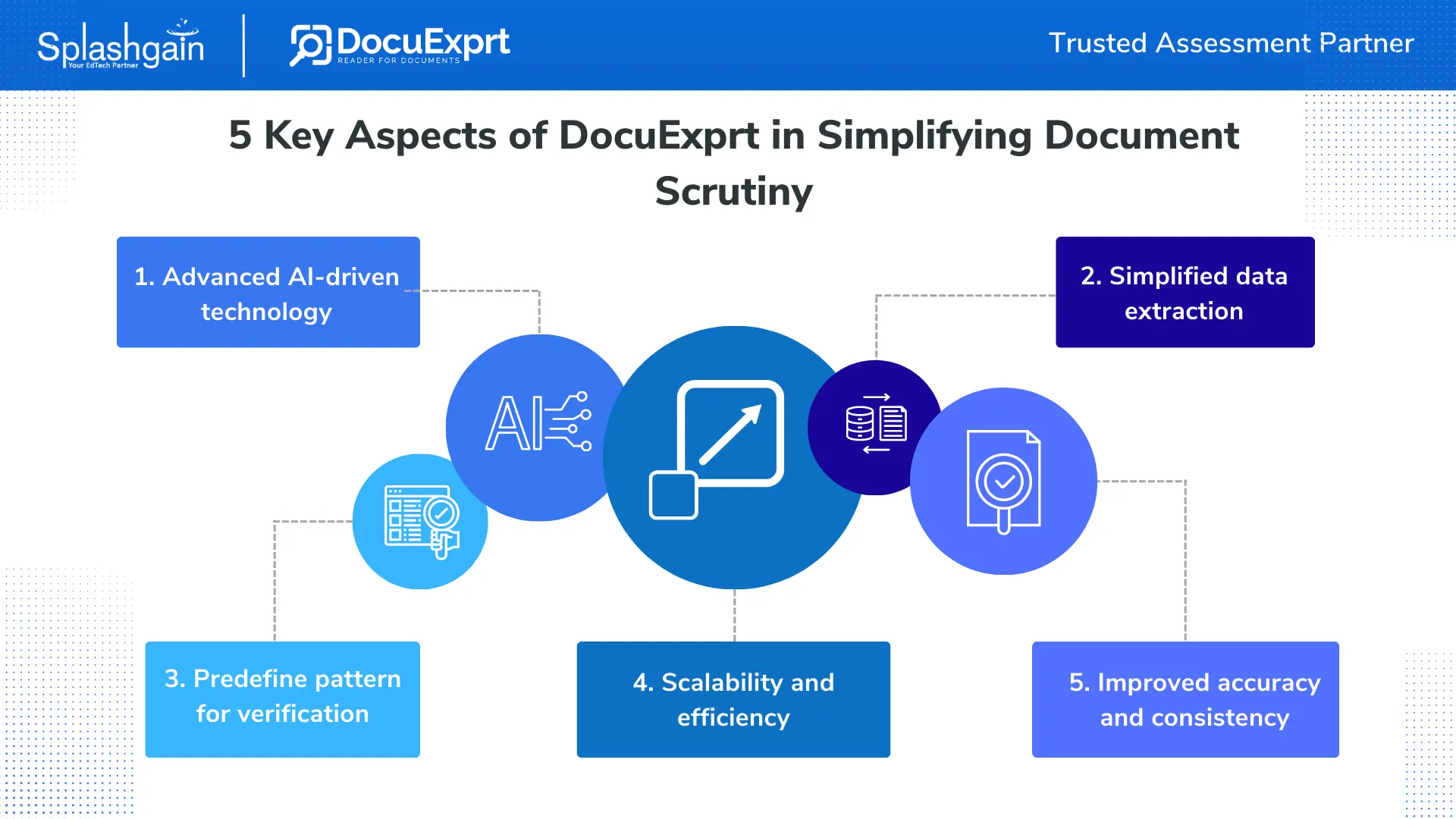
🤖 5 Key Aspects of DocuExprt in Admission Counselling
Five features do most of the work in document scrutiny during counselling:
1. Advanced AI-Driven Technology
Extracts information from scanned marksheets, academic certificates, government ID proofs and category certificates
Automates scrutiny that would otherwise be done by eye, document by document
Delivers accurate verification without a proportional increase in manual effort
2. Simplified Data Extraction
Retrieves text, images and structured data from PDF and scanned documents
Feeds verification and analysis directly, with no retyping step in between
Frees counsellors to give personalised guidance based on the extracted record
3. Predefined Patterns for Verification
Validates extracted data against predefined patterns and reference data sets
Minimises errors and inconsistencies in how documents are judged
Gives every applicant the same standard of scrutiny
4. Scalability and Efficiency
Handles a large volume of documents concurrently
Verifies thousands of educational documents without significant human intervention
Lets a committee serve more students inside the same admission window
5. Improved Accuracy and Consistency
Reduces the human error inherent in manual scrutiny
Produces precise, repeatable results that support fair evaluation
Creates a transparent record the committee can defend on appeal
🛠 Rolling It Out Before the Next Admission Round
Institutions do not have to re-architect admissions to start. The usual path is one round, mapped and piloted.
Week 1Map Document set + eligibility rules
→
Week 2Configure Patterns + database checks
→
Week 3Pilot Last round's files, results compared
→
Round dayRun Bulk intake, exception queue live
Phase
What happens
Who is involved
Output
Map
List every document type and the eligibility rule it feeds
Admission committee, one counsellor
A verification checklist per document
Configure
Set extraction patterns and switch on source database checks
DocuExprt team
A configured, testable workflow
Pilot
Re-run a previous round and compare against the human result
Counsellors
A measured exception rate and accuracy baseline
Run
Bulk intake on round day; counsellors work the exception queue
Full counselling team
Cleared applicants with a timestamped audit trail
Pilot on last round's files: you already know the right answers, so it measures accuracy and gives you a real exception rate to staff against — before students are waiting.
🌟 Proof at Scale
🏛
State boards
Government admission committees run scrutiny on DocuExprt
📄
Thousands
of educational documents verified per admission round
🔒
CERT-IN
Certified, ISO/IEC 27001, data stays in India
✅
99%+
extraction accuracy on scanned academic documents
Testimonial: Centralized Admission Committee, Maharashtra Council of Agricultural Education and Research
DocuExprt has revolutionized our document scrutiny process with its high accuracy. We can now verify thousands of educational documents without any human intervention. It is a top-notch document reading software that automates information extraction using predefined patterns.
Key Takeaways
Counselling stalls on paperwork, not advice. At the cited 20-minute average, twenty applicants consume almost a full working day before any guidance happens.
The risk is real: around 40% of applications carry false information, and 40% of admissions officers report encountering fraudulent ones.
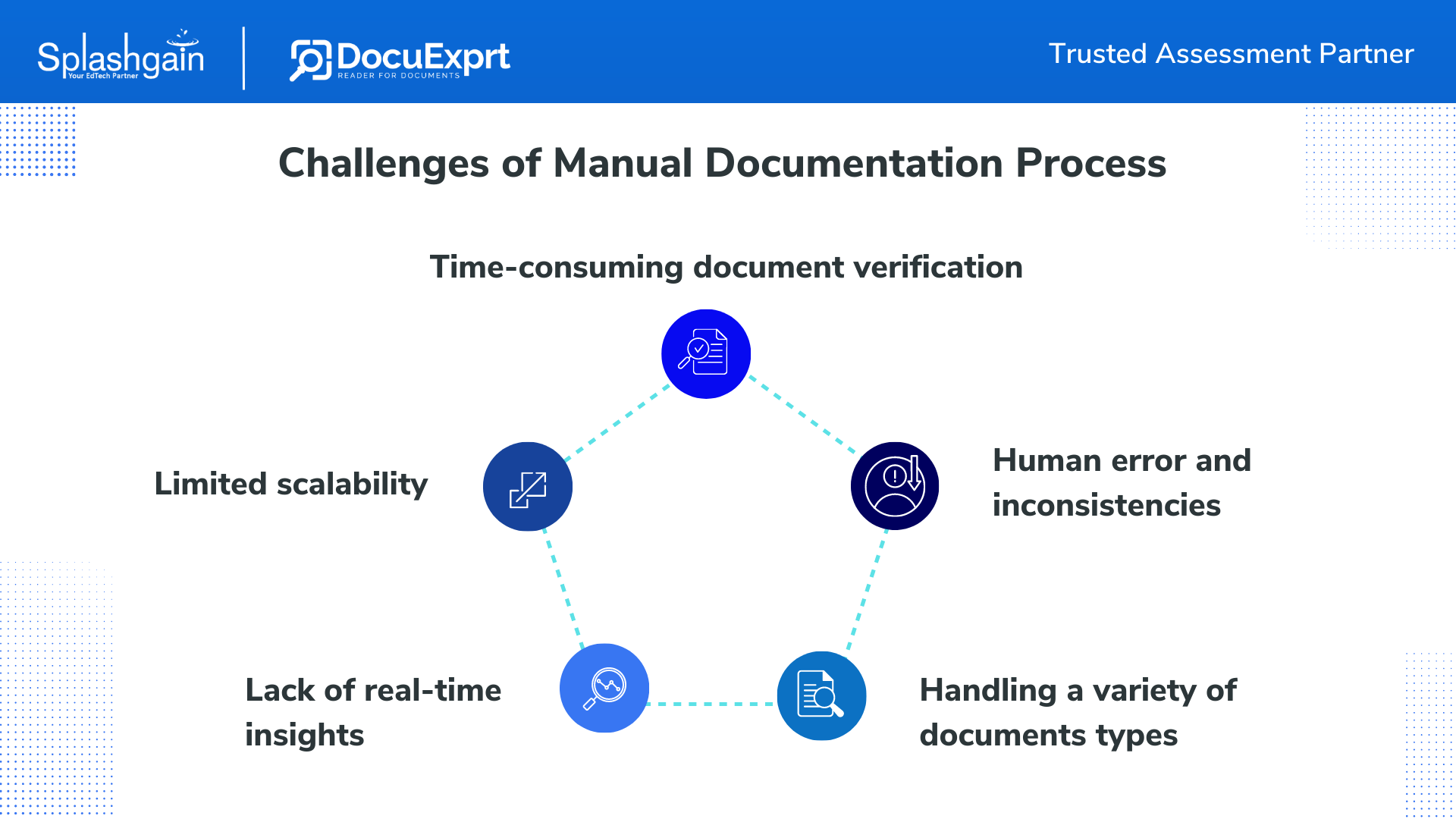
Manual scrutiny fails in five predictable ways — time, human error, document variety, scalability and no real-time visibility.
AI verification changes the unit of work: clean files clear automatically, and counsellors open only the exception queue.
DocuExprt extracts fields from scanned marksheets, certificates and ID proofs, then validates them against predefined patterns and 30+ government databases.
Consistency is the underrated benefit — the same rules apply to applicant 1 and applicant 10,000, which is what survives an appeal.
Every decision carries a timestamped record of what was checked and what was found.
Start with one round: map the document set, configure the checks, pilot on last round's files, then run it live.
Frequently Asked Questions
How does AI document verification simplify education counselling?
AI document verification simplifies education counselling by automating the process of academic document and certificate scrutiny and validation. AI algorithms can extract and compare information from various types of academic certificates, reducing the need for manual data entry and human intervention. This streamlines the verification process, saves time, enhances accuracy, and allows education counsellors to focus more on providing guidance to students.
What types of documents can be verified using AI?
AI can verify various types of documents, including academic certificates, mark sheets, identification proofs (such as Aadhaar cards, and PAN cards), category certificates, government-issued documents (like driving licenses, and ration cards), and more.
Can AI document verification be integrated with existing admission systems?
Yes, AI document verification can be integrated with existing admission systems. APIs and software development kits (SDKs) provided by AI document verification platforms allow seamless integration with existing systems. This integration enhances the efficiency, accuracy, and speed of academic document verification, ensuring a streamlined and comprehensive admissions process.
How does AI document verification improve the admission process?
AI document verification improves the admission process by reducing the manual effort and time required for document scrutiny. It enhances accuracy by minimizing the risk of human errors. Thus, AI document verification streamlines the entire process, allowing for faster academic document and certificate processing.
What are the benefits of using AI document verification in education counselling?
Using AI document verification in education counselling offers several benefits. It simplifies and automates the academic document verification process, saving time and effort spent by education counsellors. AI ensures accurate and consistent results and allows counsellors to focus more on providing personalized career assistance to students.
How accurate is AI document verification compared to manual verification?
AI document verification is highly accurate compared to manual verification. The advanced algorithms and machine learning models used in AI systems can precisely extract and analyze information from documents. The results thus obtained are error-free. AI-based verification processes provide a higher level of reliability in academic document scrutiny compared to manual methods.
💡 Conclusion
Counsellors can bring DocuExprt in at initial application screening, or at transcript and certificate verification.
Either way, scrutiny stops being the thing that sets the pace of the round.
The counselling team gets its hours back for guidance to students and parents, which is where the round is actually won or lost.
Book a demo and bring one day of applications. See what AI document verification clears, and what it flags.
Admissions Season Starting Soon?
Map one counselling round before it begins.
Scanned documents to verified data
Exception queues, not full reviews
Audit trail for every applicant
Free trial tokens to test with
Trusted by enterprises and government boards
CERT-IN CertifiedISO/IEC 27001:2013Data stays in India
ROI for Insurance Companies The business case for AI document verification in insurance is compelling and well-documented. Quantified Benefits Metric Manual Process AI-Automated Improvement Claims processing time 10+ days 36 hours 63-90% faster Processing cost per...
Introduction: The Tender Document Processing Challenge As someone who has spent years implementing tender management systems for government agencies and large enterprises, I’ve witnessed firsthand the monumental challenges that tendering authorities face in...
The Phone Call That Changed Everything It was 3:47 PM on a Tuesday when a Chief Compliance Officer at MegaCorp Financial, received the call that would haunt her for years. The federal auditor’s voice was calm, almost clinical: “We’ve identified...
At 10:00 AM on a Monday, a tender agency in Maharashtra opened its portal for a Rs. 150 crore infrastructure contract. By 4:00 PM, it received 268 tender submissions, each packed with dozens of annexures, legal declarations, scanned certificates and technical bids....
About Haryana Knowledge Corporation Ltd. (HKCL) Haryana Knowledge Corporation Ltd. (HKCL) is a government-supported entity that plays a pivotal role in implementing IT-driven solutions across education, skill development, and public administration in Haryana. It...
Introduction Government departments are inundated with vast paperwork and data in the digital age. Traditional document scrutiny and verification methods are often time-consuming and prone to human error. However, DocuExprt’s artificial intelligence (AI)...
In the fast-paced legal and compliance sector, the sheer volume of documents that need to be scrutinized, verified, and managed can be overwhelming. Traditional methods of handling these tasks are not only time-consuming but also prone to errors. Enter DocuExprt, an...